(This story has been updated to add a video.)
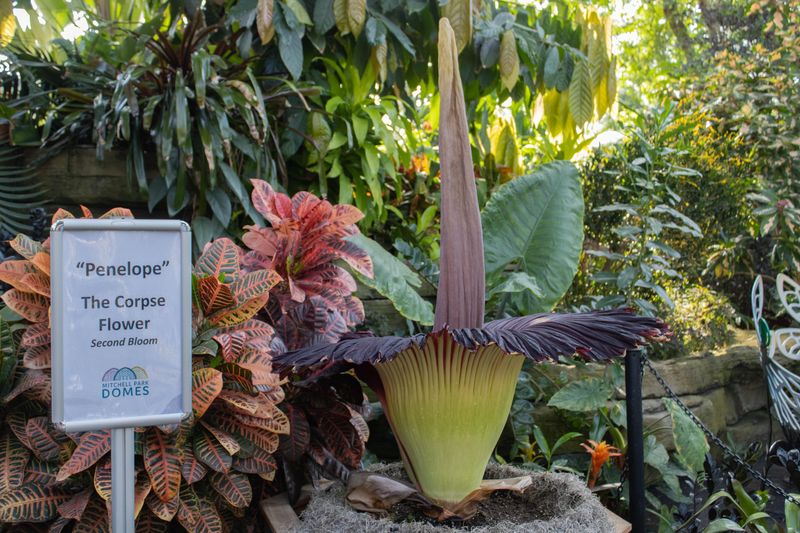
Penelope the corpse flower is in bloom at Milwaukee’s Mitchell Park Domes.

Penelope, which last bloomed in 2024, will be open and stinking for the next 24-48 hours. This rare and very large flower only booms every couple of years; when it does, it emits a powerful – and disgusting – odor.
“Typically they only bloom once every six to eight years, ” said Amanda Garchow, horticulturist at the Domes. “Penelope’s a little different in our case; this is her second bloom in two years, so it’s extra exciting for us because it’s a rare event that’s she’s blooming so soon.”
The ephemeral nature of this plant and its experience has gathered somewhat of a cult following, according to Bryan Connolly, botanist and associate professor of biology at Eastern Connecticut State University, who once had someone visit his greenhouse with a corpse flower tattoo on his leg.
Below, with some help from Connolly and Garchow, we answer questions about this fascinating plant.
What exactly is a corpse flower?
The corpse flower, also known as a Amorphophallus titanum to scientists and “titan arum” to fans of David Attenborough’s “The Private Life of Plants,” is a flowering plant native to rainforests on the Indonesian island of Sumatra. It is known for its putrid smell, often compared to the scent of rotting flesh, and for only blooming for 24-48 hours every couple years.
Why does it take so long to bloom?
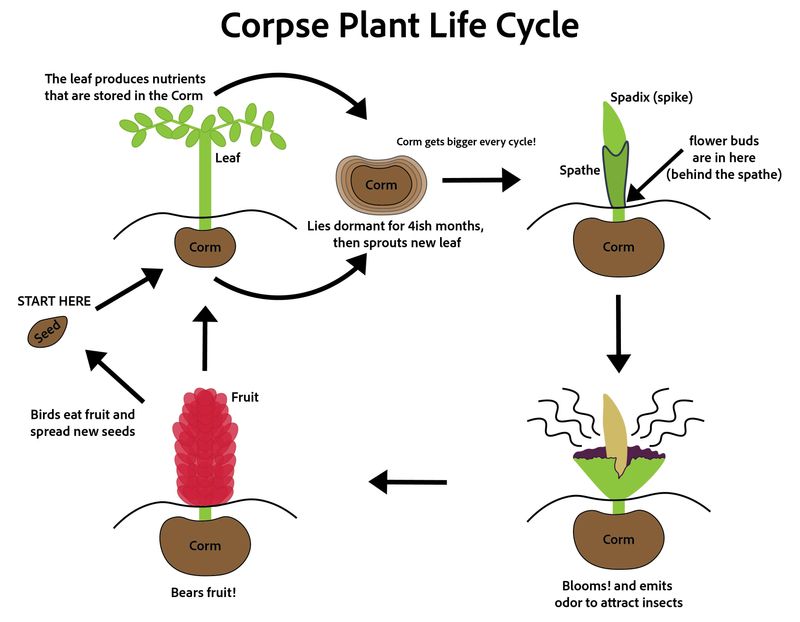
It needs to accumulate enough nutrients. The corpse plant starts as a seed or, if it’s already bloomed, an underground tuber-like corm (think potato). Both produce a really large leaf, which can be up to 15 feet tall.
“There’s no stem when it’s not flowering, and so it has a petiole, which is part of the leaf that looks kind of like a stem, but it’s not a stem,” Connolly explained. “They can get very large, like bigger than your thigh around.”
The leaf generates sugar – food for the plant – and stores it in the underground corm.
After a year, the leaf dies, and the tuber rests for four months. Then it produces a new leaf and repeats the cycle until the tuber becomes large enough. This takes about seven to 10 years for a new seed and three to four years for a corm that’s bloomed before.
The corm of a corpse flower is the largest of any flowering plant. According to Connolly, the biggest one has been up to 200 pounds, but they’re typically more like 60 pounds.
Why the rotting meat smell?
To attract pollinators. After years of tuber growing, the tuber eventually produces a spike, formally known as a spadix, of flowers wrapped in a specialized leaf called a spathe. Female and male flowers grow in a ring at the bottom of the spadix. This stage is called an inflorescence, which is a group of flowers.
The corpse flower is the world’s largest unbranched inflorescence or group of flowers.
Eventually, as the spathe opens, the spadix heats up to about 99 degrees F and the flowers begin to emit pulses of powerful odor to attract insects, like carrion beetles or fruit flies, that typically eat or lay their eggs on rotten meat. These insects pollinate the flowers at the base of the plant.
Are there benefits to being pollinated by insects like fruit flies and carrion beetles instead of more common pollinators like bees?
Not really.
According Connolly, it may be related to the plant’s native environment. Corpse plants can be miles apart in a rainforest, and since they bloom infrequently they can only be pollinated and reproduce every few years. Because of that, it could be advantageous to seek pollinators that are willing to travel long distances between plants.
What makes it smell so bad?
Chemists have isolated identified over 40 compounds that make up the odor released by the plant. Some of the chemicals include two that smell like garlic (dimethyl trisulfide and disulfide), one that smells like sulfur (methanethiol), one that smells like citrus (limonene), one that smells like feces (idole), and one that smells like urine (phenylalanin).
Why should I care?
There is inherent intrigue to a smelly plant named Penelope. But also, corpse flowers are an endangered species due to loss of habitat, climate change and encroachment from invasive species. Garchow said that it’s estimated there are only 800 left in the wild.
Additionally, these plants are difficult to conserve via seed preservation because their seeds aren’t viable after drying.
Therefore, they must be conserved in living collections in gardens, research labs or greenhouses and conservatories like the Domes.
Since they can’t self-pollinate, despite having both male and female flowers, they must be pollinated by another plant. Different research labs and greenhouses often rely on sending stored pollen to each other to keep these plant lines going.
“I’m really thankful that we have this giant, smelly, weird plant that, you know, kind of brings botany to the public,” said Connolly with a smile. “And just the conservation of plants and of the species in general.”
The Domes will have extended hours on Saturday and Sunday to accommodate visitors who want to see the corpse flower in bloom, though the smell will mostly fade by Sunday. Stop by to see Penelope, support important conservation work and acquire a unique, albeit smelly, experience.
The Dome, 524 S. Layton Blvd., will host extending hours for this event, from 8 a.m. to 4 p.m. both days. Admission is $10 for adults ($9 for residents), $6.50 for ages 3-12 and free for children younger than 2. Due to road construction and the closure of the 27th Street bridge, the Milwaukee Domes Alliance suggests using GPS to plot a route. Directions and more information, including specific discounts, are available at www.MilwaukeeDomes.org.
Reach Donnisa Edmonds at DEdmonds@usatodayco.com.
This article originally appeared on Milwaukee Journal Sentinel: See the corpse flower in bloom this weekend at the Domes
Reporting by Donnisa Edmonds, Milwaukee Journal Sentinel / Milwaukee Journal Sentinel
USA TODAY Network via Reuters Connect
By Donnisa Edmonds, Milwaukee Journal Sentinel | USA TODAY Network