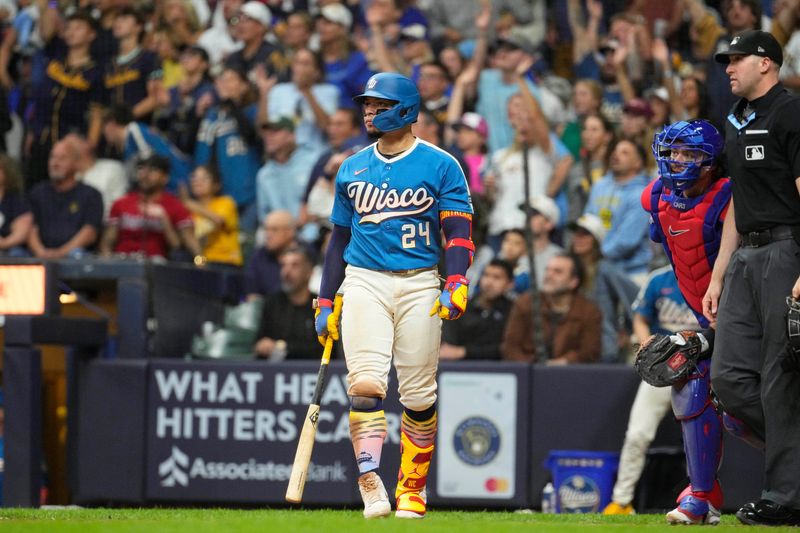
As William Contreras watched the baseball fly toward the farthest reaches of the stadium, as the fans adorned him with praise and as strobing lights flashed down upon him, this was not the place he wanted to be.
On this night, Contreras’ thoughts were where they should have been.

With his country.
In a sense, they always are on Venezuela. But now more than ever, his heart, mind, tears and prayers are firmly on centered on home.
As Contreras took the field in the top of the first inning of the Milwaukee Brewers’ 6-2 win over the Chicago Cubs, he did so with Venezuela on his heart – and not merely metaphorically. Sporting his catching gear from the World Baseball Classic this spring, Contreras wrote a message on the bright yellow chest protector in black marker.
Dios Bendiga VZLA.
God bless Venezuela.
Dios Ayudanos.
God help us.
While the Brewers took on the Cubs in front of a sellout venue, the home country of Contreras, fellow Brewers star Jackson Chourio, pitcher Angel Zerpa and Nestor Corredor, the team’s beloved jack-of-all-trades coach, was in ruins.
On June 24, a magnitude 7.5 earthquake struck northern Venezuela, devastating parts of Caracas, the nation’s capital, and the surrounding areas. At the most recent update, at least 920 were dead, Venezuelan officials said. The final number will surely be higher.
The situation in Venezuela is dark? And Contreras, Chourio and company are some 2,600 miles away from the destruction, the ruin in their homeland.
Words, Chourio said after the game, are difficult to come by. Understandably so. Yet Contreras, through the pain and the tears and the yearning for a restoration that isn’t visible, exhibited strength by simply trying.
“I love them and to forgive me for not being able to be there right now to help them,” Contreras said of the message on his chest in a postgame interview with Apple TV. “I’m always going to be the best version of myself for them.”
Contreras, frankly, owed it to nobody to even say a word, give a single interview. Grieving is not easy; now imagine doing so with cameras and microphones in your face.
By lacing his cleats, by stepping onto the diamond, by inscribing a message to God in the dirt near the on-deck circle, by putting on a brave face while also displaying a moving level of vulnerability, Contreras said all he needed to.
“They’re feeling like, in this situation, your family is alone, you’re feeling like you have the power to go and help, but you understand that this is your job and you have to be far, far away,” Corredor said. “There’s a lot of emotions right there.”
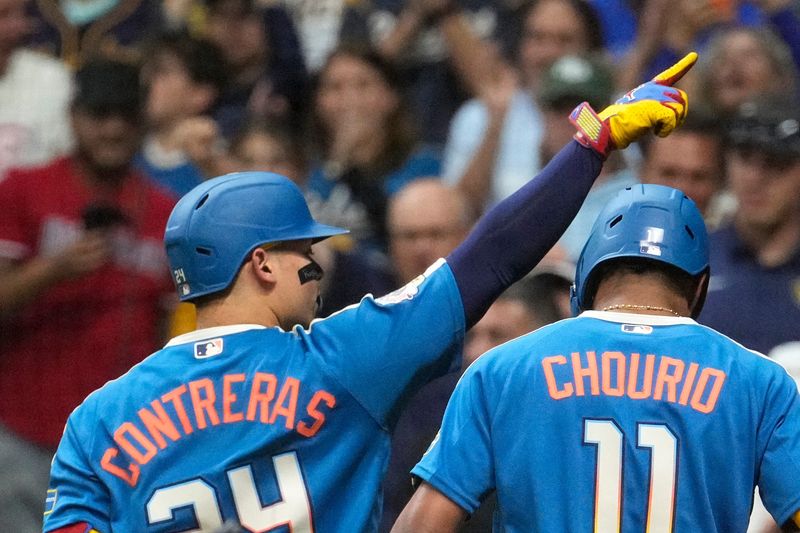
In retrospect, it was incredible that Contreras was able to compose himself enough to hit a homer, and Chourio enough to reach base twice, including with a double right before his countryman brought him home with his emotional homer.
“When you’re at the plate, you’re thinking about every Venezuelan who lost their father or the father who lost his children, or those who lost their loved ones,” Chourio told the Journal Sentinel in Spanish. “That home run was for Venezuela.”
To understand, to truly comprehend, what Contreras and Chourio and Corredor and the many, many peloteros Venezolanos – Venezuelan baseball players – are going through is impossible. The best thing you can do is to care. To have empathy. To be human.
Hear Chourio speak of standing in the box and thinking of the parents who lost their children, feel the solemn tone of the 22-year-old’s voice and tears well up.
For he and Contreras to be composed in vulnerability, so strong in weakness, so gracious to answer questions when they owe nothing to anyone, is nothing short of remarkable.
“It’s difficult,” Contreras told Apple TV, “the fact that there is nothing we can do, even while wanting to be everything. That’s the truth. It’s hard to play, but it’s our job.
“What hurts the most is being here, showing up and putting on a happy face for work, while deep down I just want to help my country. I want to be back home helping out wherever I’m needed, but it’s just not possible.
“That’s the life of a ballplayer – the life many lead. People think this is easy, but it’s not.”
To all of us who have some earnest, comforting semblance of home where we live and work, this serves as a reminder.
The life of a foreigner is not always an easy one.
No home run removes feelings of unease. No amount of money cures homesickness.
“It’s really hard,” Chourio said. “Regardless of what’s happening, you still have to play. It’s quite complicated. Quite complicated, because I can’t stop thinking about all the Venezuelans who are suffering.”
Chourio, Contreras and Corredor were part of a Venezuelan World Baseball Classic that showed the globe the joy and passion their nation contains within. When they beat the United States in the championship, distress over decades of political unrest was in a way unshackled, Corredor said. So to now have to go through the strongest earthquake strike in a century feels almost unfair.
“Three months ago we gave the country a lot of joy through baseball,” Corredor said. “You can’t blame this on anything because this is natural. This is nothing created.
“But we know how the country the last 20 years has gone. But when something like this happens and you have the privilege to have a great life, it’s hard.”
Corredor’s family, like Chourio’s and Contreras’, is safe. Yet they all invariably know someone whose isn’t. And to be away from their loved ones at all, Chourio said, hurts deeply.
“This is when you need your family the most, given what happened,” Chourio said. “There are a lot of people suffering.”
Corredor sees the anguish of the two fellow Venezuelans in the room with him and does all he knows how to do: He becomes the family they don’t have here with them.
“You got to be the strong piece,” Corredor said. “You have to be the support for these guys. I know they are big pieces of this team. You have to be the tough guy.”
Even hearing that is hard.
Not even deep down, but right on the surface in eyes that are best known around the Brewers for how they light up alongside deep, belly laughs, lies sadness for Corredor. But for players who could very well be his sons, Corredor is strong. This, 2,000 miles from home, is their family.
With no choice, no recourse but to write a message to Venezuela on their eye black, to wear the colors on their chest and arms, to play Luis Silva’s “Venezuela” as their walk-up music, they trudge forward.
May they continue to find the strength to carry on.
May we weep with those who weep.
May God bless Venezuela.
This article originally appeared on Milwaukee Journal Sentinel: Venezuelans Jackson Chourio, William
Contreras display courage beyond words
Reporting by Curt Hogg, Milwaukee Journal Sentinel / Milwaukee Journal Sentinel
USA TODAY Network via Reuters Connect
By Curt Hogg, Milwaukee Journal Sentinel | USA TODAY Network