GREEN BAY − It’s hard to overstate the seriousness of the domestic-abuse allegations against Josh Jacobs.
The Green Bay Packers running back was arrested May 26 and released May 27. The Brown County District Attorney has not yet decided whether to file charges.

Suffice it to say, this is grave matter concerning a huge societal problem.
To express a public opinion on it, though, with so little information available about what Jacobs did or didn’t do would be reckless. He has strongly asserted his innocence. We’ll surely learn more in the coming days when the DA decides whether to charge Jacobs.
But in the meantime, the Packers are a football team and, like every club in the NFL, serious off-field matters involving star players can have a major impact on a franchise. Jacobs is a star player, and his arrest is an earthquake for the Packers’ football offices and locker room.
Considering the current uncertainty of Jacobs’ case, and with training camp still two months away, the Packers don’t have to do anything now regarding his roster status or their running back position. They can go about their work at OTAs and minicamp with the running backs on hand.
But general manager Brian Gutekunst and his scouting staff now are obligated to study even closer the running back depth charts around the league for possible trade candidates, just in case. There were real questions about their depth at that position as it was, and without Jacobs, they are scarily thin at a position that’s critical to coach Matt LaFleur’s offense.
At this point, the Packers have a lot – too many – eggs in the MarShawn Lloyd basket. That’s a precarious place to be. Lloyd, a 2024 third-round draft pick, essentially has been injured the entire two seasons he’s been in the NFL.
It’s probably not an exaggeration to say he’s been healthy for a full week only once in his career – Week 2 of his 2024 rookie season, when he practiced all week and had seven touches (six runs and a reception) against Indianapolis. That was, as far as we can tell, the only time he’s been healthy for a full week, and he injured his ankle late in that game.
When Lloyd has practiced during his two training camps, he’s shown some explosiveness, especially for a back with good size (220 pounds).
“He’s extremely explosive, and he’s a dual-threat guy, a guy that you can design routes for,” coach Matt LaFleur said of Lloyd before OTA practice May 27. “But we’re in the early stages right now.”
In fact, it’s difficult if not impossible to tell how good a running back is until he plays in real games with defenders trying to tackle him.
Think back, for instance, to 2017, when the Packers drafted three running backs: Jamaal Williams in the fourth round, Aaron Jones in the fifth and Devante Mays in the seventh.
None of them did much to stand out in camp or the preseason as rookies. Ty Montgomery opened that season as the Packers’ starter, with Williams his backup and Jones the No. 3.
But in Week 4 against Chicago, Jones got his chance when Montgomery sustained a knee injury and looked good enough while rushing for 49 yards on 13 carries to get the start ahead of Williams the next week at Dallas. Jones exploded for 125 yards on 19 carries, and the Packers realized their No. 3 running back was a player.
Until Lloyd does it in a couple of games, we won’t know just how good he is.
The bigger question, of course, is whether he can avoid the recurring soft-tissue injuries that have basically prevented him from playing his first two seasons. He visited a University of Wisconsin performance lab before the ‘25 season, but that treatment plan didn’t work – he injured his groin five practices into training camp, and later sustained a hamstring injury that ended his season.
He also visited a movement clinic in California late last season and, according to PackersNews reporter Tom Silverstein, learned that the biomechanical changes from an ACL injury in college likely were causing the recurring groin and hamstring issues.
Lloyd hasn’t been available to reporters to talk about the program the clinic put him on to improve his biomechanics, though he’s presumably been working on it since late last year. This spring, he’s taken part in the Packers offseason program and was on the field May 27 for the team’s second OTA practice of the offseason (the first that’s been open to reporters).
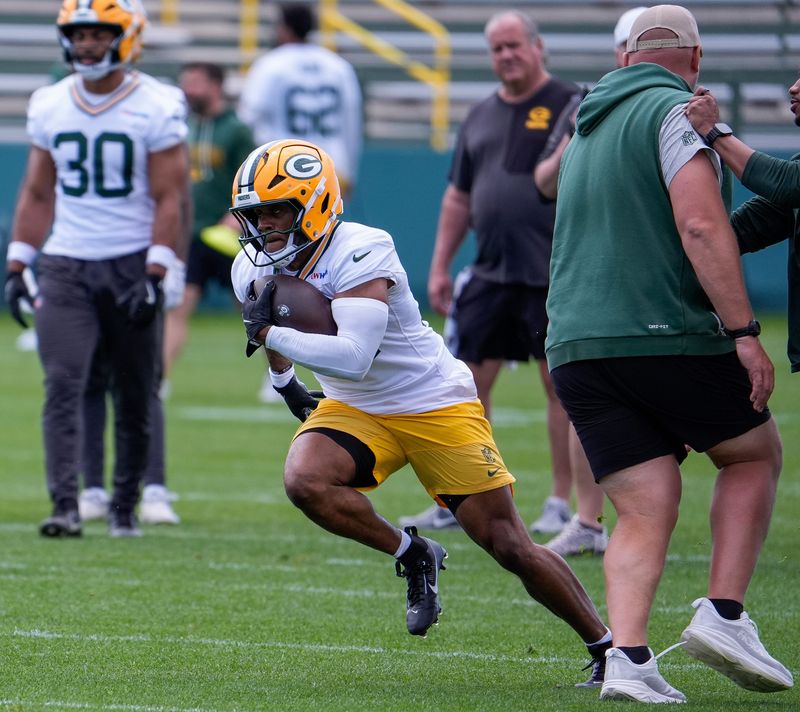
However, the Packers are being extremely cautious with him. He took part in individual and group drills in the unpadded practice but didn’t take any snaps in 11-on-11.
“He’s done a nice job,” LaFleur said of Lloyd before the May 27 practice. “But we’ve only had one practice, so I think the proof will be in the pudding. He’s got to show that consistently over the course of all the OTAs into training camp, into the preseason and we’ll see where we go from there.”
Even in the best-case camp where Lloyd gets through healthy, it’s hard to see the Packers putting him in a role where he’d be their primary back if Jacobs is suspended or no longer on the team. They’re going to want to limit his workload and slowly see how much his body can handle.
But after not tendering Emanuel Wilson a contract in restricted free agency and watching him sign with Seattle, the Packers don’t have another obvious candidate for No. 2 back, let alone someone to share starting snaps. Wilson was a decent No. 2 last season.
Chris Brooks worked as the No. 1 back on May 27, but his value is more as a core special-teams player who also sometimes plays on passing downs because of his protection abilities. But he’s not a threat with the ball in his hands and isn’t a No. 2 back, let alone a time-sharing No. 1.
Behind him, the Packers in the offseason signed fourth-year pro Pierre Strong Jr., who at age 27 has played for New England and Cleveland. Though he has a career average of 5.0 yards on 99 carries, his contract (a one-year minimum deal for $1.25 million with no signing bonus) suggests the chances of him becoming a big part of the offense are slim.
Sure, there’s always the chance undrafted rookie Jaden Nixon of Central Florida will be a camp surprise (199 pounds). But again, the odds are low.
The running game is just far too important to LaFleur’s offense for the Packers to go into the season with their current running back corps if they don’t have Jacobs. The Packers need a good running game for LaFleur’s marry-the-run-with-the-pass scheme and to be Jordan Love’s best friend.
But as interesting a player as Lloyd is, the Packers just can’t count on him as their No. 2, let alone a time-sharing No. 1. They will have to be ready to trade some of their valuable 2027 draft capital for a running back if it comes to it.
This article originally appeared on Packers News: Packers must start preparing alternate running back plan now | Pete Dougherty
Reporting by Pete Dougherty, Green Bay Press-Gazette / Packers News
USA TODAY Network via Reuters Connect