

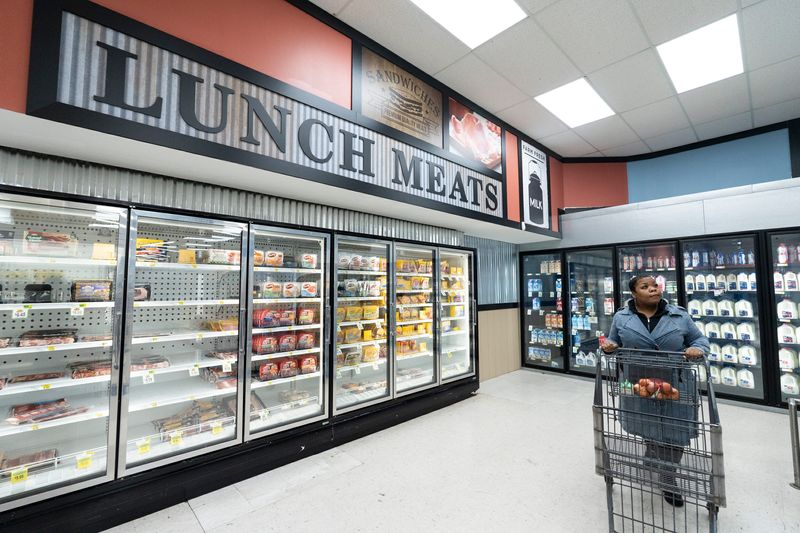
Recent grocery store closures have rocked the north side of Milwaukee, where growing food deserts – areas where quality food is difficult to find – have left entire neighborhoods without ready access to food.
“When Pick ‘n Save closed on 35th Street, it sent a painful message,” said Ald. Russell Stamper of the 15th District. “That corporate disinvestment continues to treat central city neighborhoods as optional. Let me be clear, our community is not optional.”

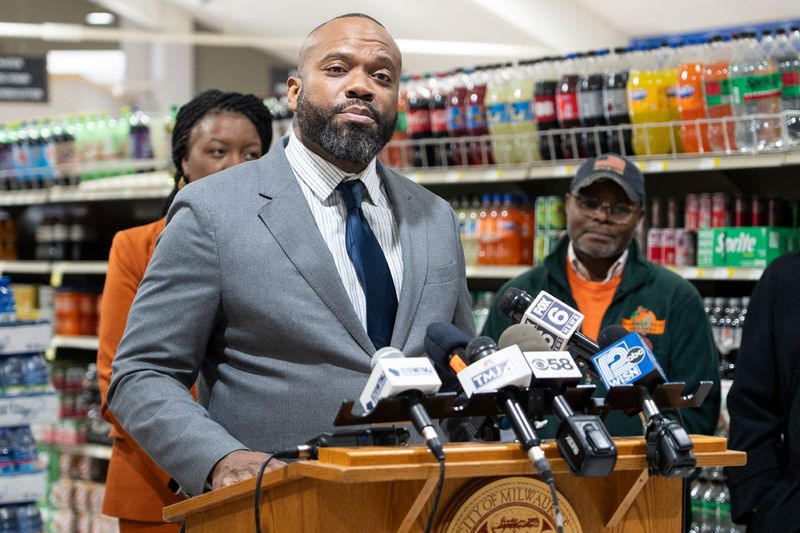
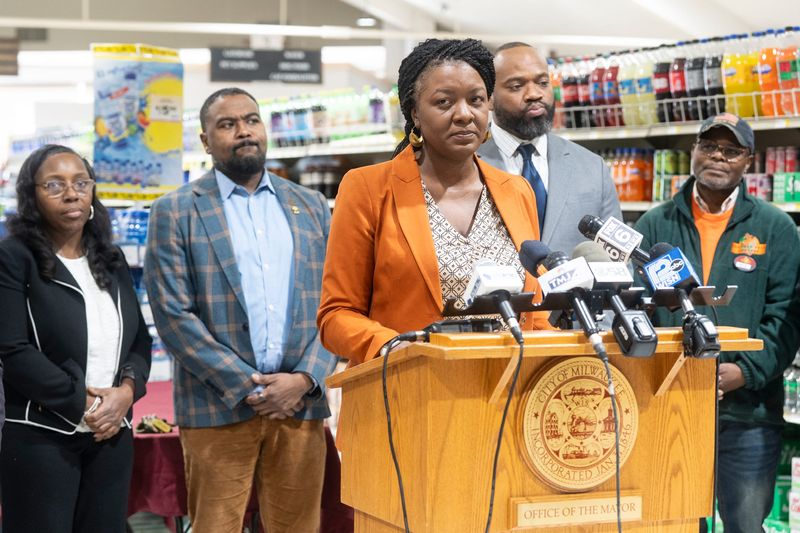
Stamper, and several other city officials, including 1st District Ald. Andrea Pratt, announced on Monday, Feb. 9, at Sentry Foods on West Lisbon Avenue, plans to combat food insecurity and commercial disinvestment by preventing grocery store and pharmacy closures through legislation and additional funding to support local stores.
“Food security is about dignity,” Pratt said. “I should be able to get a tomato in my neighborhood… It has to be easier than this.”
Stamper and Pratt announced three pieces of proposed legislation at the press conference that would protect residents from abruptly losing essential resources.
The first was an ordinance requiring grocery stores and pharmacies to provide a 60-day notice to the city before closure so officials can determine if there is something the city can do to help keep the store in business.
According to Pratt, she was given a two-day notice when the Aldi near North Hopkins Street and West Sherman Boulevard closed.
The second is a resolution declaring a food apartheid in the City of Milwaukee – this will mirror a similar declaration by Milwaukee County.
Food apartheid refers to systemic injustices that restrict access to affordable and nutritious food, specifically for low-income residents and racial minorities.
Lastly, the city officials announced an order that directs the city’s health department and the Department of City Development to work together to determine the best course of action to attract and retain grocery stores.
This is similar to a resolution introduced by Alderwoman Milele Coggs on Feb. 2.
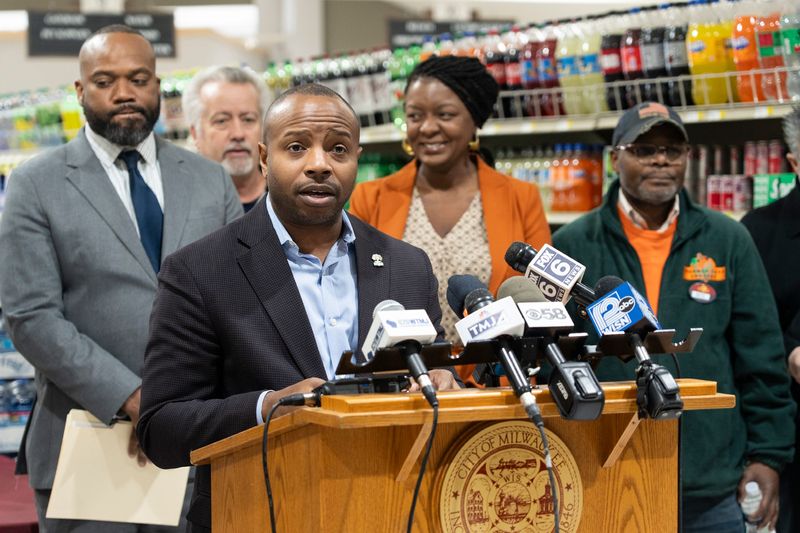
During Monday’s press conference, Mayor Cavalier Johnson said he hosted a private roundtable discussion with several city grocery store owners.
He said one of the main concerns he heard was that stores are struggling to make large investments like upgrading ageing or broken equipment.
“Those are big issues, especially for grocery stores that are running on margins,” Johnson said.
Johnson stressed the importance of city grants to keep grocery stores open, especially those locally owned and operated.
The city’s Commercial Revitalization Fund has about $1 million allocated from the city budget to be granted to businesses for storefront and equipment repairs.
Johnson said he is working with the Common Council on another grant program to help grocers with equipment needs, but it has not been finalized.
This year, Navjoot Sandhar, owner of Sentry Foods 92 Lisbon, Inc., received a $25,000 grant from the commercial revitalization fund to replace aging refrigeration systems.
According to Sandhar, the grant helped replace the equipment, but the store’s profits remain low because of recently completed roadway construction that has reduced patronage.
“We went from having 800 customers a day to about 300 customers a day,” Sandhar said. “Now, we are slowly building up, but it is nowhere near what it was.”
Recently, he had to lay off employees to make ends meet, and he is concerned he may have to let go of more, leaving just him and a few immediate family members to keep the business afloat.
Sandhar would like to see the city implement additional tax breaks for locally-owned grocers or solutions for driving traffic back to small businesses.
“We could do something where food stamps are exclusively accepted at local stores rather than big box stores,” Sandhar said. “It is tough because these big stores have a bunch of lawyers to help them prevent things like that.”
Community involvement after closures
The legislation announced by Stamper and Pratt must still pass the Common Council. In the meantime, neighborhoods on Milwaukee’s north side are working to minimize the impact of losing grocery stores and pharmacies.
“When systems fail our community steps up,” Stamper said.
There is currently a system of five “community fridges” in the works. The mutual aid system will run on donated food made available to residents for free. The initiative is led by several community organizations, including Metcalfe Park Community Bridges, OneMKE and Tricklebee Cafe.
The first of the five fridges is open and installed at Tricklebee Cafe at 4424 W. North Ave.
Giacomo Fallucca, CEO of Palermo’s, a Milwaukee-based pizza manufacturing company, attended the press conference and said he is working with food pantries in the city to identify areas with the greatest needs so he can donate to pantries in those areas.
“Pizza is a food that unites us,” Fallucca said. “I always say I will give away as many pizzas as I can.”
According to Stamper, while the work the community is doing to stand together and help one another is inspiring, it cannot replace legislation that helps keep resources in the city.
“Mutual aid does not have to replace policy,” he said. “That is why today is powerful.”
Everett Eaton covers Harambee, just north of downtown Milwaukee, for the Journal Sentinel’s Neighborhood Dispatch. Reach him at ejeaton@usatodayco.com.
Support for this effort comes from the Zilber Family Foundation, Journal Foundation, Bader Philanthropies, Northwestern Mutual Foundation, Greater Milwaukee Foundation and individual contributions to the Journal Sentinel Community-Funded Journalism Project. The project is administered by Local Media Foundation, tax ID #36‐4427750, a Section 501(c)(3) charitable trust affiliated with Local Media Association.
Learn more about our community-funded journalism and how to make a tax-deductible gift at jsonline.com/support. Checks can be addressed to Local Media Foundation with “JS Community Journalism” in the memo, then mailed to: Local Media Foundation, P.O. Box 85015, Chicago, IL 60689.
This article originally appeared on Milwaukee Journal Sentinel: Milwaukee alders introduce resolution declaring food apartheid a public health emergency
Reporting by Everett Eaton, Milwaukee Journal Sentinel / Milwaukee Journal Sentinel
USA TODAY Network via Reuters Connect

1 comment
They clearly are not going far enough. They should simply pass a Law prohibiting business from closing at all without Government permission. That would solve the problem.