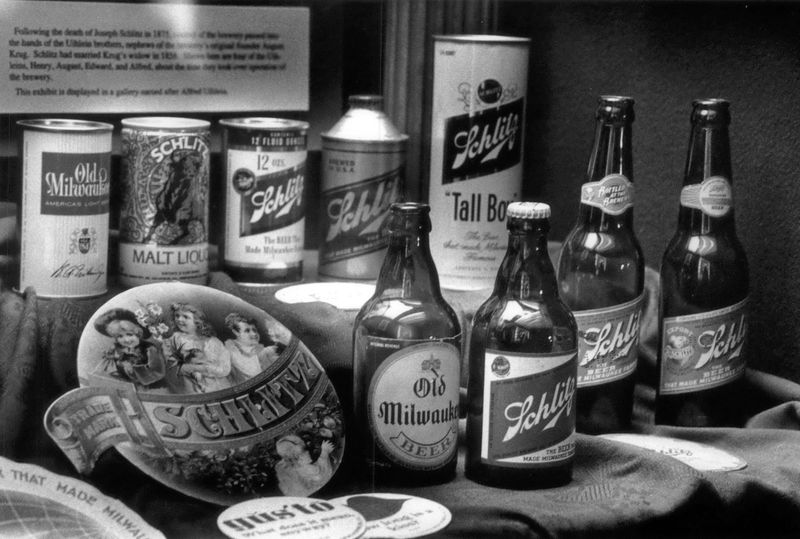
Schlitz beer will soon be an artifact of yore, as Pabst Brewing Co. has announced plans to stop production of the iconic Milwaukee beer with a history dating back 177 years.
While fans mourn the loss of “the beer that made Milwaukee famous,” they also are celebrating its legacy.

Here, we’ve put together a timeline of Schlitz’s history:
1849: The start of Schlitz
Schlitz Brewing Co.’s origin is traced back to 1849, in a Milwaukee tavern brewery owned by German immigrant August Krug. The tavern was located on what is now Juneau Street (then known as Chestnut Street), between Fourth and Fifth Streets, according to the University of Wisconsin-Milwaukee’s Encyclopedia of Milwaukee.
Joseph Schlitz, another German immigrant who recently arrived to Milwaukee, worked as a bookkeeper at the tavern.
1856: Joseph Schlitz takes over brewery
After Krug died in 1856, Schlitz took over as owner, and changed the name to the Joseph Schlitz Brewing Co.
In 1858, Schlitz married Krug’s widow, Anna Maria Hartig Krug.
1870-1900s: Schlitz moves to larger location, begins to expand
Under Jacob Schlitz’ ownership, the tavern quickly expanded. Schlitz purchased a larger brewery on what is now King Drive and Galena Street (at the time, Third Street and Walnut Street) in 1870.
By the 1890s, the brewery expanded into a multi-block complex, according to UWM’s Encyclopedia of Milwaukee.
In 1875, Jacob Schlitz died in a shipwreck. The Uihlein family (related to the Krug family and whose descendants founded Uline shipping company) took control of the company, keeping the Schlitz name.
Expansions continued. Between the 1870s and early 1900s, Schlitz opened dozens of tied houses – bars that exclusively sold Schlitz beer – throughout Milwaukee and Chicago. Many of the buildings are still recognizable today, with Schlitz’ globe logo in concrete on their exteriors.
Multiple reports indicate Schlitz was able to rapidly grow in Chicago after the Great Chicago Fire in 1971 destroyed many breweries in the city, and the Milwaukee brewery seized on the opportunity to make its presence known there. Around that time, it adopted the slogan “The Beer that Made Milwaukee Famous.”
1902: Schlitz becomes largest brewer in the United States
At the start of the 20th Century, Schlitz surpassed Pabst Brewing Co. as the largest brewer in the nation, producing about a million beer barrels a year.
1912: Schlitz popularizes the brown beer bottle
Schlitz was a pioneer in using brown glass beer bottles. Several sources claim the Milwaukee company developed the brown bottle – useful to prevent light from ruining beer quality and shelf stability.
While there are some debates about where brown beer bottles originated, Schlitz began packaging its beer that way around 1912, popularizing it for much of the beer industry.
1920-1933: Schlitz pivots during Prohibition
During the 13-year nationwide banning of alcohol known as Prohibition, Schlitz survived by producing non-alcoholic products, including malt syrup, sodas, bakery products and candy, according to UWM’s Encyclopedia of Milwaukee.
After Prohibition was repealed in 1933, Schlitz returned to its role as a leading brewer in the U.S., stealing the title of the country’s top-selling beer from Anheuser-Busch’s Budweiser.
Budweiser permanently surpassed Schlitz for that title in 1957.
1950s-1960s: Schlitz expands across the country and beyond
In the ’50s and ’60s, Schlitz continued to expand, with plants in Brooklyn; Kansas City, Missouri; Tampa, Florida; San Francisco, and Longview, Texas. It also had affiliate breweries in Puerto Rico and Spain.
Around this time, Schlitz made several significant contributions to its city of origin, including the Performing Arts Center’s Uihlein Hall, the Schlitz Audubon Nature Center and the Streets of Old Milwaukee exhibit at the Milwaukee Public Museum, according to UWM’s Encyclopedia of Milwaukee.
Schlitz also sponsored Milwaukee’s first Great Circus Parade in 1963, and continued to support the annual event, held until 1973. The parade returned from 1985 through 2003, and one final parade was held in 2009, according to OnMilwaukee.
1970s-80s: Schlitz loses popularity, shuts down Milwaukee brewery
A series of poor business decisions – perhaps most notably, a move in 1976 to add a stabilizing agent that turned Schlitz beer hazy – led to a loss of Schlitz’ popularity around the ’70s and early ’80s.
In 1981, as a way to cut costs, Schlitz dropped its Milwaukee production facility, built in 1870. The large brewery had been operating at 60% capacity, the least efficient of seven breweries Schlitz operated around the country.
The decision – initially announced as the elimination of up to 200 jobs, then ultimately a closure of the whole brewery – led to a large strike, involving more than 700 workers.
1982: Detroit-based Stroh Brewery Company purchases Schlitz
Stroh Brewery Co., a Detroit-based company, bought Schlitz in 1982. Stroh shut down the remainder of Schlitz’ operations in Milwaukee, and sold its brewery complex to a Milwaukee developer that converted it into an office park, known as Schlitz Park.
1999: Pabst obtains Schlitz
Pabst Brewing Co. purchased Stroh’s assets, including Schlitz, in 1999. Pabst began producing the beer at contracted facilities.
2008: Pabst revives Schlitz’ old formula
In 2008, Pabst Brewing Co. began selling Schlitz under its old formula, which had been changed in the 1970s – a contributing factor to the company’s downfall.
The formula change was accompanied by a nostalgia-filled marketing campaign, and began being sold in bottles, instead of cans, for the first time in years. It was a success; In 2008, Pabst had its best sales trend since 1999, the Milwaukee Journal Sentinel reported.
And in 2009, Schlitz again started being produced in Milwaukee – at the MillerCoors brewery.
2026: Pabst announces the discontinuation of Schlitz
On May 15, Pabst announced it will no longer produce Schlitz. One final 80-barrel batch of the beer will be brewed by Wisconsin Brewing Co. at its brewery in Verona May 23. Pre-orders for the final batch open the same day at wbcll.com, and the beer will be available June 27.
This story has been updated to include new information.
Contact Kelli Arseneau at (920) 213-3721 or karseneau@gannett.com. Follow her on X at @ArseneauKelli.
This article originally appeared on Milwaukee Journal Sentinel: A timeline of Schlitz’s 177-year-history, which left an impact on Milwaukee
Reporting by Kelli Arseneau, Milwaukee Journal Sentinel / Milwaukee Journal Sentinel
USA TODAY Network via Reuters Connect