OAK CREEK – Greg Septon of Muskego had banded about 1,500 falcon chicks since he founded the Wisconsin Peregrine Falcon Recovery Project in 1986.
Each was fitted only with colored and numbered leg bands to help identify the bird.

Until May 18, 2026, that is.
That’s the date he added a high-tech device to the mix.
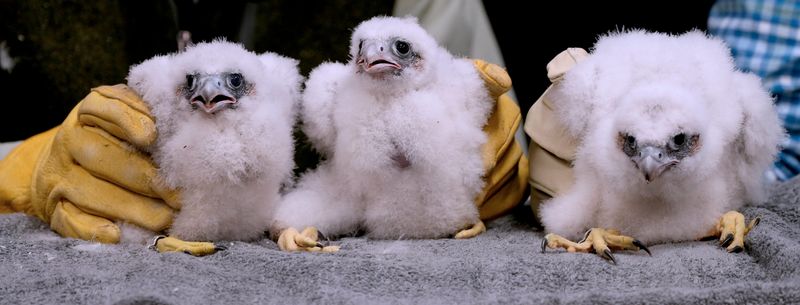
The three downy peregrines he handled May 18 at the We Energies power plant in Oak Creek also received a BlūMorpho transmitter.
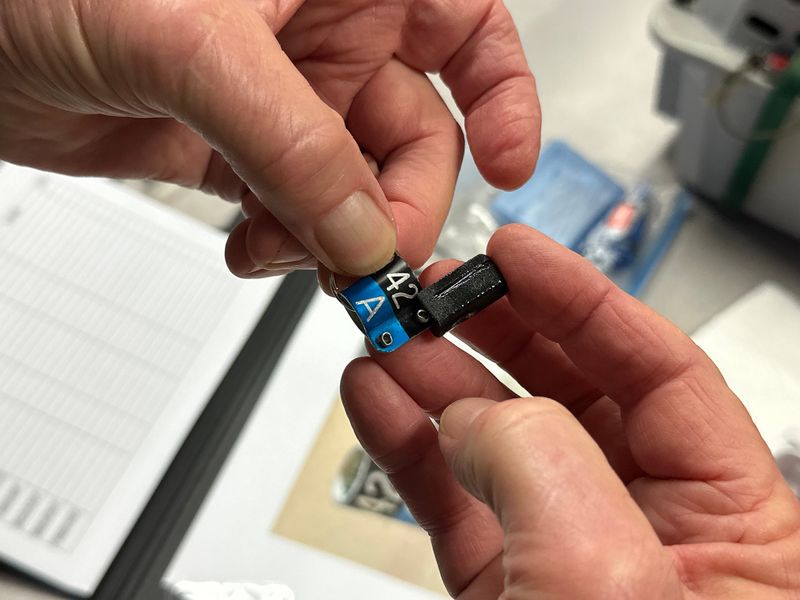
The device, about three-quarters of an inch by a quarter of an inch and weighing less than one-tenth of an ounce, is solar-powered and designed to connect with cell phones and wildlife monitoring networks.
Its small size belies its significance.
For the first time, Septon expects to get data on where the birds go and the paths and habitats they use to get there.
“This will be a game changer,” Septon said. “It’s always been a dream of mine to be able to easily and safely attach something like this to a young peregrine and here we are.”
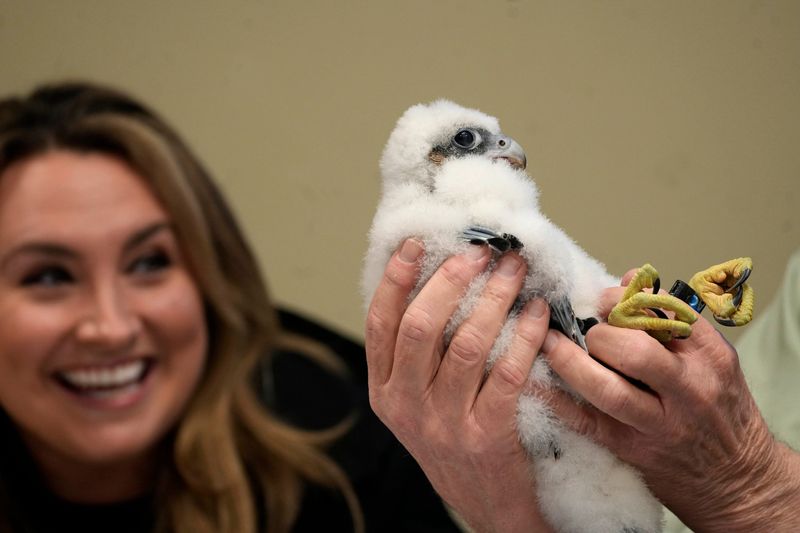
As he has for four decades, Septon attached aluminum leg bands to the roughly 3-week-old chicks in Oak Creek. The legs are sufficiently developed at that age to accept a permanent band.
But in what is being heralded across the wildlife world as a technological leap, these birds also were fitted with the tiny black box of the BlūMorpho transmitter. Septon crimped the device to a flange on the leg band and added a dab of super glue for good measure.
After attaching the bands and transmitters to the three chicks named for local TV meterologists – ‘Brian Nestnansky,’ for Brian Niznansky from WTMJ, ‘Mark Birden,’ for Mark Baden from WISN, and ‘Brooke Flighton,’ for Brooke Brighton from Spectrum News – and a few photos with assembled media, the young birds were placed back in their nest box at the We Energies plant.
It’s the first step in what Septon expects to be a treasure trove of data.
Tracking animals is among the most important aspects of wildlife science. It allows researchers to learn about animal behavior, habitat needs, food sources, life spans and causes of mortality.
Historically, wildlife transmitters have been heavy and bulky and required scientists to spend lots of field time and expense to obtain data.
The BlūMorpho transmitter is none of that. It was developed and is manufactured by Cellular Tracking Technologies (CTT) in Rio Grande, New Jersey.
The company specializes in wildlife tracking and had been working for about a decade on something small and light enough to fit on a butterfly, essentially the industry’s holy grail.
Key developments came during the COVID-19 pandemic when CTT, after facing growing delays from suppliers, brought all manufacturing processes in-house, said David La Puma, CTT’s vice president of global market development.
The company’s engineers were able to refine a design that didn’t require a battery and operates on the same frequency as Bluetooth. At from $200 to $400 each, the transmitters are also a fraction of the cost of most wildlife tracking devices and open up a world of possibilities for bird and insect and other researchers, La Puma said.
In 2025 several hundred BlūMorpho transmitters were attached to monarch butterflies before the fall migration.
The devices allowed scientists and the public via several websites unprecedented data on the paths and timing of monarch migration to wintering habitat in Mexico.
Several of the butterflies also provided data on their return trip this year to the U.S.
The location data is provided via a technology that works like Bluetooth on cell phones. The transmitters are also detected by the Motus and Terra wildlife tracking towers and networks in North America.
The result is researchers can use their computers to access data on their wildlife subjects, 24/7.
Septon said he has high hopes for what the transmitters will bring to the Wisconsin falcon project. Last year a researcher in California deployed some of the devices on peregrines.
This year We Energies purchased 13 of the transmitters for Septon to attach to peregrine chicks at each successful nest box.
The technology represents a new chapter in Wisconsin’s peregrine recovery project.
Peregrines were native to Wisconsin but declined severely due to pesticides in the environment, including DDT, which cause the birds to lay thin-shelled eggs and resulted in extremely poor nesting success.
By the 1970s the species was considered extirpated from Wisconsin.
When Septon started the recovery in Wisconsin with young birds he raised in hack boxes on the top of the U. S. Bank tower in Milwaukee, the chicks received only aluminum bands.
The unique colors and numbers on the bands allowed individual birds to be identified, including when photographed.
However, no or very few sighting reports were obtained when birds were traveling. Little was also known about where Wisconsin peregrines go in the first year or two of life.
So Septon is looking forward to data on where young peregrines go after they leave the nest.
“When I started I couldn’t have imagined a day when I’d be doing this,” Septon said. “It’s really remarkable and I’m really looking forward to this next chapter.”
This article originally appeared on Milwaukee Journal Sentinel: Tiny transmitters on falcon chicks usher in new era of peregrine recovery
Reporting by Paul A. Smith, Milwaukee Journal Sentinel / Milwaukee Journal Sentinel
USA TODAY Network via Reuters Connect