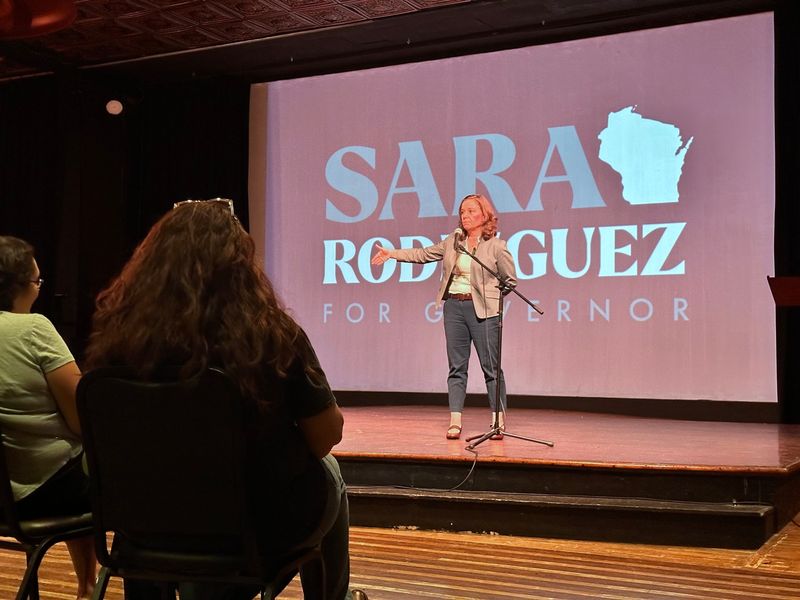
Lt. Gov. Sara Rodriguez started her first public remarks in Green Bay as a Democratic contender to replace Gov. Tony Evers by introducing herself as a reluctant politician.
The Democrat from Brookfield emphasized that in her state Assembly and lieutenant governor races, which she would ultimately win, the urge to run for office came from others whom she repeatedly told “‘No,’ multiple times” before relenting.

Circumstances were different this time when she launched her bid for Wisconsin governor less than 24 hours following Evers’ announcement in July that he wouldn’t seek a third term, and after Republicans Bill Berrien and Josh Schoemann already announced their campaigns.
“When [President Donald Trump] won again, nobody had to ask me. I was ready,” Rodriguez told the audience of Democrats gathered Sept. 2 at the Tarlton Theatre, 405 W. Walnut St. “I was ready for what Wisconsin needed. If Gov. Evers was going to run again for a third term, I was ready to run as lieutenant governor. But if he chose not to ― if he chose to retire ― I was ready to run for governor because we needed somebody who’s gonna fight for us here in Wisconsin.”
For over an hour, and with repeated jabs at the Republican-led Legislature, Rodriguez answered questions on such issues as health care, America’s political divide, public transit, President Donald Trump. It was part of Rodriguez’s listening tour across Wisconsin’s 72 counties that’s kicking off her campaign.
Her main priorities as governor would be on housing and childcare, the two things she was hearing people bring up the most, Rodriguez said. She emphasized her background in the health care industry and as a mother, saying that public schools should be fully funded and that reproductive rights to abortion and in vitro fertilization should be considered health care. She also supported stronger union bargaining rights.
“I have an 18-year-old son,” Rodriguez said. “I want him to stay in Wisconsin, build his life here, have a family here. He will not do that if he cannot afford housing and health care.”
Removing red tape on housing is a priority, Rodriguez says
Rodriguez said she was open to removing red tape at the state level that would allow more apartments and houses to be built. More homes on the market with rent caps or subsidized rents, she said, were going to be important to addressing the ever-present housing crisis. Before the end of this year ― well before the 2026 election ― Rodriguez said she would gather a panel of residents, developers, and local governments across Wisconsin to discuss where the state could cut any “byzantine” rules that make it more difficult to build more homes, Rodriguez said.
She held up the model of the 72-unit apartment building City Center Lofts, 216 Northland Ave., which Rodriguez visited earlier in the day, praising the Gateway Collective nonprofit’s method of capping rents to a household’s income and doing financial planning with residents to set aside 10% of their income towards an emergency fund.
And for Wisconsinites looking to buy a home, Rodriguez supported looking at a broad down payment assistance program similar to one her family had benefited from in Colorado, she said.
Rodriguez further supported capping the cost of utilities to 2% of a household’s income, and added that expanding Wisconsin’s renewable energy usage, even without federal support, was another solution to lowering utility costs.
“I paraphrase a Wayne Gretsky quote, which is, ‘I want to skate to where the puck’s going to be.’ And that’s renewable energy,” Rodriguez said.
Public-private partnership on childcare accessibility; expanding Medicaid
“Childcare, if you can find it, it’s as much as your mortgage or your rent,” Rodriguez said.
Rodriguez said her approach to expanding childcare accessibility as governor would center around a public-private partnership with the business community, equating childcare to infrastructure. She said the state’s Child Care Counts program that helps pays childcare providers was “insufficient, and I know that we still have childcare providers that are closing.” Caretakers ― often mothers ― saddled with childcare typically give up their work, meaning less retirement money and Social Security for families and a worsened financial picture, Rodriguez said.
“And so how do we work with our business community to say, ‘Hey, we’re willing to do this as the state of Wisconsin. Are you willing to do this to make sure that we can cover what folks need?'” Rodriguez said.
Expanding Medicaid, Rodriguez added, was “low-hanging fruit” that she would support as governor.
She said she was embarrassed that Wisconsin was one of nine states that had not expanded Medicaid, and further embarrassed that only Wisconsin and Arkansas have not expanded Medicaid to cover 12 months postpartum ― the time after a woman gives birth. On both points, she said the expansions failed due to a “hostile Republican Legislature,” saying that though the state Senate nearly unanimously passed Republican-led postpartum bill in April, the effort was blocked by Republican leadership from being discussed in the state Assembly. Republican lawmakers on the Joint Finance Committee voted later to reject funding postpartum coverage in the state budget, citing fiscal responsibility and wanting to encourage private health insurance coverage.
She hedged on an audience member’s suggestion of a single-payer health care system, saying that, “I think the low-hanging fruit is the expansion of Medicaid and I think we move from there.” She continued later, “but just for moral clarity, everybody should be able to get the health care that they need without going bankrupt.”
On the Trump administration’s health and immigration policies, it was personal
Rodriguez’s campaign launch video called Trump a “maniac,” a descriptor she said she was not going to take back, casting herself as a defender of Wisconsinites against the second-term Trump administration. The former nurse and CDC epidemic intelligence officer lamented the resignations of senior level officials at one of the nation’s most prominent public health authorities. She has called for Robert F. Kennedy Jr. who heads the Department of Health and Human Services to be fired or resign.
She did not comment on the legality of ICE activity across the country; she was not a lawyer, Rodriguez said. However, she said ICE agents “do not belong in our schools, in our churches, in our communities.” Rodriguez said documentation of any illegal actions by ICE agents who did not follow the letter of the law needed to happen “for folks to be able to do something about it.”
She said the immigration rhetoric was personal. Her husband is a first-generation Mexican immigrant. Her family was met with accusations that her husband is undocumented after Rodriguez announced her campaign, she said.
“Racist garbage, right off the bat,” Rodriguez said. She continued, “And if I’m nervous about my husband as the lieutenant governor of the state of Wisconsin, I cannot imagine how scared familiar are across the whole country.”
She said she would not allow the National Guard to aid deportation efforts, nor would she allow Wisconsin’s National Guard to be put under federal authority, citing a district judge’s recent ruling that Trump’s deployment of the National Guard to respond to protests in Los Angeles was illegal.
Rodriguez’s solution to political divisiveness
Rodriguez was exhausted with the divisiveness in politics, she said, and on this point, returned to talking about her neighborhood in Waukesha County.
“We are able to speak to each other in ways that make sense, and that’s what they want in terms of leadership in Wisconsin,” Rodriguez said. She said that during her time as a state representative, she returned calls to constituents who disagreed with her voting record to explain why she voted the way she did.
“I’m willing to work with anybody who’s going to make Wisconsin better,” she said, continuing that, “And I will not demonize Republicans, but Republican leadership is not doing any favors to Wisconsinites.”
Berrien in a news release immediately following Rodriguez’s campaign announcement called her “a continuation of the Evers’ politics that kept us in reverse,” and equated Rodriguez to “radical left Democrats.”
Rodriguez calls for intervention to break cycle of school referendums
Rodriguez said the state should step in to stop the cycle of public school referendums “where community members vote to increase their own taxes to be able to fund their public schools,” calling the pattern “unsustainable.”
She said voucher schools are “siphoning money from our public schools system into a private, unaccountable system,” and that the result was two parallel education systems “which we do not have the funding to be able to do. We just can’t.”
A fan of expanding train service
Rodriguez was a fan of train lines from Green Bay to Milwaukee, and Milwaukee to Madison.
“I think the train is civilized,” she said. “It’s just lovely to be on. It’s clean, it has Wi-Fi, it opens up traffic. It’s fantastic. And it’s very, very popular.”
Rodriguez touted the heavy ridership of Amtrak’s newly opened Borealis line from the Twin Cities to Chicago.
Rodriguez optimistic that Democrats will flip one, if not two, legislative chambers
Rodriguez was upbeat about Democratic prospects in the Legislature. She said she was “very confident” that there would be a Democratic majority in the state Senate in the next election. As for the state Assembly, a flip to a Democratic majority was “hard but doable,” Rodriguez said.
Rodriguez herself may have to compete against a wide field of Democrats to get to the November 2026 election. She is already facing Ryan Strnad, a beer vendor from Mukwanago who threw his hat into the governor’s race as a Democrat. Other Democrats who have been floated as possible contenders include Attorney General Josh Kaul, former Lt. Gov. Mandela Barnes, Milwaukee Mayor Cavalier Johnson, and state Sen. Kelda Roys of Madison.
In addition to Berrien and Schoemann, the field of Republican candidates could also expand in the coming weeks to include U.S. Rep. Tom Tiffany of Hazelhurst, 2024 U.S. Senate candidate Eric Hovde, 2022 gubernatorial candidate Tim Michels, and state Senate President Mary Felzkowski of Tomahawk.
“This is going to be a marathon, not a sprint,” Rodriguez said. “And I plan on winning in November.”
Jesse Lin is a reporter covering the community of Green Bay and its surroundings, as well as politics in northeastern Wisconsin. Contact him at 920-834-4250 or jlin@gannett.com.
This article originally appeared on Green Bay Press-Gazette: Lt. Gov. Sara Rodriguez outlines political platform in first Green Bay visit in governor’s race
Reporting by Jesse Lin, Green Bay Press-Gazette / Green Bay Press-Gazette
USA TODAY Network via Reuters Connect