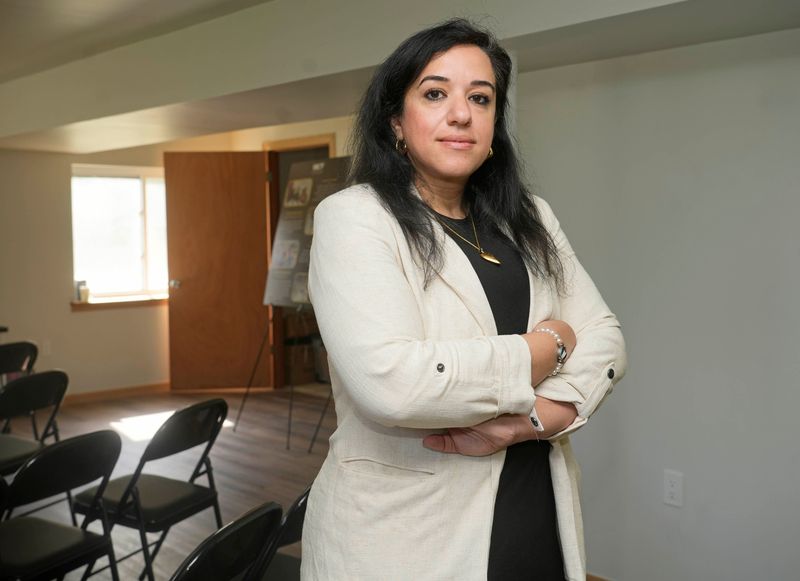
A decade ago, Sheila Badwan was working in health care administration when a friend connected her with a few local Syrian refugee families that needed help. Seeing the Milwaukee home where one family of 13 had been placed, she was horrified.
Badwan changed careers and threw herself into helping refugees successfully acclimate to life in Milwaukee. In 2016 she became the executive director of Hanan Relief Group, which had been started by her college friend in North Carolina. Badwan brought the nonprofit to Milwaukee, and by 2022 it became a refugee resettlement agency.

That meant it received federal funding, through a national partner, to resettle refugees in Milwaukee. Its staff and volunteers furnished apartments, helped enroll children in school and connected parents to jobs, and provided a cultural orientation – from English lessons to riding the bus.
Hanan expanded and resettled over 500 refugees in Milwaukee from 2023 to 2025, Badwan said. That all came to a halt when President Donald Trump took office and stopped almost all refugee resettlement. Federal and state funding has been slashed, and many agencies, including Hanan, had to lay off staff.
Hanan is among those who have started resettling white South Africans, or Afrikaners, the only people allowed to enter as refugees. Statewide, 185 South Africans have been resettled in Wisconsin, according to federal data, and about 6,000 nationally, since October.
Now, after the gutting of the resettlement program, Badwan is leaving Hanan. She doesn’t know what its future could even look like. The funding cuts make most resettlement work impossible, so her agency and others have been helping people with visa applications and food security. Beyond that, the administration is exploring moving to a model where states have more control and could opt out of resettlement entirely.
She’s not sure which Wisconsin resettlement agencies will survive the second Trump administration.
“It’s a challenging time, and it’s very stressful,” Badwan said. “But also, I don’t know the vision of Hanan.”
Badwan’s leadership and prominence in refugee resettlement circles in Wisconsin allow her to speak to the existential threats facing resettlement agencies such as Hanan and others, which now have less money and resources to help refugees already in the U.S.
Her next step: consulting for nonprofits. She will remain active in the Milwaukee area, where she is the board president of the Wisconsin Muslim Civic Alliance.
Badwan remains a believer in Hanan’s work over the last decade, as well as in her efforts at increasing collaboration between service providers, and the value refugees bring to the U.S.
That family of 13 she first met when she got into the work has since purchased a home, and the oldest son graduated from Marquette University, she said.
What role has Hanan played in refugee resettlement in Milwaukee?
When I brought Hanan to Milwaukee, we did something different. We were community-focused. So many different churches, mosques, synagogues, different communities – they just wanted to help, but they didn’t know how to help. And they were disconnected.
One of the reasons Hanan was formed was we were filling in gaps that other resettlement agencies were missing. They had case managers that had huge workloads, and families that didn’t speak the language, didn’t understand the culture.
Hanan brought a different perspective. We provided that cultural orientation and were able to understand the families.
For example, we started an Afghan women’s ESL (English as a Second Language) class, and we would transport the women to class. Historically what I saw, even during the Syrian crisis, was women tend to get left behind when they come to this country.
We wanted to help them become independent, have that socialization, and we did that. We did that well with the Afghan women. A lot of them started driving. A lot of them speak the language now, they read and write in English, where they’re illiterate in their own native language.
Can you describe the state of refugee resettlement right now in Milwaukee?
In 2025, we took a huge hit. We lost $1.5 million because of the resettlement work. The challenge is we didn’t have the sustainability like other organizations.
Resettlement is tough work, to be honest. Right now, at a state level, they’re losing 75% of their funding from the federal government. They’re deciding, which agencies can they really keep that will hold us over for the next few years of this administration?
There’s uncertainty when it comes to refugee resettlement right now. There’s just so many policy shifts happening (such as cuts to SNAP and Medicaid for refugees waiting for green cards).
They do anticipate to increase the ceiling for Afrikaners. Right now our priorities have just been to help with immigration and food insecurity, and a lot of the agencies are putting together resource packets for families.
What do you think about agencies resettling Afrikaners?
A lot of the resettlement agencies here in Wisconsin are resettling Afrikaners. They are trying to keep quiet about it, because this isn’t the population these organizations were founded on.
We started resettling Afrikaners in March of this year. It’s tough because there are families that are waiting for loved ones – Rohingya refugees, Afghan refugees – and unfortunately because of this travel ban, they’re not allowed to come in.
All of this kind of factored (into my decision to leave). It was a lot of stress. The vision of Hanan – when we started Hanan, we were helping Syrian refugees. Then we had a global branch, helping Palestinians.
I got into this work because I’m a humanitarian. I’m not the type to discriminate, but in my own opinion, they’re not a population that needs help. A lot of them are coming in, and they’re just fine. They know how to navigate their communities. They know how to ride the bus. I’ve met a few of the families, and they’re very nice people, but they’re not refugees.
Why should people care about the changes to refugee resettlement and funding cuts?
Employers care, for sure. We have jobs that a lot of refugees take that normal Americans unfortunately don’t take. And, we are a country that helped other countries. They contribute to the economy, they’re taxpayers. We’re a nation of immigrants. We can’t forget that. We should care about our neighbors.
This has a rippling effect for all of us. When SNAP benefits are cut for refugees, they go to a local pharmacy, they can’t pay their prescriptions. Its going to affect businesses, it’s going to affect supermarkets. It’s going to hurt small business owners.
Right now we’re in a time where there is so much hate, and sometimes you just have to learn to get to know your neighbors.
Can you describe what it was like to go from lean days in the first Trump administration to growth during Biden to cuts now?
The first Trump administration, there were many agencies that shut their doors, but some of us survived on a skeleton staff. At the end of the Biden administration, they were just getting back to their normal feet. Also, they had to take on the Afghan resettlement, which was bringing in 80,000 people.
And now we have to go back, and it’s more severe than the first time. They definitely want to strip this program and develop it in a different way.
Sophie Carson is a general assignment reporter who reports on religion and faith, immigrants and refugees and more. Contact her at scarson@gannett.com or 920-323-5758.
This article originally appeared on Milwaukee Journal Sentinel: With refugee resettlement halted, outgoing leader reflects on Trump’s impact
Reporting by Sophie Carson, Milwaukee Journal Sentinel / Milwaukee Journal Sentinel
USA TODAY Network via Reuters Connect