This spring, thousands of college students took hold of a diploma that declared their technical mastery of an artistic discipline, an achievement many thought would give them a competitive edge in a market notoriously unforgiving toward artists.
But in a climate saturated with social media, seduced by AI and suffocated by budget cuts, recent graduates may be asked what value their degree holds and whether life as a professional artist is possible at all.

Freshly minted graduates from the Milwaukee Institute of Art and Design and the University of Wisconsin-Milwaukee’s Peck School of the Arts spoke with the Journal Sentinel to answer a provocative question. Though becoming a full-time artist has been challenging for many years, much has changed since they chose to pursue their degrees four years ago. Given that, do they still have the same hope of becoming full-time artists that they did as freshmen?
‘I have found my true calling’
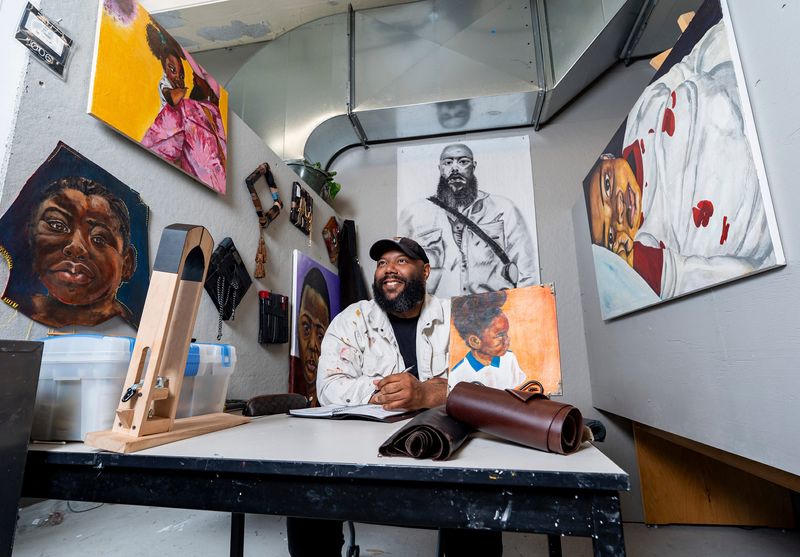
When Kevin Brown Jr. decided to pursue a bachelor’s in fine art at the Milwaukee Institute of Art and Design, he already had an associate’s degree and five children. For the 38-year-old, the life he was living, beholden to factory jobs and retail managers, seemed more illogical than dedicating himself to his artistic passion.
As art schools and cultural institutions struggle to keep free expression alive under the threat of punitive budget cuts, Brown stands among the fine arts graduates who believe the pursuit of a full-time art career is still worth the risk because, in the artist’s own words, he has found his true calling.
Brown was 32 years old, working a temp job at an SC Johnson conveyer belt, when he quit to become an artist. Though he obtained an associate degree in graphic design at Gateway Technical College in Racine, he quickly realized he wanted to make art on his own terms, and a bachelor of fine arts degree felt like the natural next step.
At MIAD, art students follow a traditional curricular model, which emphasizes technical precision, experimentation and portfolio development.
“That’s why I wanted to be in a fine arts program because I could explore more with the resources. There was no limitation to the type of tools we could use. It made it easier and less scary to try something [experimental], versus wasting my money on trial and error,” Brown said.
While Brown’s Fine Art and New Studio Practice degree may not have specifically devoted much time to career preparedness, he has been happy with his choice.
“Faculty members in the classroom [prioritize] talking about the purity of typography or lithography or painting or figure drawing, and we spend less time in those moments talking about how you’re going to pay your light bill,” said MIAD President Jeffrey Morin. “I think, personally, you can talk about both in the classroom.” Morin knows the college needs to do that to be effective today.
Threats of federal budget cuts affect Milwaukee’s arts schools
Like many fine art students, Brown has considered pursuing a teaching career if life as a full-time artist doesn’t pan out.
For now, he’s getting into the habit of bringing his work before the world’s most brazen voices in art criticism: teens. As a substitute teacher at Racine Alternative Learning, Brown incorporates art in his lesson plans to redirect students’ emotional outbursts into artistic expression.
Unafraid of recent and threatened rollbacks in university positions, Brown believes his work shines brighter amid nationwide attacks on diversity, equity and inclusion.
Brown’s work is a shrine to Black culture. Through his sculpture, he reimagines the utilitarian tools that define African American culture as priceless heirlooms. Through painting, he exalts his five Black babies, portraying their rich complexities to a world often ready to relegate them to a stereotype.
Opportunities that once would’ve supported the themes in his work have shrunk in the face of federal threats. In February, MIAD refused to host the Black Leaders and Artists Coalition exhibition because it would have featured only work from Black MIAD students.
“Under current federal regulations, student groups may propose to host exhibitions in MIAD spaces, so long as participation is open to all enrolled students,” said Stacey Steinberg, senior executive director for marketing and recruitment strategy at MIAD.
Undeterred, Brown keeps seeking ways to get his work in front of the public, applying to residencies, attending open critiques and organizing exhibitions to refine and sell his work.
He hopes sales from his work will eventually pay the bills, but for now he works other jobs. Among them is a sales associate position with Coach, where he will do a short artist residency this summer at the company’s Racine location.
A digital arts graduate on entering an AI-seduced world
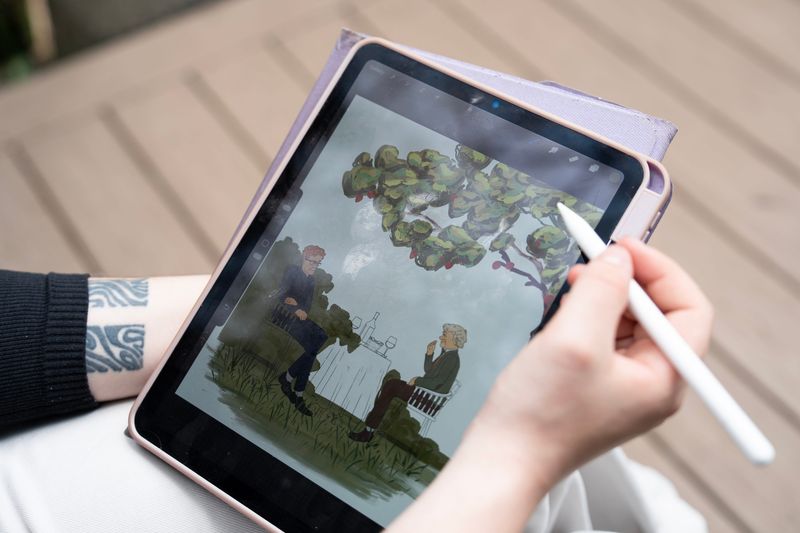
When emerging animator Kas Cook arrived at MIAD, generative AI was little more than a party trick. But the popularity of chatbots catapulted in 2022, with the introduction of OpenAI’s ChatGPT. Soon, students were using it to write research papers, answer existential questions and, even, make art.
But Cook still thinks there’s hope for human animators, so long as they lean into animation styles that only humans can perfect.
The technology made waves in Cook’s classrooms during her junior year, when professors began integrating AI at their own discretion, but she says students were largely resistant to incorporate it. According to Cook, professors were divided on the issue, with some instructing students to avoid it altogether. Others felt students should learn to work with the tool, as it’s only likely to become more prevalent.
It seems that both the students and faculty in the illustration department agree the creativity should come from the artist, not AI.
“When it comes to actually making the illustrations, the idea is that the students are making them, and they want to,” said Andrew Bernier, chair of MIAD’s illustration department.
Bernier sees AI much like any shell-shock technological advancement – promising efficiency and affordable assistance, which may benefit independent animators, while threatening the job security of those employed by major studios that are looking to cheapen their labor costs.
“In some ways to some people yes, [AI] can be [a threat], in other ways to other people no, it can be kind of a savior,” said Bernier.
According to Bernier, the difference now is that appetites for long-form animation and television are decreasing in a short-form content, social media driven world, where quantity and efficiency may be valued over quality.
Though Cook recognizes the threat AI poses, she believes it still has a long way to go in outpacing humans. As the technology continues to develop, Cook considers it her responsibility to perfect, as best she can, the kind of animation that AI can’t do.
“I want to get into traditional animation, instead of 2D computer animation. I want to get into paper and painting animation, which is a beautiful medium. It’s something that AI can’t replicate,” said Cook.
While AI could eventually attempt these more tactile mediums, like painting animation, there’s a certain human intentionality and even imperfection that make them so stunning. As animators continue to experiment with the medium, Cook has faith that the crowds will follow them.
“There’s people who are making things without AI, who are bringing themselves up on smaller platforms, and I think there’s a huge chance that’s going to boom instead of AI,” said Cook.
But its advancement isn’t her only concern; she thinks the harm the technology causes outweighs the reach of its assistance. Noting the well-documented environmental costs of AI, Cook, if given the option, would choose the longer, human way every time.
Emerging performers meet age-old challenges
Dancers have always been taught to brace for an unforgiving market.
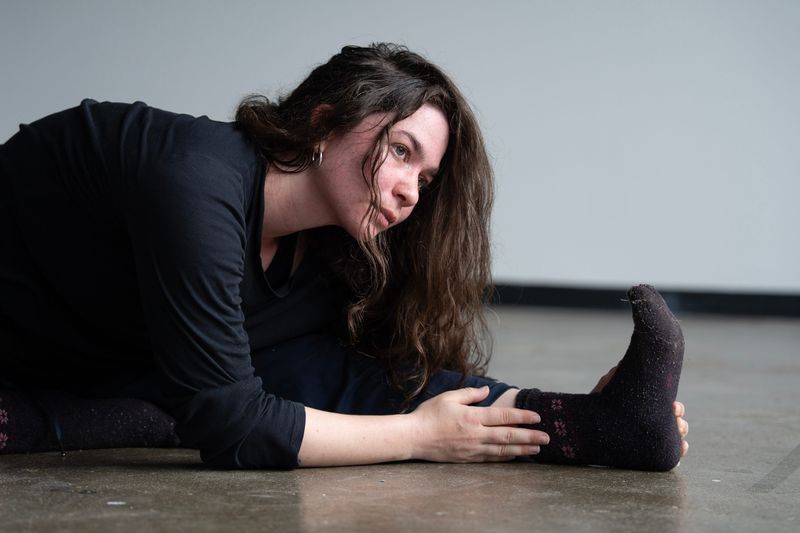
Lia Smith-Redmann, a recent graduate from the University of Wisconsin-Milwaukee, approached her dance degree accordingly, with a broad definition of success.
Born to a family of artists, Smith-Redmann often says she was taught to love dance first; technique came later. Before partner pirouettes and fouettés, she fell in love with twirling around her parents’ kitchen, as her father’s guiding hand spun her through a Jimmy Buffett record.
Smith-Redmann never danced competitively, so she was spared the abusive teachers, eating disorders and body-shaming that characterized some peers’ early dance careers. The dance program at the University of Wisconsin-Milwaukee’s Peck School promoted a safe environment, according to Smith-Redmann. If anything, she says it may overly shelter its students from the realities they’ll face as professional dancers.
Notoriously competitive, major companies audition hundreds of dancers for one spot, if they hold an open audition at all, which Daniel Burkholder, chair of the dance department at Peck School of the Arts, notes are rare. According to Burkholder, that’s part of why a degree in dance still holds tremendous value.
A bachelor’s degree offers years of concentrated training and credible instruction in an industry built on technical precision and rigorous conditioning, and it connects students with guest artists and professors, many of whom are choreographers, leading to job offers.
Since graduation, it’s become increasingly clear to Smith-Redmann that the path to becoming a professional dancer is often winding and unpaved.
“Some of [our professors] auditioned in New York and just didn’t get into companies in their youth,” said Smith-Redmann. “Their first few jobs out of graduating were as waiters or clerks, [and] I wish there was more discussion, especially from professors, about all the ways a dance career might look.”
According to Burkholder, the unrealistic notion of a perfectly paved career path is more the fault of social media, where dancers present the illusion of long-term success through popular posts and curated highlight reels. That’s often not the full story, says Burkholder, and he hopes dancers at the Peck school don’t enter the professional world holding themselves to that standard.
Peck trains dancers to become more than just performers, since the day of signing long-term contracts with theatrical companies as a ticket to financial stability is all but gone.
Theatrical companies are dwindling, says Burkholder, with many small companies having to close their doors after massive losses during the pandemic.
Of the dancers who make it into a company, many are paid a very low wage. Just before the pandemic, the National Endowment for the Arts named dancers and choreographers the lowest-paid artists in the country, and in 2024 their median salary sat just under $48,500, according to the Bureau of Labor Statistics.
For Burkholder and Smith-Redmann, a career built strictly on performance and choreography is not the only route to success.
“Successful art careers in many different forms were modeled for me from a very young age,” said Smith-Redmann. “Some of them make a living or have a career in the arts … [others] have a career doing something else, but they continue to pursue art and have successful artistic practices. Whether or not you’re making a career from [art], and many are, or it’s just an integral part of your life, to me that’s [still] a successful career.”
Since graduating in 2025 Smith-Redmann splits her time between Door County and Milwaukee, working as a marketing coordinator at Door County Auditorium and running a nonprofit that houses her independent projects across performance, choreography, dance film and theater.
Her independent projects work has yet to yield stable income or audition offers for Smith-Redmann. But the dancer, still very early in her career, is not discouraged.
“One of my dreams is to have a contract of my own and to be able to dance live and be offered [opportunities],” said Smith-Redmann. “But as they are not falling into my lap or coming into my inbox … another great option for me is to start creating opportunities and putting out there what I would like to cultivate in return.”
Anya Sesay covers arts and culture for the Milwaukee Journal Sentinel. Send her story ideas, things to see and people to meet at asesay@usatodayco.com. Follow her on Instagram @anyanic0lette.
Anya’s reporting is supported by the Richard and Ethel Herzfeld Foundation, the Maine-based Rabkin Foundation, and reader contributions to the Journal Sentinel Community-Funded Journalism Project. Journal Sentinel editors maintain full editorial control over all content. To support this work, visit jsonline.com/support. Checks can be addressed to Local Media Foundation (memo: “JS Community Journalism”) and mailed to P.O. Box 85015, Chicago, IL 60689.
The JS Community-Funded Journalism Project is administered by Local Media Foundation, tax ID #36-4427750, a Section 501(c)(3) charitable trust affiliated with Local Media Association.
This article originally appeared on Milwaukee Journal Sentinel: Given AI and budget cuts, what do Milwaukee art grads have? Hope.
Reporting by Anya Sesay, Milwaukee Journal Sentinel / Milwaukee Journal Sentinel
USA TODAY Network via Reuters Connect





By Anya Sesay, Milwaukee Journal Sentinel | USA TODAY Network