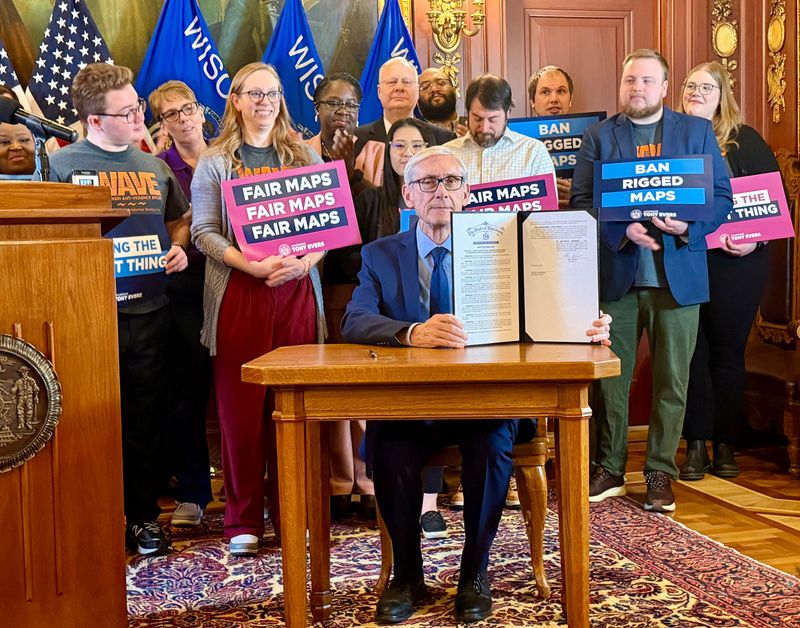
Gov. Tony Evers has decided to convene the Wisconsin Legislature in April to consider his proposed constitutional amendment to ban gerrymandering: “Districts shall not provide a disproportionate advantage or disadvantage to any political party. Partisan gerrymandering is prohibited.” The session provides an important opportunity to move beyond outdated redistricting models, in which maps are rigged in favor of political parties, and embrace fair redistricting practices.
Recall that from 2011 to 2024 the legislative map was so skewed that, despite Wisconsin’s electorate being about 50% Republican and 50% Democratic, Republicans consistently won about 65% of the seats in the state assembly and Senate. The legislative map essentially guaranteed highly disproportional election results, about 15% (= 65% – 50%).

The governor’s proposal is welcome news and should be approved, but it is only an intermediate step toward fully fair and open redistricting in Wisconsin. Why do I believe so? First, the amendment states that maps must not provide a “disproportionate advantage” to any political party. But how much is too much? Clearly, 15% is unacceptable. What about 5%?
The Evers proposal does not answer this question. Better wording would be: “A strong preference will be given to maps that perform the best for accepted measures of partisan fairness.” That would signal that even a map with 1% disproportionality “built into it” would be unconstitutional if there is another map with no disproportionality built into it. Second, the Evers proposal still allows incumbents to rig maps in their favor behind closed doors. Third, the proposal will likely lead to litigation after a map is adopted because lawyers will argue about how much disproportionality is too much.
A longer-term solution for Wisconsin is to take mapmaking privileges away from lawmakers. Among the eleven states that have done so, do any have a redistricting process that consistently delivers fair maps? Unfortunately, my answer is no. For example, in most of these states, there is no statute requiring maps to be politically fair.
The only state where political fairness is a major mapping criterion is Michigan. The recent proposal by the Wisconsin Fair Maps Coalition for a Wisconsin Independent Redistricting Commission closely resembles the Michigan process. Still, neither is adequate because “political fairness” is given a lower priority than other nonessential mapping criteria.
Also, neither is robust enough to consistently deliver high quality, legally acceptable maps. This is because the commission itself makes the maps even though commissioners are not skilled mapmakers and mapmaking is a very complicated and challenging endeavor. For example, in 2021, the Michigan Independent Citizens Redistricting Commission spent many months slowly drawing legislative and congressional maps. Two of the three were later deemed unconstitutional.
My proposal for Wisconsin delivers better, fairer maps
This brings me to my own proposal for Wisconsin redistricting which I believe will deliver better, fairer maps that are less likely to be challenged in court than any existing alternative.
My proposal leverages advanced technology to turn a formerly closed-door redistricting process into a public mapmaking competition. Instead of drawing maps, an independent redistricting commission (IRC) would invite online map submissions from the Wisconsin public, including skilled mapmakers. Websites such as DavesRedistricting.org already allow anyone to draft a map proposal in a timely manner, so the number of map submissions would likely be in the thousands.
Hired experts would then use advanced computer tools, which already exist, to 1. Quickly and automatically evaluate all submissions; 2. Display their numerical performance in a large spreadsheet for everyone to see (similar to Professor Don Leake’s 2023 analysis), and, with the IRC’s input; 3. Narrow them down to a final set of five that have the best scores for objective, quantitative criteria and satisfy strict legal requirements. This would only take a few weeks.
Public input would then be sought regarding the five finalists. Lastly, the IRC would use a modified version of ranked-choice voting to adopt one of the five finalists as Wisconsin’s new district map. Individual commissioners’ votes could be based on both qualitative and quantitative criteria.
Political fairness is the most important mapping criterion
In my proposal, political fairness is the most important mapping criterion besides strict legal requirements. Importantly, I also provide a method for combining scores for individual mapping criteria — e.g., political fairness, district competitiveness, district compactness, keeping counties and municipalities intact within districts — into a single number that represents a map’s overall quality. This enables easy identification of the five best maps.
Overall, my approach is speedy, efficient, transparent and robust. It will consistently deliver high quality maps because Wisconsin will always get one of the best among thousands of maps submitted by members of the public, including experts. It also maximizes public participation and transparency. Quantitative metrics for all map submissions will be made public, so there will be little to litigate after a map is adopted.
The time has come to embrace a new kind of redistricting made possible by recent advances in computer technology. In 2026, Wisconsin can become the first state to do redistricting right.
Matthew Petering is an Associate Professor of Industrial Engineering at UW-Milwaukee and the owner of District Solutions LLC, a Milwaukee-based redistricting consulting company.
This article originally appeared on Milwaukee Journal Sentinel: Evers’ proposal to ban gerrymandering won’t achieve fairness | Opinion
Reporting by Matthew Petering, Special to Milwaukee Journal Sentinel / Milwaukee Journal Sentinel
USA TODAY Network via Reuters Connect