On the South Shore of Milwaukee’s Lake Michigan shoreline, including Cudahy’s Sheridan Park, residents and city officials are concerned about the accelerated erosion of the bluffs that officials say could cost more than $20 million to stabilize.
“It’s the people’s park,” Cudahy resident Aga Artka said of Sheridan Park. “Whatever we can do to keep it safe, do what needs to be done to preserve the parts of it that are naturally getting degraded. It’s nobody’s fault necessarily, water is a powerful element and it’s on display.”

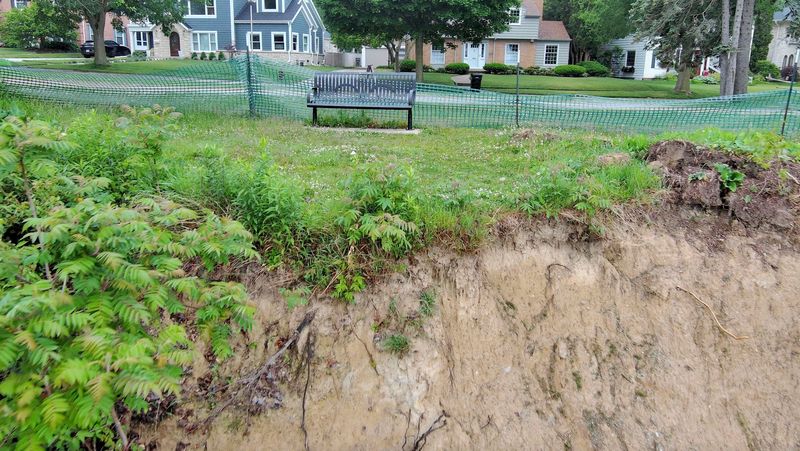
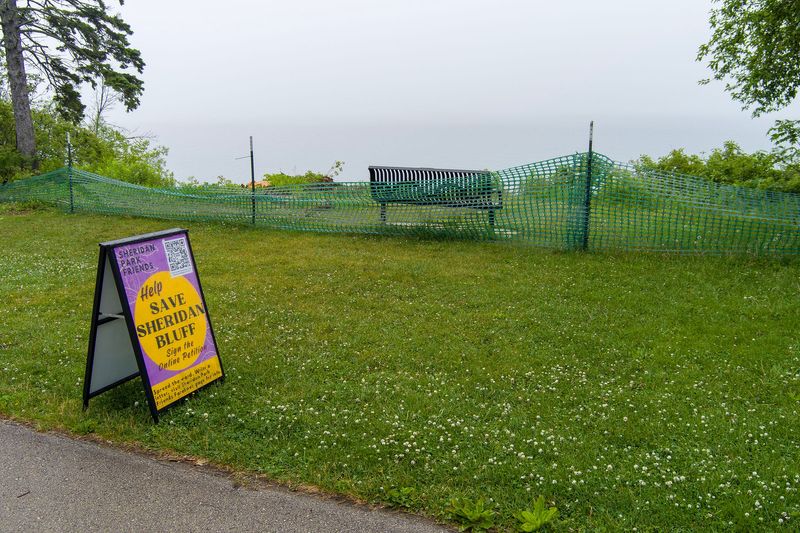
Sheridan Park provides access to the Oak Leaf Trail, sights of the lake and various recreational activities. Now, the erosion is creeping closer, forcing Milwaukee County Parks to fence off parts of the trail and areas along the bluff. A bench can be spotted on the side of the lakefront, the bluff inching closer and closer to claim it.
Residents, concerned about the rate and extent of the bluff erosion along the lakefront after spring storms, have started a petition asking for emergency funding to stabilize the bluffs. If the erosion isn’t mitigated, they worry about how it could affect future access to the park, public safety and infrastructure.
Why is the erosion happening?
The bluffs on the coastline are natural to Lake Michigan. According to Milwaukee County Parks, the erosion process is caused by various factors, including runoff water from heavy rain, strong winds or waves hitting the shore.
Recent storms and fluctuating lake levels have been influencing the erosion on the bluffs. When lake levels get high, they can erode the toe of the bluff – its base – and cause failures.
After severe weather in April, trees on the Sheridan Park bluffs fell landward and lifted the ground around them, resulting in soil from the bluff to fall down the slope.
Previous attempts to slow erosion along the bluffs
For Milwaukee County, attempting to mitigate the erosion on the bluffs is not something new.
In 1933, two years after Sheridan Park first became part of the Milwaukee County Park system, the Civilian Conservation Corps constructed 11 groins in the water along the shore of Sheridan Park in an attempt to reduce coastal erosion.
A groin is a structure that is placed in the water, perpendicular to the shore, to protect beaches and bluffs from erosion. Groins trap and build up sediment, which maintains and grows the shore width.
In a study conducted decades later, funded by the Wisconsin Sea Grant and the Wisconsin Coastal Management Program, it was discovered that although the beach width within the groin field almost doubled in size, the areas south of the groin field did not receive enough sediment, resulting in rapid erosion in these areas.
In 2024, Milwaukee County Parks conducted a countywide bluff assessment study funded by the American Rescue Plan Act to evaluate the resilience of the bluffs. The bluffs were rated on a scale from “A” (most resilient) to “F” (least resilient).
Three parks had ratings in the “F” category due to the bluffs’ instability, including Sheridan Park and Warnimont Park in Cudahy and Bay View Park in St. Francis.
The erosion is also impacting bluffs in Oak Creek and South Milwaukee.
How are residents reacting?
Cudahy residents have started a petition to request emergency funds to be allocated towards the stabilization process. As of June 12, the petition had 576 signatures.
Kirsten Prost, a Cudahy resident, has led the online push for the petition. Enjoying the South Shore parks even before she moved to Cudahy, for Prost these parks have been a getaway.
Her biggest concern is public safety and infrastructure for those who use the parks.
“My husband almost went over the cliffs of Warnimont Park a couple of years ago before they planted all the grasses and [vegetation] because there’s no fence, there’s no railing, there’s no warning there and the cliff comes out of nowhere,” Prost said.
In April, a man was rescued from mud below the bluffs near Warnimont Park Golf Course after it was believed he had fallen down the cliff.
Even though fences have been put up to prevent people from getting too close to the bluff edge, Prost says some are still exploring.
“Whenever people see a fence, a lot of people’s natural inclination is, ‘Oh, what’s on the other side of it? Why is it roped off? Let me go investigate,'” Prost said.
Artka, a Cudahy resident for the last six years, goes to the parks with her kids and enjoys the tranquility at Sheridan Park.
“We ride bikes, we come to the park, the playground,” Artka said. “We live just across the street from Lake Drive, so we cross the busy street to come to a much calmer part of the city.”
She said that although it’s great that people use the trails and enjoy the parks, it’s equally important for residents to join the cause.
“Membership and volunteering with some of those organizations are that much more critical too, because if we all enjoy this natural beauty that’s around us, we all need to get involved to keep it that way,” Artka said.
Parks department proposes mitigation concepts for Sheridan Park bluffs
Milwaukee County Parks has studied the bluffs and has come up with two mitigation concepts for both the north and south sections of the Sheridan Park bluffs.
Mitigation concepts for the north section of Sheridan Park:
Mitigation concepts for the south section of Sheridan Park:
How is Milwaukee County Parks taking precautions?
Milwaukee County parks is urging residents to:
Milwaukee County Executive David Crowley said in a news release that the county wants to protect public safety as well as preserving the lakefront for future generations.
“Milwaukee County will continue taking proactive steps to safeguard infrastructure, improve shoreline resilience, and ensure residents can safely enjoy our parks and natural spaces for years to come,” Crowley said.
What comes next?
To stabilize the bluffs, coastal engineering is required and can be expensive due to wave dynamics, complex access and regulations on the Great Lakes.
Milwaukee County Parks requested funding from the county in the 2026 capital fund for the bluff project, but it was not approved. The department has resubmitted its request with hopes to be considered in 2027.
The request includes approximately $1 million for planning and design, and to obtain permits, with full construction estimated to cost more than $18 million.
Some funds have recently been allocated to the cause.
Milwaukee County made additional funds available for three projects that were not included in the 2026 capital projects budget; one was the Sheridan Park bluff stabilization project, which will receive $200,000 to begin the planning process.
Now, the project is seeking $1.1 million toward a study that would reassess the bluff’s conditions. The study would serve as a prerequisite to be considered for more funding through FEMA’s Building Resilient Infrastructure and Communities (BRIC) program.
If approved by FEMA, the project could receive $23 million toward the bluff’s stabilization.
The Milwaukee County Finance Committee will meet June 18, where Milwaukee County District Supervisor Steven Shea, representing Cudahy, is planning to ask for the funding toward the study.
Editor’s note, 6/24/2026: This story has been amended to indicate that erosion is affecting bluffs in Oak Creek and South Milwaukee.
Stephanie Perez is a 2026 summer intern for the Milwaukee Journal Sentinel. She can be contacted at sperez@usatodayco.com.
This article originally appeared on Milwaukee Journal Sentinel: Continuing bluff erosion at Cudahy’s Sheridan Park creates unease
Reporting by Stephanie Perez, Milwaukee Journal Sentinel / Milwaukee Journal Sentinel
USA TODAY Network via Reuters Connect
By Stephanie Perez, Milwaukee Journal Sentinel | USA TODAY Network