Democratic candidates running for Wisconsin’s top government job want to use the state’s projected $2.5 billion budget surplus to bolster safety net programs, education and early childcare initiatives.
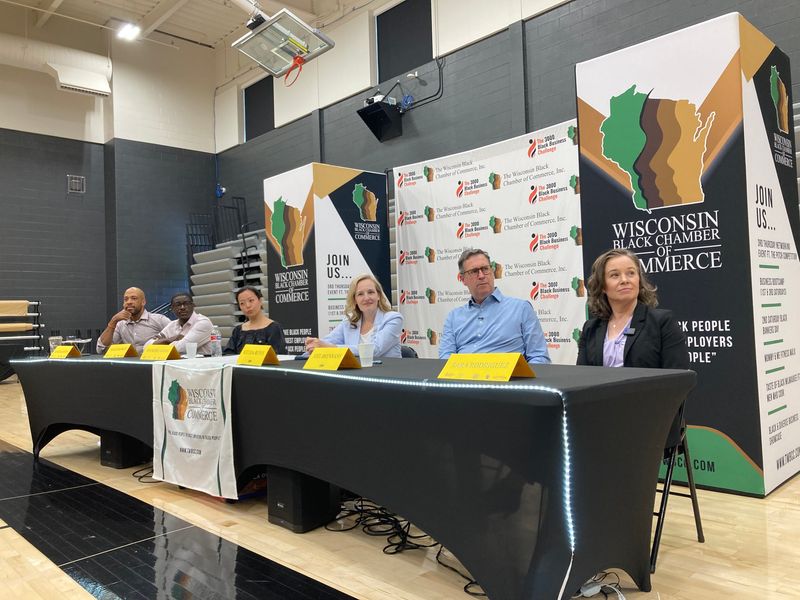
Those were some of the responses six candidates running in the governor’s race gave during a June 20 town hall hosted by the Wisconsin Black Chamber of Commerce.

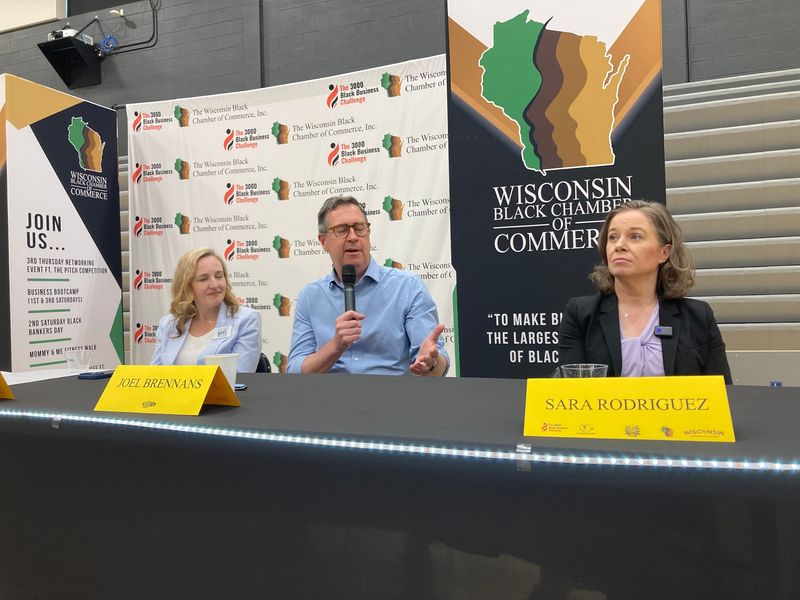
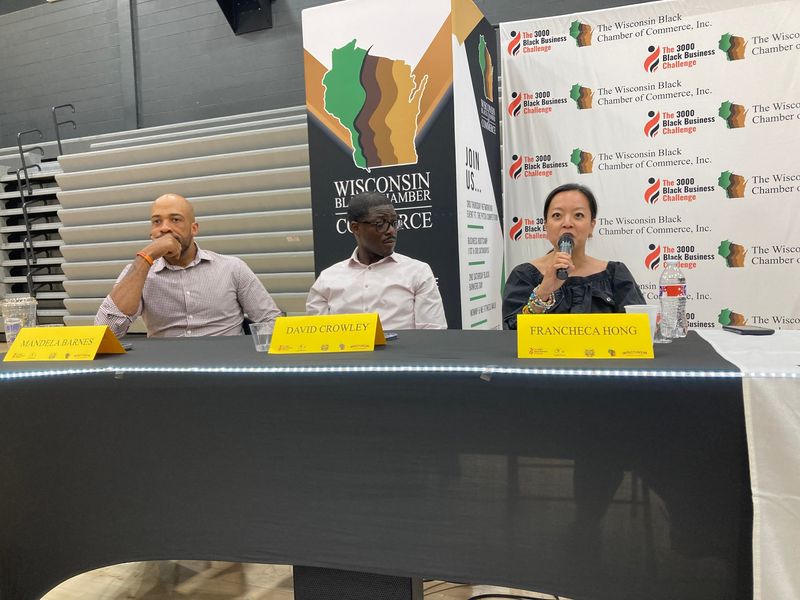
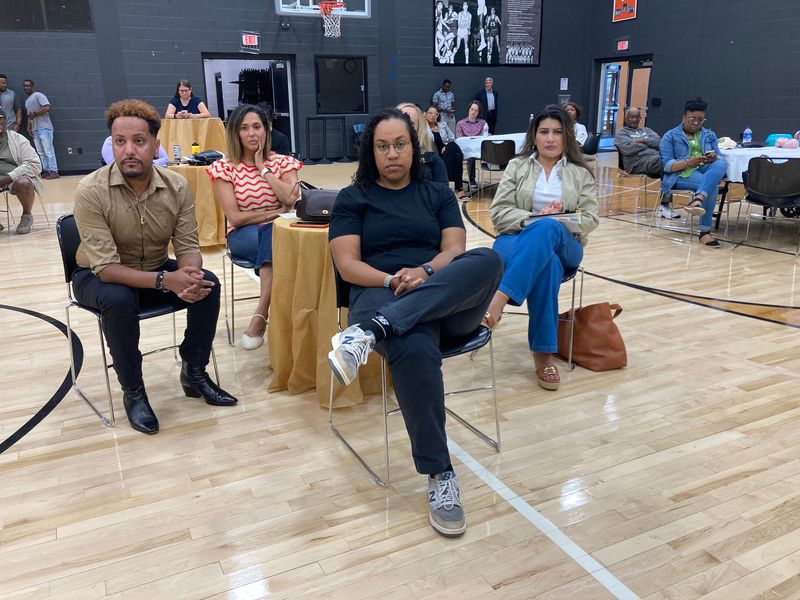
The event, held at Dr. Howard Fuller Collegiate Academy on North Vel Phillips Avenue, touched on such topics as affordable housing, the state’s shared revenue formula, homelessness, and diversity, equity, and inclusion efforts in state contracting.
Appearing were former Lt. Gov. Mandela Barnes, Milwaukee County Executive David Crowley, state Rep. Francesca Hong, state Sen. Kelda Roys, Greater Milwaukee Committee president Joel Brennan, and Lt. Gov. Sara Rodriguez. All are Democrats.
Rep. Tom Tiffany, a Republican, was invited but did not join. Also absent was Missy Hughes, who dropped out of the Democratic primary race days later.
The gubernatorial primary election is Aug. 11.
Here are some takeaways.
Plans for Wisconsin’s budget surplus
All the candidates agreed the surplus should go to bolster public school funding, expand Badger Care eligibility and create more affordable housing.
Hong said the funding should also secure the state’s FoodShare program. Its spending cuts stem from legislation passed in 2025 by Congress and signed by President Donald Trump.
Roys said her priority would be to invest in Wisconsin’s public schools.
Barnes said the Republican-controlled Legislature has shortchanged schools, underpaid teachers and ignored environmental issues such as lead pipe removal and weatherization programs.
“We only got the surplus because our basic needs and essentials have not been met,” he said.
Milwaukee should get more shared state revenue
All the candidates said the state’s shared revenue formula should be changed so Milwaukee get a higher share.
Rodriguez said Wisconsin is in the top ten for high property taxes in the U.S. because local communities aren’t appropriately funded by the state.
“I think this is a real bipartisan solution we can come up with that allows the cities and municipalities to have the funding they need to actually provide the services their citizens expect,” Rodriguez said.
Milwaukee’s high property taxes are unsustainable and inequitable, preventing residents from buying a home, living in their communities or even retiring in the city, Roys said.
Relying solely on property taxes, she said, starves local governments of resources and robs them of local control.
The passage of Act 12 in 2023, which increased state funding to local governments, didn’t solve all the problems, Crowley said. Three-quarters of every dollar in state funding goes to state-mandated services, he said.
The shared revenue formula includes income among its factors, Crowley said. That means Milwaukee County loses income from people who work here but live elsewhere, he said.
Hong said the formula should be based on a community’s demographics and not per-capita based.
Dealing with the Trump administration
Hong said she would challenge the Trump administration by building coalitions with like-minded Democratic governors across the country to leverage negotiations.
Brennan, who served as Department of Administration secretary during Gov. Tony Evers’ first term, said he has the backbone to stand up to Trump, especially on immigration and election issues. He acknowledged there would be opportunities to work together to secure federal resources for education, housing, or healthcare.
Crowley said securing federal funding for public transit would be a priority.
“We can’t continue to make decision based on who’s occupying the White House,” Crowley said. “We have to start focusing on what is our long-term vision for our community locally and also for the state of Wisconsin.”
Diversity, equity, and inclusion is an issue
Hong expressed disappointment that the Asian community was involved in efforts to reverse affirmative action. In 2023, the U.S. Supreme Court ruled against race-based admission policies in higher education, siding with plaintiffs who argued such policies discriminated against Asian Americans.
“One of the most dangerous symptom of White supremacy is pitting our communities of color against one another,” Hong said.
Hong said there must be a concerted effort to fund organizations that train and support diverse leadership.
“Wisconsin is not going to succeed unless Milwaukee succeeds,” Hong said, adding she would carry that mantra into her administration.
During the Act 12 budget fight, Crowley said he fought against efforts to eliminate DEI programming from Milwaukee County.
Milwaukee County in 2019 became the first in the nation to declare racism a public health crisis. Addressing racial disparities can make the county the healthiest in Wisconsin, Crowley said.
Wisconsin has some of the biggest disparities in Black maternal and infant mortality rates in the country, cutting across social and economic lines, Rodriguez said.
A way to tackle that disparity is supporting programs that ensures health care providers look like the people they serve, she said.
As administration secretary, Brennan oversaw the state’s supplier diversity program. He said the program doesn’t have as much teeth as it needs.
Brennan said he would continue to push for programs to support diverse businesses. He touted his work with Evers to provide $75 million in pandemic-era relief funds to local chambers of commerce and community development financial institutions.
This article originally appeared on Milwaukee Journal Sentinel: Governor candidates debate plans for Wisconsin’s $2.5 billion surplus
Reporting by La Risa R. Lynch, Milwaukee Journal Sentinel / Milwaukee Journal Sentinel
USA TODAY Network via Reuters Connect
By La Risa R. Lynch, Milwaukee Journal Sentinel | USA TODAY Network