Let’s discuss three smaller flycatchers that occur within our Northcentral Texas and Southwestern Oklahoma region.
One of the birds is fairly common and widespread, but the other two flycatchers are more abundant either immediately west or south of our area.

Two belong to the same genus of flycatchers (Genus Sayornis) whereas the third avian belongs to a separate genus. These three striking little birds are the eastern phoebe (Sayornis phoebe), Say’s phoebe (Sayornis saya) and the vermillion flycatcher (Pyrocephalus rubinus).
What’s in a name?
Common and scientific names of these birds are rich in meaning. Therefore, to modify a line from the Immortal Bard’s (Shakespeare’s) “Romeo and Juliet,” let us examine what’s in their names.
Phoebe is derived from an ancient Greek word meaning bright, shining and pure, and mythology alluded to Phoebe as a Titaness linked to the moon and prophecy. In its feminine form, the word refers to the moon goddess, Artemis.
But the masculine form of the word, Phoebus, refers to the sun god Apollo. Both are bright, shining, active members of the Greek and Roman pantheon.
The name phoebe is also an onomatopoeia of the birds’ calls. Sayornis and saya are Latinized patronymic names applied to the phoebes in honor of early North American naturalist, entomologist and conchologist Thomas Say. He obtained the first Say’s phoebe specimen in 1819 near Cañon City, Colorado.
The genus name, Sayornis, translates as “Say’s bird.” Interestingly, Say’s phoebe was formally named and described in 1825 by Charles Bonaparte, a nephew of Napoleon Bonaparte.
The phoebes
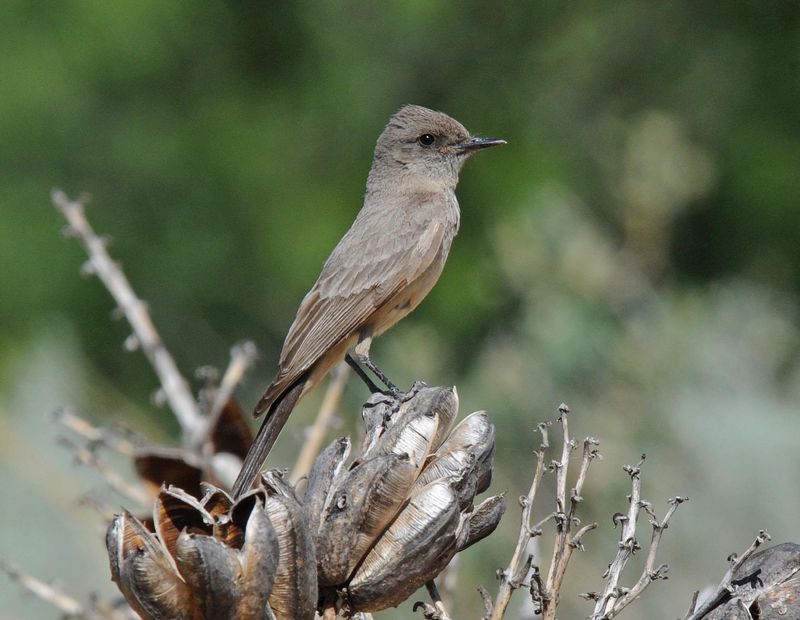
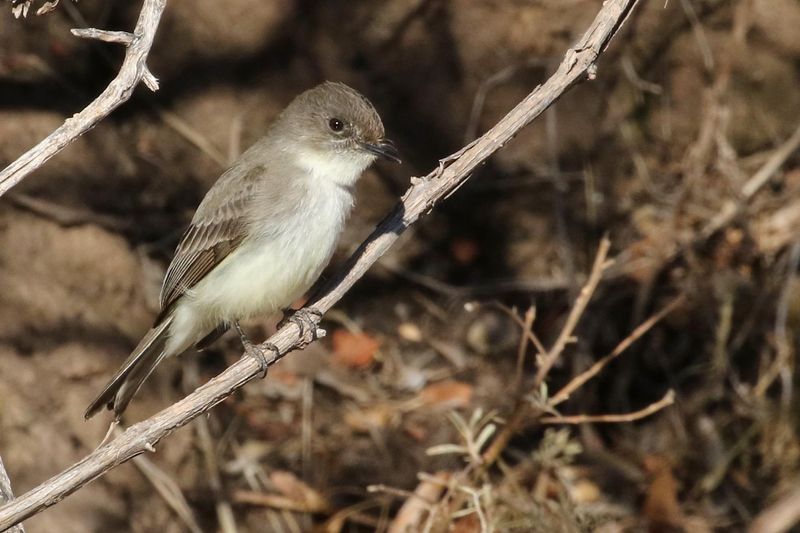
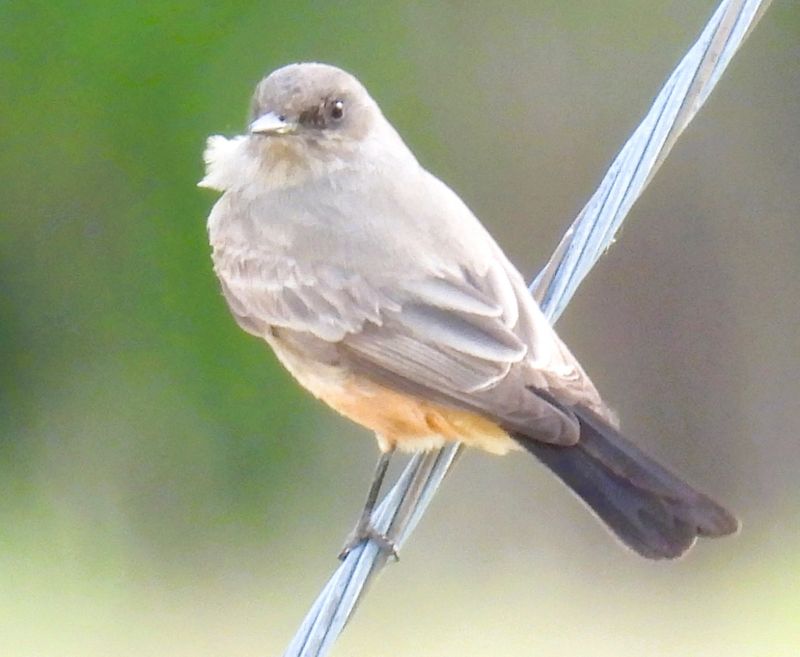
Phoebes are small flycatchers with body lengths of approximately 6-7.5 inches and heads appearing somewhat large compared to their bodies. Adults have dark gray-to-black upper parts and heads, and relatively long, black tails. The Eastern phoebe’s belly is white with a slight splash of gray on the breast.
But Say’s phoebe has a distinctive light buffy or cinnamon colored belly and gray breast. The bills of both birds are black and rather short.
Eastern phoebes are residents throughout most of Northcentral Texas and Southwestern Oklahoma, but Say’s phoebe is an early spring migrant more abundant in the southern and western portions of the region. The Eastern phoebe is often found near water and will utilize buildings, bridges and other structures with overhangs as nesting sites.
Say’s phoebe avoids heavily wooded and riparian areas and prefers open habitats in pasturelands, prairies, fallow fields, buttes and canyonlands. The birds demonstrate site fidelity or natal philopatry behavior, and migrants annually return to their previous territories within an area.
In 1803, John James Audubon tested philopatry behavior by placing silver bands upon young Eastern phoebes to determine if individuals would return to their birthplace; thus, Eastern phoebes became the first banded birds in North America.
Tail wagging and hunting
Phoebes usually rest upon low perches and wait for appropriate insect prey. When prey is sighted, the birds sally forth and capture insects in midair or, unlike most flycatcher species, pounce upon the insect on the ground. Prey items include beetles, grasshoppers, crickets, flies, bees and other insects.
Phoebes are noted for tail wagging when perched, and researchers have observed that wagging patterns may be species specific. Although both of our species tail wag, Say’s phoebe performs this action less frequently than the Eastern phoebe.
The bird behind the mask
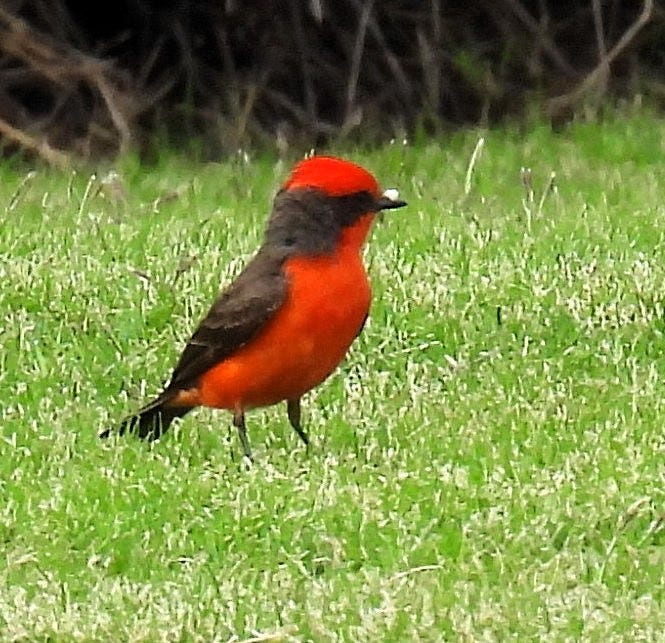
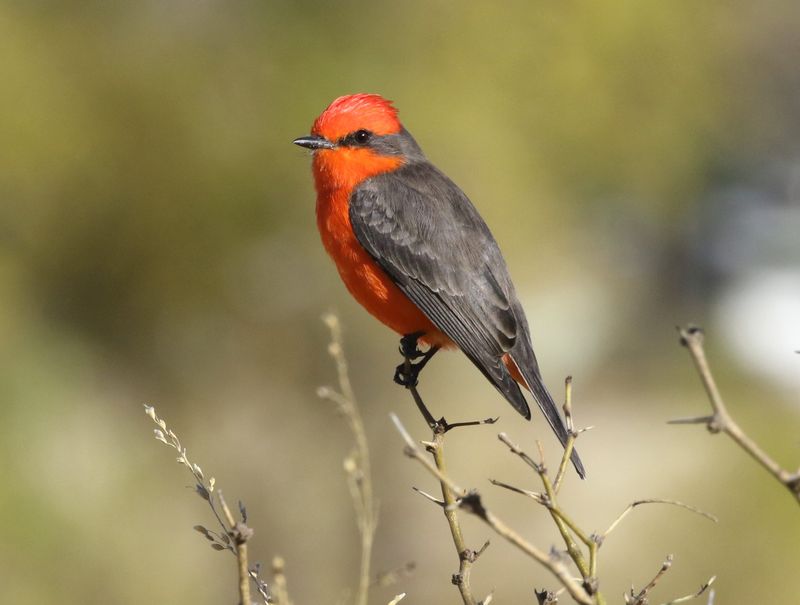
The vermillion flycatcher’s common name is based upon the adult male’s brilliant, red-orange crown, throat, breast and belly. The adult male’s bill, facial mask, back, wings and tail are a dark, sharply contrasting charcoal color. The vermillion flycatcher has a shorter tail than the phoebes.
The scientific name of the vermillion flycatcher (Pyrocephalus rubinus) can be translated as “fire-headed ruby” — an apt description of mature males. Whereas the sexes of most flycatcher species are very similar in color and pattern, the vermillion flycatcher is a notable exception.
Immature or first-year male birds are spotted and streaked pink and red on their crown and underparts and gradually acquire the solid, red adult coloration. First year males also have brownish gray upperparts.
Female vermillion flycatchers possess salmon-colored bellies, narrowly streaked white breasts, white-edged black tails, and a dark facial mask extending as far as the eye.
The vermillion flycatcher is a rare summer visitor of the Rolling Plains and is more commonly found in the South Texas brush country and Trans-Pecos Texas. Vermillion flycatchers prefer edge habitats of pasturelands and woodlands and open habitats of xeric, shrubby areas.
Hawking hunters
Mesquite trees are favored perches. These flycatchers also are found in parks and golf courses. Vermillion flycatchers rest upon fenceposts and other exposed perches at medium heights and hawk insects in midair. Vermillion flycatchers also drop to the ground and capture prey in a similar manner as phoebes.
Hawking flights are usually performed as looping circles returning the hunters to their original perches. Large food items, such as grasshoppers and lepidopterans are often transported to and whacked against the perch to subdue the prey before consumption.
Courtship and nesting
The male vermillion flycatcher conducts impressive courtship displays by flying high above his perch with slow wingbeats, expanding his chest and crown plumage, and emitting a series of sharp notes and twittering calls before swooping back to the perch. The usual call is described as a soft “peet-peet” or “peet-a-weet.”
Cup-shaped nests, often camouflaged with lichens, are constructed within forked tree branches near stream banks. Males guard their territories from other vermillion flycatchers with warning postures of raised tails and erected head crests. Males feed their mates as the females brood their eggs, and both parents engage in care and feeding of the altricial chicks.
Lucky looks
These flycatchers are not considered threatened throughout most of their ranges. In fact, human settlement and construction have possibly increased phoebe nesting sites. However, habitat conversion, clearing understory brush in pasturelands and depletion of surface water may negatively impact these attractive little flycatchers.
Enjoy their spring and summer displays and activities if you are fortunate enough to discover phoebes and vermillion flycatchers in our area!
Jim Goetze is a retired professor of biology and former chairperson of the Natural Sciences Department of Laredo College with an avid interest in all aspects of the natural world. He can be contacted at gonorthtxnature@gmail.com.
This article originally appeared on Wichita Falls Times Record News: Three attractive bug getters | Opinion
Reporting by Jim Goetze, Wichita Falls Times Record News / Wichita Falls Times Record News
USA TODAY Network via Reuters Connect
By Jim Goetze, Wichita Falls Times Record News | USA TODAY Network