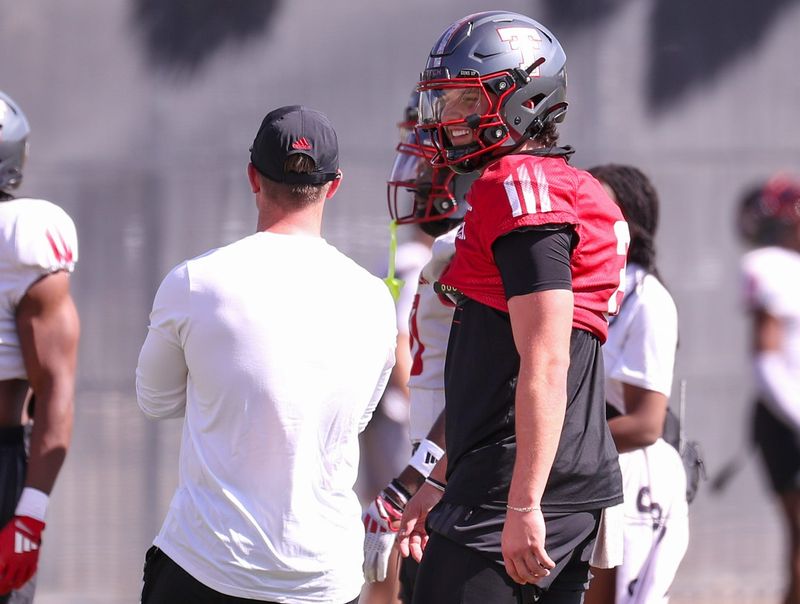
The future of Texas Tech quarterback Brendan Sorsby may soon be decided in a courtroom. According to multiple reports, Sorsby filed for an injunction against the NCAA on Monday in district court in Lubbock County, Texas, seeking to preserve his eligibility for the 2026 college football season amid the ongoing gambling investigation tied to what court filings describe as a “clinically diagnosed gambling addiction.” The court filing takes direct aim at the NCAA, calling the organization’s position on sports betting “deeply hypocritical.” Sorsby’s attorneys also accuse the NCAA of abandoning its duty to prioritize student-athlete well-being while simultaneously benefiting from the sports gambling landscape it publicly condemns.
At the center of this legal battle sits a very difficult question that stretches beyond the football field, however. Where should accountability end and treatment begin when addiction enters the equation?

A legal fight over one final season
Sorsby transferred to Texas Tech after a stint at Cincinnati and was projected as one of college football’s top quarterbacks. However, due to the ongoing investigation, he is currently ineligible to play as the NCAA reviews gambling-related violations connected to thousands of sports wagers placed during his college career.
The NCAA strictly prohibits athletes from betting on any sport it sanctions, and there are especially harsh consequences for wagering on games involving a player’s own school or team. Penalties can be as severe as permanent ineligibility. But Sorsby’s attorneys, who include high-profile sports lawyers Jeffrey Kessler and Scott Tompsett, are arguing that the circumstances specific to Sorsby warrant a different approach. According to the court filing, Sorsby has been in an inpatient residential treatment facility since late April after it was revealed that he had placed thousands of sports bets through a gambling app. So, his legal team argues those actions stemmed from a diagnosed mental health condition rather than any effort to compromise competitive integrity.
“The NCAA has weaponized his condition to shore up a facade of competitive integrity, while simultaneously profiting from the very gambling ecosystem it polices,” the filing states.
The NCAA timeline and the clock working against Sorsby
The lawsuit paints the NCAA as a bureaucracy moving too slowly for a player running out of time, which time is of the essence. According to the filing, Sorsby’s attorneys claim Sorsby previously offered to accept a two-game suspension, complete residential treatment, as well as participate in educational efforts warning athletes about the dangers of gambling. However, the NCAA refused and instead continued to request interviews and additional documentation without issuing a timely decision.
Sorsby’s legal team also requested a court hearing by June 15, hoping for a decision or some clarity before the June 22 deadline for the NFL Supplemental Draft. Without any kind of ruling, the filing states, Sorsby faces an “impossible choice.” He can either risk losing a year of football entirely or forgo his final season of college eligibility to pursue professional options, which is even more uncertain.
“The NCAA will suffer no cognizable harm from letting Mr. Sorsby play football while this case proceeds,” the filing states. “But if this Court does not act, no future judgment can give Mr. Sorsby what the NCAA will have taken from him.”
What Sorsby admits and what he disputes
The court filing does acknowledge that Sorsby bet on sports extensively, including small wagers ranging from $5 to $50 on Indiana football games while he was with the Hoosiers in 2022. However, his attorneys also made sure to emphasize that he did not play in those games, never bet against Indiana, never attempted to manipulate outcomes, and never used insider information.
“To be clear, I never placed any bets “against” Indiana or against any players on the team,” Sorsby said in the affidavit that was included in the filing. “I never used any non-public information that I knew about the team in deciding what bets to place. My bets were purely intended to make me feel more connected to the game and my teammates and to give me more of a reason to root for my teammates. Because the Indiana football team was not a very strong competitor in 2022, I lost most of the bets I placed.”
Sorsby also described the progression of what he says became a severe gambling addiction. “In retrospect, by the end of my freshman year at Indiana, I was truly addicted to gambling. I began placing hundreds of bets on anything and everything, including non-major doubles tennis tournaments and the Major League Baseball draft.”
The language in the court filing argues that Sorsby’s conduct “undisputedly did not raise any integrity issues” because there is no solid evidence that game outcomes were influenced. However, NCAA bylaws have historically considered betting on an athlete’s own school as one of the most serious violations, regardless of the intent.
Texas Tech caught in limbo
The uncertainty extends beyond Sorsby as well. The lawsuit argues Texas Tech football itself is being harmed by the lack of a decision, stating the program cannot properly prepare for 2026 without knowing whether its presumed starting quarterback will be available. And that uncertainty carries major weight in Lubbock, as Sorsby arrived as ESPN’s No. 1-ranked transfer portal quarterback and is viewed as one of the most high-profile players entering the 2026 season. He is also reportedly tied to NIL compensation worth more than $5 million and projected as a potential top QB prospect in the 2027 NFL Draft. But now, instead of preparing for fall camp with the rest of the team, one of college football’s biggest offseason acquisitions finds himself waiting on judges, lawyers, and NCAA administrators.
As of Monday’s filing, there’s been no official decision on Sorsby’s eligibility, but after news of the lawsuit broke, the NCAA released a statement to On3 about the broader situation. “The NCAA has not received a reinstatement request for this case,” the NCAA said in a statement obtained by On3. “The NCAA generally doesn’t comment on pending reinstatement requests, but the Association’s sports betting rules are clear, as are the reinstatement conditions.”
The statement also directly addressed one of the lawsuit’s central arguments that Sorsby’s bets on Indiana football while on the scout team did not create integrity concerns because he never wagered against the Hoosiers. “When it comes to betting on one’s own team, these rules must be enforced in every case for the simple reason that the integrity of the game is at risk,” the NCAA said. “Every sports league has these protections in place, and the NCAA will continue to apply them equally because every student-athlete competing deserves to know they’re playing a fair game.”
His legal team argues that the intent of the wager is what matters, that he never bet against Indiana, never influenced outcomes, and was battling a diagnosed gambling addiction. The NCAA, meanwhile, appears to be drawing a much firmer line that betting involving one’s own team, regardless of motive, crosses into territory where competitive trust becomes non-negotiable.
Somewhere between those opposing positions sits a courtroom in Lubbock, where one of college football’s most closely watched eligibility battles may soon be decided.
This article originally appeared on Red Raiders Wire: Texas Tech’s Brendan Sorsby bet on his Team, not against it, sues NCAA
Reporting by Lauren Beasley, Red Raiders Wire / Red Raiders Wire
USA TODAY Network via Reuters Connect