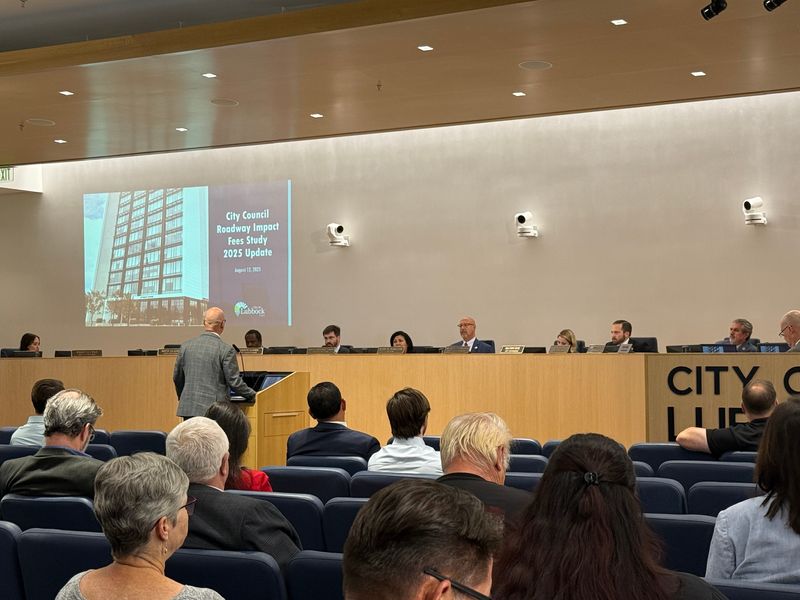
If there was a city council meeting to watch — this was it. However, the public couldn’t live-stream it due to “network issues” with the city’s livestream.
But that didn’t deter community members from showing up and speaking for and against several items on the agenda, sparking healthy civil debate among the council.

During their three-hour meeting, the council members made decisions on crucial items that will have an impact on the growth, look, and future of Lubbock. Here’s a brief summary of three items they voted on that you need to know about.
City Council eyes getting rid of Impact Fees
A hotly debated item since they were first approved years ago, the future of Impact Fees was on the council agenda again.
For context, Impact Fees are a fee the city charges developers whenever they pull a permit to help offset the cost of upgrading roads to accommodate the new traffic a business or home will be generating. Currently, Lubbock charges 25% of the cost it would take to upgrade the road. The city foots the rest.
However, the Avalanche-Journal previously reported that due to inflation, the 25% has technically shrunken to 12.5% with a citizens committee recommending readjusting the fees back to 25%.
It was up to the council’s discretion on how they set the fees, but it was Councilwoman Dr. Jennifer Wilson who best summed it up.
“Impact fees have been probably one of the hardest topics we’ve had to tackle in the last four years,” Wilson said. “To me, any — and you can call them there — but any tax that is that complicated, that we cannot all understand, and we can’t even speak the same language, trying to get motion out because they’re that complicated is never the right thing.”
She further clarified that the city has seen a benefit from the Impact Fees around the community, but given the state of the local economy and national economy, it’s up to the council to consider where Lubbock should land on charging Impact Fees.
Councilwoman Christy Martinez-Garcia was on board with this recommendation. Councilman Tim Collins proposed setting specific impact fee rates based on the area of service they are in.
However, it was Councilman David Glasheen who proposed the idea that garnered enough support — zeroing out Impact Fees altogether. Every council member except Martinez-Garcia, Collins and Councilman Gordon Harris voted in favor of this idea.
The council will consider Impact Fees for a final time and vote at their next meeting.
Lubbock adopts some of the proposed UDC Amendments
The council voted in favor of 55 of the 56 amendments to the City of Lubbock Unified Development Code.
The one that didn’t was hotly contested Amendment #31 relating to wall signs on a parking garage — specifically for the Raider Parking Garage across from Texas Tech University’s Jones AT&T Stadium. Of note, the university does not own the parking garage.
McBrayer, along with others, said they voted no to the ordinance because it was to impact only one certain entity, even though other council members offered up amendments to restrict the amendment further.
“I’m fearful of this, even though technically it is not, maybe for a single user, I’m fearful of it really being that and I don’t think that’s what our sign ordinances, or general ordinances, are meant to do,” McBrayer said.
Both Collins and Glasheen offer amendments to the amendment, but both failed 3-4. Ultimately, the amendment failed to garner a second, meaning it died; the ordinance the amendment seeks to amend will stay the same.
Council sets maximum tax rate it could adopt for the 2026 budget
The final item was the first of many that will come from the City of Lubbock’s 2026 budget.
In a 6-1 vote, with Glasheen opposing, the council adopted the proposed maximum tax rate of $0.479365.
“We have received a budget from our city manager, and we are setting a maximum tax rate, a tax rate based on supporting his budget, and once we do that, that is the number we cannot go above,” McBrayer said. “We are not setting our tax rate for the upcoming year.”
The city will host a public hearing where they are tentatively set to adopt the actual tax rate for the 2026 budget on Sept. 2.
To note the proposed maximum tax rate is “higher than the 2025 no-new-revenue rate of $0.461938 and lower than the 2025 voter-approval rate of $0.497402,” according to the city.
Mateo Rosiles is the Government & Public Policy reporter for the Lubbock Avalanche-Journal. Got a news tip for him? Email him: mrosiles@lubbockonline.com.
This article originally appeared on Lubbock Avalanche-Journal: Lubbock City Council approves UDC amendments, proposed maximum tax rate. Here’s what to know
Reporting by Mateo Rosiles, Lubbock Avalanche-Journal / Lubbock Avalanche-Journal
USA TODAY Network via Reuters Connect