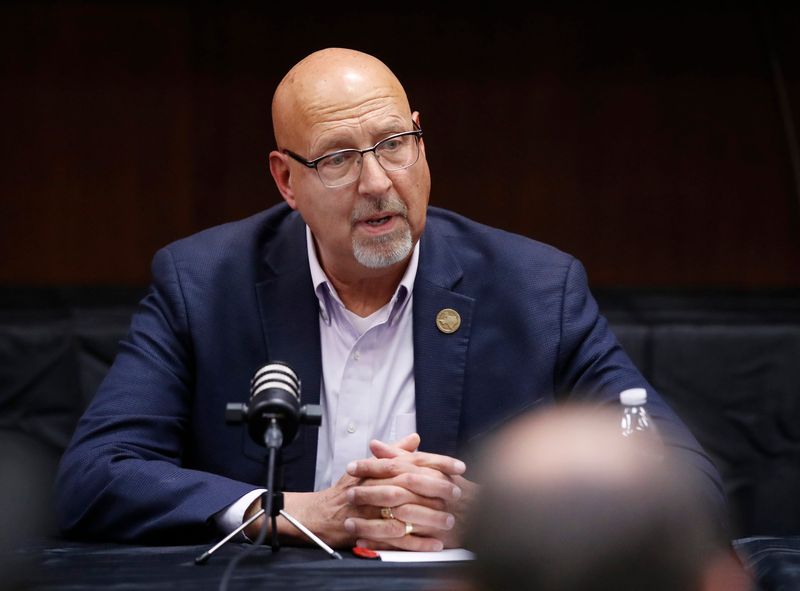
Early voting for Lubbock’s May 2 municipal election is underway, with the race for mayor at the top of the ballot.
One of the candidates is Mark McBrayer, the current mayor of Lubbock and a local attorney.

In an effort to get to know the candidates in this race, the Avalanche-Journal sent out a questionnaire to all the candidates to get to know their platforms and priorities.
Here are McBrayer’s answers to the questionnaire, as early voting is from April 20 – April 28. Election Day is May 2.
Q: The hyperscale data center proposal for northeast Lubbock was rejected by Planning and Zoning and then withdrawn. The developer plans to resubmit. What criteria should the city require before approving a project of this scale — and should the city require mandatory water and energy consumption disclosure from data center operators?
A: The city council and I are very cautious about data centers. We are not chasing them and are looking carefully at how they are affecting cities where they already exist. I have been very clear that I am only interested in data center projects that meet specific criteria: 1) they are low water consumption and recirculation or air cooled projects; 2) they provide some or all of their energy needs on site; 3) they are not located close to residential areas inside the city and provide sufficient surrounding land buffers to mitigate sound; 4) they are not seeking big tax abatements from the city; and 5) the are not speculative builds (in other words, they should already have an occupant for the center).
Q: LEDA’s CEO said the project would bring significant tax revenue. Critics say the same land zoned for residential and commercial use would generate more long-term revenue. How do you evaluate that tradeoff? Is Lubbock even ready for an AI project, given the recent developments across the state on AI Data centers?
A: Although the centers do not provide much new employment, under the right circumstances, they can provide significant property taxes to the city for its infrastructure and other needs, relieving the tax burden on homeowners. I am not favorable to data centers wanting to locate near existing residential areas or areas inside the city that are likely to be developed for residential or commercial uses in the near future. So, the question for me is: development now or not? Given all the right conditions, I am willing to consider them. But I am also watching what happens around the state and country to cities who rushed into agreements for data centers without a careful vetting process.
Q: The City, like other governing entities, is facing budget constraints, and recently the city dissolved impact fees. Last year the city also saw shortfalls in sales tax collections and lost dollars from LCAD. Given that the 2026 budget already required a tax rate higher than the no-new-revenue level just to maintain current services and the growing size and population of the city, are you for or against raising the tax rate? Explain your reasoning
A: I have always voted for the NNRR during my time on the council and as mayor. That was the right vote, although the majority on the council did not vote with me for the NNRR. Nevertheless, the rate that was adopted did not raise homeowners’ taxes by much, and I believe that is one of the reasons the 2024 Road Bond passed just two years after the 2022 Road Bond. Given my priority to add a significant number of police officers next year, I cannot promise I will be able to vote for the NNRR in our next budget, but I will continue to look for other ways to reduce our expenses, as I have done each year as mayor, before raising taxes
Q: Lubbock’s crime rate has dropped significantly, but staffing hasn’t kept pace with population growth. How many additional sworn officers and firefighters does Lubbock need, and how will you pay for them without raising taxes or would you raise the tax rate for this reason?
A: My staffing priority will be adding a significant number of new police patrol officers to our force. That will likely be a part of the “Meet and Confer” proposal that comes before the council for a vote at budget time. As I stated above, if that requires a small tax increase, I would vote for one on that basis, believing that is in the best interests of our citizens and would meet with their approval.
Q: The First Friday Art Trail generates tourism, foot traffic, and economic activity downtown — exactly what HOT funding is designed to support. In 2024, the council cut that funding over content concerns, then restored it with new restrictions requiring grantees to avoid issues of a divisive or controversial nature. Who defines “controversial” and is that standard enforceable without becoming viewpoint-based censorship?
A: The city provides grant money on a discretionary basis for outside organizations’ art and culture events, based on whether those events serve a broad public purpose of drawing visitors to the city. This is not “censorship” because we are not telling anyone what they can or cannot do, only what conditions need to be met to receive the discretionary grant. This past year, FFAT agreed to the terms of our grant that apply to all applicants, and so we restored their funding.
Q: Hotel Occupancy Tax is paid by visitors, not Lubbock taxpayers. Should HOT-funded cultural grants be evaluated primarily on their economic and tourism impact, or should the council exercise content-based oversight of what artists and venues present?
A: See my answer above.
Q: The feasibility study noted the Civic Center has reached “the end of its functional life”. What is the cost of doing nothing — how much economic activity is Lubbock losing by not having a competitive convention facility?
A: Our Civic Center currently operates off event fees and money from our HOT tax (Hotel Occupancy Tax). Much of the Center’s usage is by local or regional events, and event fees alone do not cover the operational expenses. So, we cover the gap with about $2 million in HOT tax. Also, local events don’t bring in much in HOT taxes because they do not put many “heads in beds” in our hotels. We miss opportunities to attract many regional and larger events because our current facility does not have a large enough exhibit space or adequate meeting room and banquet space. The goal of the expansion project is to provide a larger multi-purpose space that will allow us to attract more trade shows, conventions, concerts and sporting events, while converting our current space to meet the other requirements. More hotel-stay nights will generate increased economic activity and more HOT tax , which will provide greater support for the Center’s operations.
Q: Private-public partnerships have been a contentious point with the City of Lubbock with a big project being stalled for a while — outside of the city control— while smaller ones under the city’s purview have succeeded but not without their complaints — lack of funding, ambitious ideas having to be edited down or the entities having to place a timeline on it. Should the city consider pursuing public-private partnerships for the civic center project and/or for future projects?
A: Public-private partnerships are already a part of the plan. It is very important for our city’s taxpayers to understand that none of the money to fund this project will come from them in the form of property taxes. It is all funded by taxes the state allows the city to collect from hotel stays, car rentals and a portion of the hotel taxes the state already collects from visitors, which the state keeps for itself but will release to the city for a project like this. By law, these taxes can’t be put into the city’s general fund for normal operations. We also have potential private funding sources ready to step up and contribute significantly to make this project happen.
Q: Lubbock loses college graduates to bigger cities. What specific quality-of-life investments would you make to retain young professionals — and is “affordable” enough to compete with cities that offer more cultural and recreational amenities?
A: Lubbock has long known how important Tech and our other colleges and universities are to us. I recently met with Chancellor Creighton and President Schovanec to look at ways the city can become more important to Tech, for attracting and keeping students and faculty. The Lubbock Economic Development Association’s efforts to recruit larger manufacturing, distribution and technology businesses that will bring numerous good paying jobs to our city is working to keep more university graduates here in Lubbock. Small businesses employ the majority of our residents, so development of these will be fostered by a low regulation, efficient permitting and low tax environment. Quality of life will be impacted by developing our downtown alongside the civic center expansion, establishing a better working relationship with Texas Tech, maintaining and upgrading our parks and recreational facilities, and by making significant improvements to our current Canyon Lakes system and development of the recreational potential of Lake 7. The city’s healthy growth will promote private development that will improve the quality of life.
Q: If elected, what issue would be your top priority, and how would you work with council to accomplish it?
A: See my answer to # 3 and 4 above. I believe all our council members understand how important public safety is to the residents of their districts and will be willing to work with me on this priority.
Mateo Rosiles is a reporter for the Lubbock Avalanche-Journal and USA TODAY Network in Texas. Got a news tip for him? Email him: mrosiles@usatodayco.com.
This article originally appeared on Lubbock Avalanche-Journal: Get to know about Lubbock mayoral candidate Mark McBrayer, his platforms
Reporting by Mateo Rosiles, Lubbock Avalanche-Journal / Lubbock Avalanche-Journal
USA TODAY Network via Reuters Connect