Water quality in Petronila Creek has long been a concern. The creek has suffered from elevated levels of nutrients and bacteria.
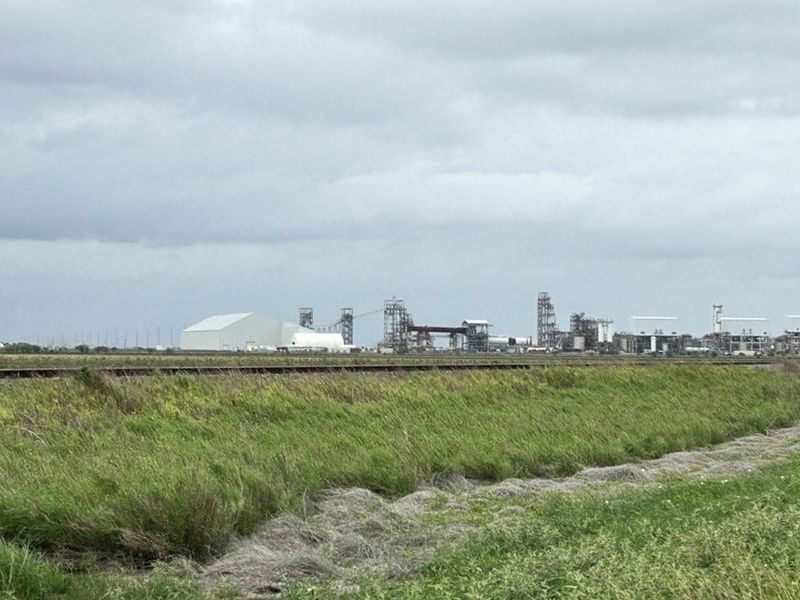
But now, a local drainage district has concerns about a new potential source of pollution — Tesla’s lithium refining plant located between Robstown and Driscoll.

Shortly after the facility became fully operational early this year, workers for Nueces County Drainage District No. 2 discovered a pipe discharging into a ditch that drains into Petronila Creek, according to the drainage district.
Tesla has Texas Commission of Environmental Quality approval to discharge wastewater from its battery-grade lithium compounds manufacturing facility into “an unnamed ditch,” according to permit documents. But the ditch is managed by Nueces County Drainage District No. 2, which says the company never notified the entity of its intent to discharge.
In February, a TCEQ investigation found no permit violations by Tesla. Tesla is required to self-monitor discharge. The facility didn’t report any exceedances of the effluent permit between April 2025 and January 2026.
But the drainage district commissioned its own third-party study and is still concerned, drainage district spokesperson Steve Ray said.
On April 15, the drainage district sent a letter to Tesla requesting the company cease and desist any further discharge until the two entities can discuss next steps.
Jason Bevan, Tesla Corpus Christi site operations senior manager, wrote in an April 17 email to the Caller-Times that Tesla was reviewing the letter and “looks forward to working cooperatively with the drainage district to address their concerns.”
Concerns about water quality
The drainage district commissioned Eurofins Environmental Testing for a water quality study. The report is based on water samples taken in April.
The facility is located near the drainage ditch, several miles from Petronila Creek.
Petronila Creek is one of three creeks that flow into Baffin Bay, a unique hypersaline environment known for its rare serpulid worm reefs and its value as a fishery.
The April 15 letter from the drainage district describes the results as “quite disturbing.” The district is concerned about how declining water quality could potentially harm humans and wildlife.
In particular, the letter points to the presence of hexavalent chromium and arsenic, as well as elevated levels of manganese, iron, phosphorus, calcium, magnesium and potassium.
“Arsenic is a well-documented environmental toxin, and it is the District’s position that any detectable arsenic in a natural drainage canal confirms contamination from an industrial source,” the letter states.
Additionally, the report also identifies lithium, strontium and vanadium, according to the letter.
These three substances “act like a chemical signature pointing back to the battery processing facility,” the letter claims.
However, previous water quality tests in the area didn’t report on potential levels of lithium, strontium and vanadium.
TCEQ’s surface water quality web reporting tool shows that samples have been collected with some regularity from the drainage ditch downstream of where Tesla is currently located since 2014. The data tool shows results from testing as recent as 2025 for chloride and sulfate, as well as examining conditions like flow and depth.
But not included are measurements for many of the results included in the drainage district report. The tool last shows chromium testing elsewhere in Petronila Creek in 2001, though the data does not specify hexavalent chromium, the form that concerned the drainage district.
Arsenic also wasn’t included in the recent water tests for the drainage ditch location, though old data from elsewhere along Petronila Creek show higher levels than the drainage district’s study found. This data, however, was more than 20 years old.
A 2024 nutrient sampling report by Coastal Bend Bays & Estuaries Program includes data from the drainage ditch location taken between September 2023 and August 2024. This report shows nutrient levels that were often higher than what was found by the drainage district’s study.
Ray spoke positively of economic development and the employment opportunities provided by Tesla but said that “what we do have to make sure of is that we protect our citizens.”
Aref Mazloum, an engineer working with the drainage district, said that if Tesla implemented a treatment process before discharging wastewater, the drainage district’s concerns would be alleviated. Ray said the drainage district is hopeful it can come to a good agreement with the company.
During the February investigation by the Texas Commission on Environmental Quality, the commission’s industrial permits team did not note any concerns when the facility sampled the discharge.
According to the investigation report, the investigator saw only clear discharge as it flowed downstream, but did observe heavy algae and vegetation growth along the banks of the ditch.
The drainage district’s study tested for more metals and nutrients than the state’s investigation.
Environmental concerns for Petronila Creek long predate the arrival of Tesla. The creek is considered impaired.
For years, the Texas Commission on Environmental Quality has imposed a total maximum daily load, which refers to the amount of a pollutant that a body of water can receive and still support its designated uses, to restore water quality. According to the project webpage, brine, a byproduct of oil production, is a source of pollution in the area. Invasive plants can also create soil imbalances, according to the webpage.
In 2022, stakeholders in the Baffin Bay watershed developed a protection plan for the San Fernando and Petronila watersheds, identifying many sources of pollution in the region.
Pollution from improperly treated wastewater, urban and agricultural runoff, illegal dumping and fecal deposition from livestock, wildlife and pets is affecting Baffin Bay, flowing from the creeks.
Tesla’s permit does not allow the “discharge of floating solids or visible foam in other than trace amounts and no discharge of visible oil.”
Tesla’s email statement to the Caller-Times references the state commission investigation which found the company in compliance with its permit.
“Tesla remains in complete compliance with all requirements of its state-issued wastewater discharge permit, including applicable water quality standards,” Bevans’ email reads. “Tesla routinely monitors and tests its permitted wastewater discharge.”
This article originally appeared on Corpus Christi Caller Times: Drainage district raises water concerns related to Tesla refinery
Reporting by Olivia Garrett, Corpus Christi Caller Times / Corpus Christi Caller Times
USA TODAY Network via Reuters Connect