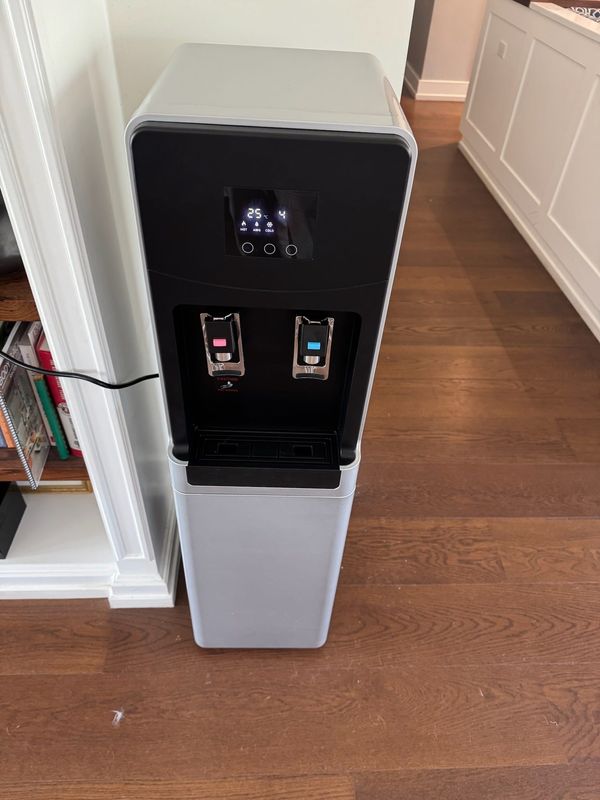
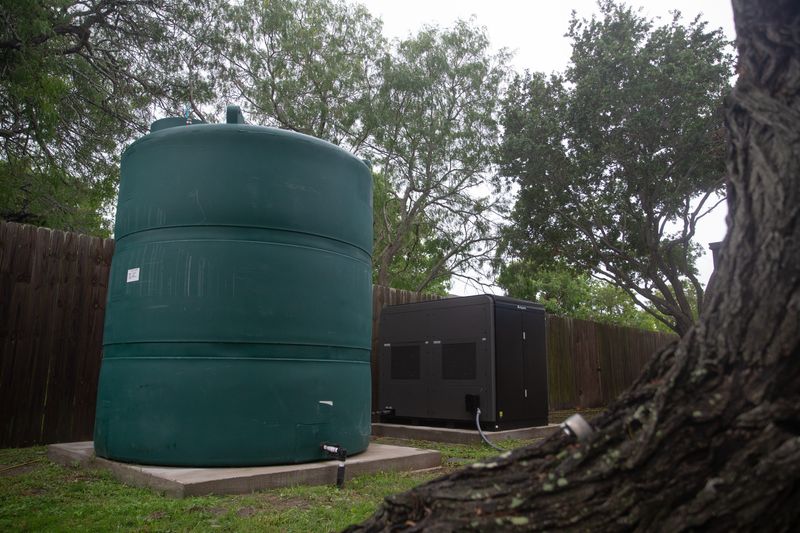
During the drought of the 1980s, a Corpus Christi man dug a well. In 2026, facing a new water crisis, his son bought an atmospheric water generator.
Longtime Corpus Christi residents are no strangers to drought.

As the community grapples with its current shortage, residents are looking at old and new ways to reduce their reliance on city water.
They’re looking below their feet, above their heads and at the air around them for water.
However, residents who are exploring auxiliary water sources should be aware of city rules and requirements.
Atmospheric water generators
David Loeb purchased an atmospheric water generator last month to supplement his family’s drinking water.
Atmospheric water generators are similar to dehumidifiers, drawing moisture from the air. Atmospheric water generators can create and store potable water. They work better in environments with high humidity.
Loeb purchased an atmospheric water generator as a birthday present for himself after his own son became concerned about the quality of the water coming out of the faucet. After testing their water, the family felt that the level of total dissolved solids was too high.
His family switched to bottled water, but this meant they needed to buy a lot at the store and were producing more plastic waste, Loeb said.
“Being able to give up the bottle is helpful,” Loeb said, referring to disposable plastic water bottles.
Additionally, Loeb envisions a mad rush on bottled water in the store if the community’s water scenario worsens, such as if water demand outpaces supply, pressure drops and authorities put out a boil water notice.
“I figured I could afford an alternative,” Loeb said.
An atmospheric water generator is likely not the most cost-conscious option. The upfront cost can run in the thousands or tens of thousands, with steeper price tags on larger units. Additionally, atmospheric water generators use electricity, though specific energy needs also vary by system.
The version Loeb chose resembles a water cooler, he said. It took about 36 hours to initially fill the tank, which is about 5 gallons. About two weeks after the purchase, Loeb said it was producing enough water for his family’s drinking water and cooking needs.
With all this in mind, Loeb believes his atmospheric water generator is more expensive than city tap water.
But for Loeb, the atmospheric water generator seemed like a better option than bottled water.
Other Corpus Christi residents have invested in larger, even costlier systems.
Brent Lanphier’s atmospheric water generator had been installed for about a month when he spoke to the Caller-Times in mid-May. He said his Aquaria system could produce up to 250 gallons per day with optimal humidity.
Lanphier is a longtime Corpus Christi resident. Back in the 1980s, Lanphier and his wife had a house on Lake Corpus Christi. During that drought, they watched the lake recede. Water that once reached six or seven feet deep ran dry, he said.
“We had a great well and then the drought came,” Lanphier said. “The water table just dropped.”
Their well ran out of water and they had to dig a second one.
This time around, Lanphier didn’t consider a well. He lives in town now and doesn’t think it would be feasible to drill on his property.
“A water well wasn’t an option for me,” he said. “If we ran out of water, I didn’t know what I was going to do.”
According to an email statement from Corpus Christi Water, current city ordinances do not allow homeowners to connect auxiliary water sources to their home if it is already connected to the city water system due to the risk of backflow.
According to city code, it is unlawful for any person to make or maintain any cross connection, which is a physical arrangement where a potable water supply is actually or potentially connected with any non-potable, used or auxiliary water system or liquid of unknown or unsafe quality.
Water wells
Decades ago, Loeb’s father drilled a well so he could water his plants. Loeb said a friend who now owns his father’s house asked him about the old well when water restrictions began.
“That’s been historical for people in that house,” Loeb said. “They ignore the well when times are good and then when we’re in the drought, they’ll start it back up when the water restrictions start.”
City residents can drill wells for irrigation use, according to the city, but these wells must be registered with the local groundwater conservation district. Well-owners should also install backflow prevention devices.
The Corpus Christi Aquifer Storage and Recovery Conservation District has the authority to permit water wells withing most of the city of Corpus Christi’s city limits.
Industrial and large agricultural wells within the district must be permitted. Residential wells using less than 25,000 gallons per day for domestic use are exempt, but must still be registered with the district.
Well registration ensures well-owners will receive the documentation necessary for city drought restriction exemptions.
According to the Corpus Christi Aquifer Storage and Recovery Conservation District, there have been 323 exempt wells registered within the district since 2022. Almost 200 of those were registered in 2025.
“CCASRD has seen an increase in non-exempt well applications,” an email sent on behalf of CCASRCD general manager Esteban Ramos states. “This reflects drought, and more people are understanding that there is a local groundwater district.”
Institutions across Corpus Christi are considering water wells. Caller-Times reporting indicates that there may be more well registrations and permit applications on the horizon.
Corpus Christi ISD is considering drilling wells at two new middle schools where the school district has been unable to irrigate to establish athletic fields and at the Cabaniss Athletic Complex. Del Mar College has talked about a water well on its Windward campus.
Well owners “must take the necessary steps to prevent well water from mixing with or flowing back into the city water supply” with an approved backflow prevention device.
“This safeguard protects the public water supply from potential contamination,” according to a Corpus Christi Water statement. More information on backflow prevention is available on the city’s website.
Catching rain and reusing household water
Atmospheric water generators generally create treated water that is safe to drink. Air conditioning units can also create water, but this water is not potable and shouldn’t be used for drinking without treatment.
But for residents focused on keeping their gardens and plants alive, normal dehumidifiers or air conditioning condensate might prove useful.
A recent native plant sale at the South Texas Botanical Gardens highlighted humidifier water, leftover tea and water from boiled eggs as reusable types of water for plants.
There’s also the age-old tactic of capturing rainwater.
The city of Corpus Christi sells 55-gallon rain barrels to customers for $47, a cheaper price than what is offered by many retailers. As of May 27, Corpus Christi Water was temporarily sold out of rain barrels.
This year, new shipments of rain barrels haven’t lasted long before selling out. As of May 27, the city has sold 1,967 rain barrels this year. That represents a sharp increase over the past several years.
The city sold just 568 in 2023, 868 in 2024 and 1,194 in 2025.
This water can be used for irrigation and car washes. The city has no restrictions on the use of rain barrel water.
The city recommends residents place rain barrels on a stable base under a downspout or in an area that receives roof runoff. To prevent mosquito breeding and to keep debris out, barrels should have a screened top.
It’s also possible to connect multiple barrels or to direct overflow to a drainage area using an overflow hose.
The city’s rain barrels are available for purchase for anyone who purchases water from Corpus Christi Water, Nueces Co. Water Control District No. 4, San Patricio Municipal Water District, South Texas Water Authority and Violet Water Corp. This includes residents of Agua Dulce, Alice, Aransas Pass, Beeville, Bishop, Corpus Christi, Driscoll, Fulton, Gregory, Ingleside, Kingsville, Mathis, Odem, Port Aransas, Portland, Riviera, Rockport and Taft.
This article originally appeared on Corpus Christi Caller Times: Corpus Christ residents get creative conserving water during drought
Reporting by Olivia Garrett, Corpus Christi Caller Times / Corpus Christi Caller Times
USA TODAY Network via Reuters Connect