Editor’s Note: Jack Becker is the editor of Caprock Chronicles and is Librarian Emeritus, Texas Tech University Libraries. He can be reached at jack.becker@ttu.edu. He is the author of today’s article and would like to give a shout out to reader Gail Faries for this story idea.
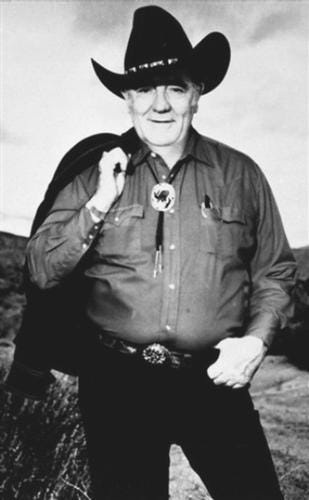
Louis LaMoore, known all his adult life as Louis L’Amour, hardly needs any introduction. Before his death in 1988 he had written 89 books and 14 short story collections.

His books were translated into over 20 languages, many of which have never gone out of print. His books have sold over 230 million copies and even 38 years after his death are still selling.
L’Amour, born March 22, 1908, in Jamestown, North Dakota, was the seventh child born to Emily Dearborn and Louis Charles LaMoore, a local politician and veterinarian.
Education and reading were important to his household and while growing up, L’Amour remembers discussions around the dinner table about books, authors, as well as other topics.
He remained a voracious reader all his life. His wide interest in reading material and extensive travels as a young man heavily influenced his later writing.
L’Amour’s idyllic life came to an abrupt end after several bank failures sent the upper mid-west’ economy into a severe recession a prelude to the Great Depression of the 1930s. So, in the winter of 1923, at 15 years of age he and his family “hit the road” traveling south in search of work.
In 1924, the family landed in Lubbock, camping near the South Plains Fairgrounds.
Near the family’s campsite lived a man named Peterson who made his living as a wolfer, trapping wolves for their pelts. Stories begin to diverge at this point, either Peterson hired another man who grew up with the Apache or Peterson himself was the one who grew up with them.
Strong for his age, sociable, and willing to do any job that came his way L’Amour began working for the wolfer, skinning the hides off dead cattle that had died during a drought on a large unnamed ranch.
L’Amour remembers between 15 to 35 dead cows were found around every windmill that dotted the large ranch.
It was filthy, messy, hard work and not for those with a weak stomach. Later in life L’Amour stated, “after I got paid, I took my pay, bought a new set of clothes, rented a cheap hotel room, and took three showers a day until my money ran out.”
But, while skinning cattle, after a day’s work, the men relaxed around a campfire and entertained themselves by telling stories.
It turned out that either Peterson or the old man he hired to work with L’Amour was, as a seven-year-old boy, kidnapped by Apache Indians sometime in the 1860s. He ended up living with Nana’s band when he soon realized that they treated him better than his abusive father.
He did everything he could to fit into his new “adopted” family and friends.
One story the old man related stuck out in L’Amour’s mind. It was the story of the old man’s first war party as a boy.
As a 12-year-old, he and the other boys his age were allowed to travel with a war party but were not allowed to participate in the fighting. They hung back to watch and learn.
The fight took place in Doubtful Canyon, New Mexico, located in Hildago County.
The Apache decided to ambush a Butterfield Overland Mail stagecoach as it passed through the canyon. The Canyon got its name because if a white man entered the canyon, it was doubtful he would return.
Anyway, the Apache picked a good place for the ambush – where the walls of the canyon closed in on the trail and waited. When the Overland Stage finally came by the Apache struck, they expected an easy victory because the Apache numbered several hundred warriors while the stage held only seven men.
The ambush did not go as planned as the occupants of the stage held out for three days and inflected heavy casualties on the Apache. Some estimates claim that over 140 Apache lost their lives in the raid.
As a young man, L’Amour had not given much thought to being a writer, he did however, love books, loved to read, and appreciated good story telling.
The story of the old man’s first raid and the other stories he told made a great impression on the young L’Amour, and several eventually made their way into his books and short stories.
But the nights L’Amour, as a boy of 16, sat around a smokey cow-chip fire listening to the old man’s stories, were the beginning of L’Amour’s slow process of becoming the most famous frontier author in America.
This article originally appeared on Lubbock Avalanche-Journal: Caprock Chronicles on West Texas’ influence on author Louis L’Amour,
Reporting by By Jack Becker, special for the Avalanche-Journal / Lubbock Avalanche-Journal
USA TODAY Network via Reuters Connect