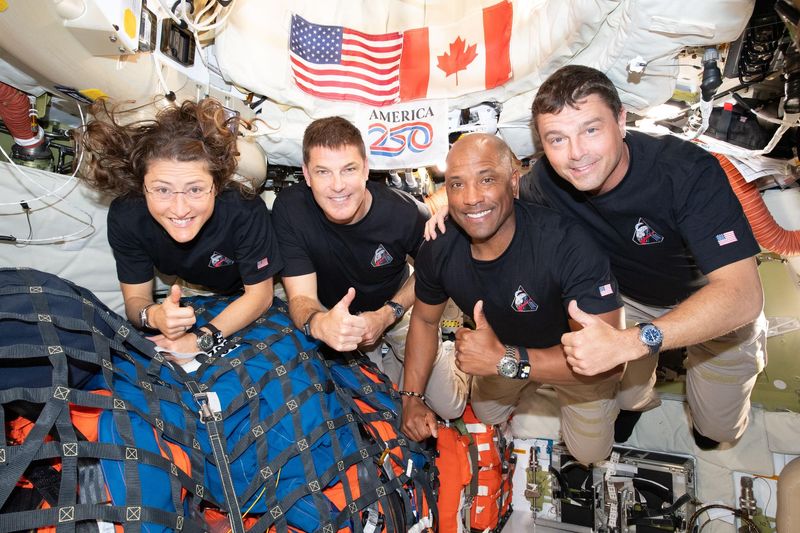
The four astronauts of Artemis II will forever be etched in the history books after becoming the first humans in more than 50 years to travel near the moon, going farther in space than any human in history.
However, the era-defining spaceflight is set to end its epic 10-day voyage on April 10, as the astronauts face a risky high-speed reentry into Earth’s atmosphere.

So, what time will Artemis II return to Earth? What does splashdown look like? And can you watch the crew’s reentry? Here’s everything you need to know.
When will Artemis II splash down?
The Orion capsule is set to reenter Earth’s atmosphere on Friday, April 10, and make a water landing around 8:07 p.m. ET in the Pacific Ocean off the coast of San Diego, California.
During their last full day in space, the Artemis II astronauts spent Thursday, April 9, working with flight control teams on Earth to review landing procedures and prepare the Orion vehicle for reentry into Earth’s atmosphere, according to NASA.
Where exactly will NASA Artemis II splashdown? See map
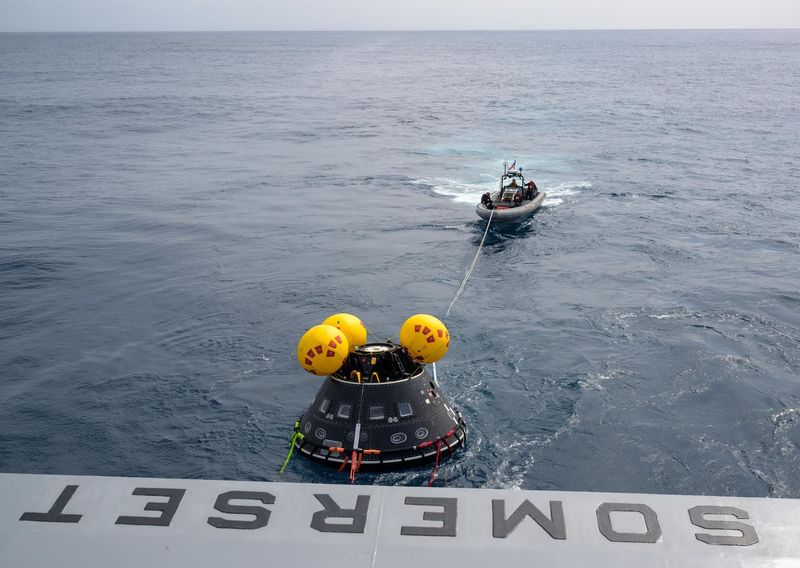
After splashdown, five orange airbags will inflate around the top of the spacecraft and flip the capsule upright. The crew will exit the craft within two hours onto a U.S. Navy recovery vessel.
Navy divers will retrieve the spacecraft by attaching devices between it and the recovery ship. Teams will bring the capsule aboard the ship and secure it for its trip to shore.
How will Orion return to Earth?
How will Orion’s reentry into Earth’s atmosphere unfold?
The astronauts are in the midst of a four-day journey back to Earth, using our planet’s gravity to naturally “slingshot,” or pull Orion back home, negating the need for propulsion or much fuel. As on the journey to the moon, Orion’s service module can fire, or burn, its engine up to three times to refine the trajectory and ensure the crew is set up for a safe splashdown.
The last of those engine firings is set to take place April 10, about five hours before the final push through Earth’s atmosphere begins. After that, the crew members would don their protective entry suits.
A component of those suits, known as the Orion Crew Survival System suit, is a garment designed to help astronauts maintain blood pressure and circulation during the transition back to Earth’s gravity. By applying lower-body compression, the garment helps counteract a common condition called orthostatic intolerance, which causes astronauts to faint or feel dizzy following an extended mission in microgravity.
Why does heat build up during reentry?
Reentry begins at what’s called Entry Interface, an altitude of about 400,000 feet. The atmosphere acts as a brake as it gets denser. The spacecraft, moving at speeds up to 25,000 mph, builds up heat by creating shock waves. Those waves compress and superheat gas in the atmosphere to temperatures of 3,000 degrees Fahrenheit or more.
Within seconds, superheated charged particles known as plasma build up around the spacecraft, causing a short communications blackout. The recovery teams wait at a holding point until GPS readings are restored and the capsule’s position is determined.
How does the Artemis heat shield work?
Reentry will naturally focus attention on the capsule’s heat shield, the largest ever built for astronauts, NASA says. It serves as a heat-protection feature, but it also provides a large drag surface to allow the capsule to brake more efficiently.
The heat shield is made of Avcoat, an ablative material that burns away bit by bit, which carries heat away from the capsule. It was used on Apollo capsules, but it’s applied differently to Artemis by using tiles or blocks that are painstakingly fitted together.
Basic steps for a safe return
To start reentry, the capsule will begin maneuvering 75 miles above the Earth for its final descent back to the surface. Here are the steps for a safe return.
Watch Artemis II splashdown live on NASA+ on Prime Video
NASA content, including some rocket launches and the Artemis II splashdown off the coast of California, is available to watch through NASA+ on desktop, both from its official site and YouTube. The platform is also available to download as a mobile app on smartphones.
Watch Artemis II splashdown on Amazon Prime Video
All NASA+ content is also available to those who have Prime Video downloaded on any of their devices – whether it be a smartphone or smart TV.
Who are the Artemis II astronauts?
The crew members of Artemis II include NASA astronauts Reid Wiseman, Christina Koch and Victor Glover, and the Canadian Space Agency’s Jeremy Hansen.
The mission makes Glover the first Black man to venture within the vicinity of the moon, while Koch will become the first woman and Hansen the first Canadian to do so.
All three Americans are experienced astronauts who have been to space before on ventures to the International Space Station, while Hansen, a veteran aviator, is making his first spaceflight.
Contributing: Stephen J. Beard, Jennifer Borresen, George Petras, Eric Lagatta and Jennifer Sangalang.
This article originally appeared on Cincinnati Enquirer: When will Artemis II splashdown? Time, location, risks of reentry
Reporting by Kaycee Sloan, Cincinnati Enquirer / Cincinnati Enquirer
USA TODAY Network via Reuters Connect