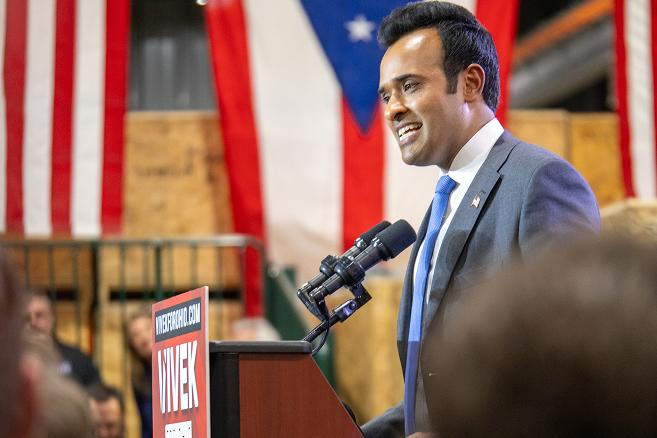
Kent State University President Todd Diacon is pushing back against a proposal from Republican gubernatorial candidate Vivek Ramaswamy to consolidate Ohio’s public universities.
In a column published on the university’s website, Diacon touted Kent State’s programs and colleges, from its pioneering liquid crystal technology research to its education of architects, commercial pilots, podiatrists and nurses.

“Ninety-nine percent of our nursing students are employed before or shortly after graduation, and the majority right here in our region,” Diacon wrote.
Diacon invited “anyone raising questions about Ohio’s public universities” to “come visit” and spend a day on the Kent State campus or at another Ohio institution.
What did Vivek Ramaswamy say about Ohio’s public university system?
Ramaswamy believes consolidation would eliminate “replicas and clones of one another throughout the state,” as he stated in a March 13 video posted to Threads, a social media site.
In a column recently published in the Columbus Dispatch, Ramaswamy said that if elected, he would have the chancellor of higher education conduct a review to see where universities’ missions are overlapping and enrollment has collapsed and where administrative functions could be unified.
Ramaswamy noted Ohio’s higher education system faces an “enrollment cliff,” with fewer college-age residents in the coming decades.
“As governor, I intend to lead a pragmatic reform that guides certain state-funded universities that suffer from under-enrollment to instead become ‘centers of excellence’ – national leaders in a specific field – with the goal of offering a higher-quality education to students at a lower cost,” Ramaswamy wrote. “Specialization creates distinction, and distinction attracts students. This will push our state-funded universities to work together, instead of in separate siloes.”
In his column, Diacon countered by saying: “The transformation of our institutions is already well underway. Come see it.”
One fact that troubles Ramaswamy is the size of Ohio’s university system: “14 public universities, 24 regional branch campuses and 22 community colleges,” his column states. Meanwhile, Florida has just 12 public universities.
Diacon, however, points out that the size of Ohio’s system dates back to Republican Gov. James Rhodes, who came to office in 1963 with the campaign promise of placing a public university within 30 miles of every Ohioan.
“The public university system in Ohio wasn’t assembled carelessly,” he said. “It was built by elected leaders responding to real public demand. “
The university president said Kent enrollment grew from about 7,000 students to 30,000 in 15 years. Kent State built 60 new buildings in the 1960s.
“This was not a waste,” Diacon wrote. “This was Ohio investing in itself.”
Diacon defends regional campus system
Diacon also defended the impact that regional campuses have on the communities that call them home.
“There is also a community argument that deserves to be made,” he wrote. “What happens to Salem without its Kent State campus? To Ashtabula, to Geauga, to Tuscarawas County and all the other communities in which Kent State maintains a vital presence? The campuses Gov. Rhodes envisioned aren’t redundancies. They are lifelines – for the students, for local employers, for the civic identities of communities that have built themselves, in part, around the presence of a university in their midst.
“To abandon our regional campuses would be to abandon our state’s small-town heartbeat.”
State support for Ohio universities declining, Kent State president says
Kent State University is facing its challenges while still conducting important research, educating key health care workers and making its mark in several programs, Diacon said.
Those challenges include less support from the state, he wrote.
Adjusted for inflation, state support for Ohio’s universities is 27% lower today than it was in 2005, he said.
“And yet total enrollment at Ohio’s public universities today is roughly the same as it was in 2005,” Diacon wrote.
State appropriations have eroded over the years, now accounting for roughly 22% of Kent State’s operating budget. In the era of Gov. Rhodes, that figure was closer to 75%, Diacon wrote.
Who’s running for governor in Ohio?
Front-runner Ramaswamy faces Casey Putsch, a northwest Ohio business owner, in the May 5 primary. Republican voters will see Heather Hill, from southeast Ohio, on the ballot, but the Ohio Secretary of State’s Office says her votes will not be counted because her running mate, Stuart Moats, withdrew from the ticket.
The Republican winner will face Democrat Amy Acton in the November election.
Reporter April Helms can be reached at ahelms@thebeaconjournal.com.
USA Today Network’s Ohio News Bureau contributed to this report.
This article originally appeared on Akron Beacon Journal: Kent State president rejects Ramaswamy’s plan to merge Ohio colleges
Reporting by April Helms, Akron Beacon Journal / Akron Beacon Journal
USA TODAY Network via Reuters Connect