‘Tis the season for caterpillar overreaction. Before we get to the protagonist of this column, a quick note on caterpillar abundance. Suffice to say, caterpillars are everywhere.
Caterpillars are the larvae of butterflies and moths, and it’s the latter group that spawns the most caterpillars, by an overwhelming margin. There are at least 3,000 moth species known from Ohio, and if all of them were known, that number would likely eclipse 4,000 species. About 140 species of butterflies have been tallied in Ohio.

Think that white-tailed deer are the largest wild animal consumers of plants in the Buckeye State? Wrong. It’s caterpillars, by a long shot. It is probable the collective biomass of caterpillars in Ohio in late summer/early fall — the peak of abundance — would outweigh the 650,000 or so deer in the state.
Most of those caterpillars are specific to a small suite of native plant species, or even a single species, genus or family. They have evolved the ability to assimilate the phytochemicals within their host plants, but are repelled by the chemical protection of other plants.
Non-native flora is generally not suitable for most caterpillars, as the larvae have a scant coevolutionary history with introduced plants. It can take a long time for a caterpillar species to evolve the ability to deal with the chemical contents of a plant new to it.
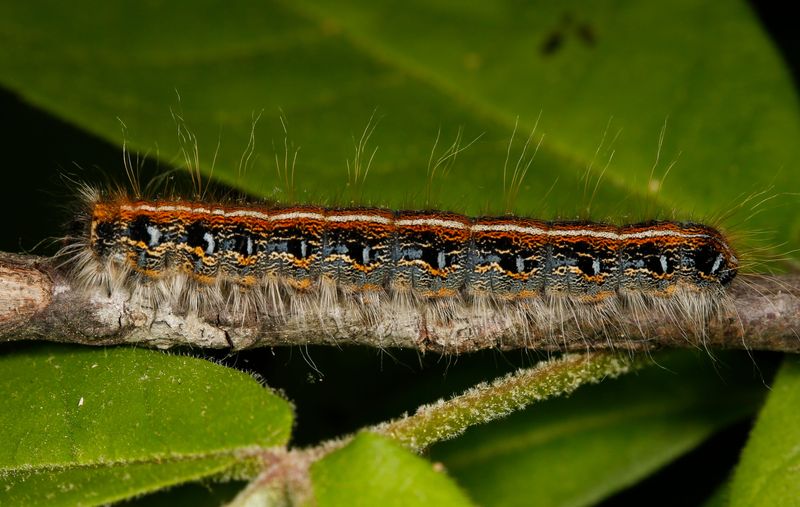
The subject of this writing is one of our most conspicuous caterpillars, the eastern tent caterpillar (Malacosoma americanum). Almost everyone has noticed them, due to the conspicuous white silken nests that begin to appear in late April and largely disappear by early June.
Eastern tent caterpillars, which are native, are specialists, and most nests are in black cherry trees, although some other members of the rose family may be used. While these caterpillars may cause local defoliation of a host tree, they do not kill the plant, and the effect of their feeding is rather short-lived.
That doesn’t stop people with tent-caterpillar phobia from employing extreme measures to vanquish them. This ranges from lopping off affected branches, employing nasty toxins to vanquish them and, in extreme (extremely dumb) cases, burning the silken nests from trees.
None of this is fair to the caterpillar, which is an important keystone species. Many other insects prey on them, including parasitic flies and wasps, many of which become food for other organisms. Caterpillars that survive to become moths are preyed on heavily by bats, and most of the dozen bat species in Ohio are in decline.
While most birds relish caterpillars, the tent caterpillars are off-limits for all but a handful of species. The thick silken tents provide effective shelter for the cats during the day, when most birds are active. Come nightfall, the caterpillars emerge to feed when most birds are idle.
Two of our most interesting birds, the black-billed and yellow-billed cuckoos, have cracked the defense systems of tent caterpillars and raid nests with impunity. The big birds rip into them and pluck the cats within.
Cuckoos can also deal with the stiff hairs that cover the caterpillars’ bodies. When a cuckoo’s stomach lining becomes a pincushion of spikelike caterpillar setae, it upchucks the lining. By then, it has grown a new stomach lining and is ready to start anew.
Baltimore orioles also plunder tent caterpillar nests. The beautiful orange and black blackbirds pluck caterpillars from the bag and deftly slice them down the middle, exposing the guts. Then the bird uses its sharp bill to slurp the cat’s innards up like a kid sucking a soda through a straw.
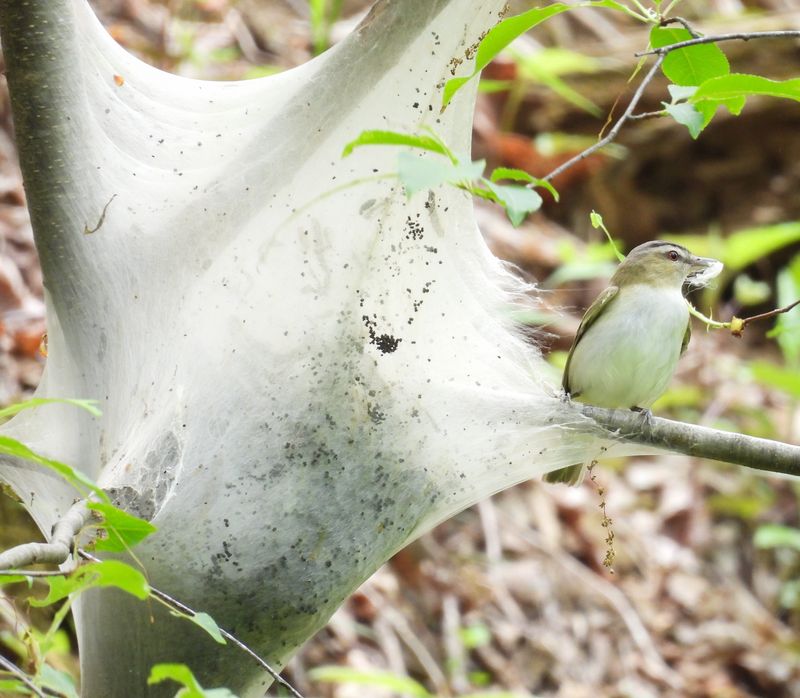
On a recent trip afield, our group saw a red-eyed vireo approaching a tent caterpillar nest. As vireos are primary caterpillar predators, I figured it was after the larvae. I watched with keen interest, as I was not aware of vireos eating tent caterpillars.
It had no interest in the cats, instead yanking large tufts of silk to use in its ornate cup-like nest. A fellow trekker, Carisa Collins, was quick with her camera and obtained the accompanying image of the nest.
Black-billed and yellow-billed cuckoos winter in the jungles of South America, as does the red-eyed vireo. Baltimore orioles winter throughout Central America, northern South America and the Caribbean.
Eastern tent caterpillars are an important part of their life cycle during the time they spend in northerly breeding, such as Ohio.
Naturalist Jim McCormac writes a column for The Dispatch on the first and third Sundays of the month. He also writes about nature at jim mccormac.blogspot.com.
This article originally appeared on The Columbus Dispatch: Nature: Eastern tent caterpillar nests can be seen throughout Ohio
Reporting by Jim McCormac / The Columbus Dispatch
USA TODAY Network via Reuters Connect