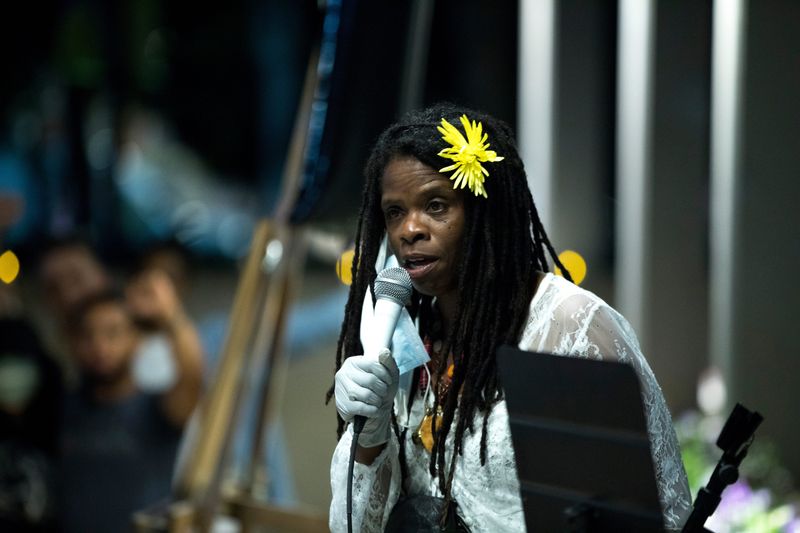
Iris Roley did not want a profile written about her.

The longtime activist said she’s endured death threats and what she sees as unfair treatment from the press and social media. Her contract with the city, worth hundreds of thousands of dollars, has increased scrutiny on Roley’s work.
“These stories that are written are not reflective of the true sacrifice that has been given,” Roley said. “You don’t talk about the amount of time I’ve put into the work.”
That’s how she declined an interview with The Enquirer for this story.
Many people approached for this story didn’t want to speak on the record about Roley. But those who talked with The Enquirer agreed: few people have impacted the city as much as Roley over the past quarter of a century.
The Enquirer looked at Roley’s influence on the city as the 25th anniversary approaches on April 7 of the fatal shooting of Timothy Thomas, an unarmed Black teenager, by a Cincinnati Police officer. Thomas’ death sparked the 2001 civil unrest and hastened a historic Collaborative Agreement between the police and city that reshaped policing in Cincinnati.
Thomas’ death and the resulting civil unrest catapulted Roley and others in the newly formed Cincinnati Black United Front into the spotlight after the organization sued the city, which led to the agreement. Roley remained at the forefront of reforming police-community relations, gaining enough respect from city leaders they contracted with her to monitor the reforms of the agreement and work to reduce violence in the city.
Roley has long been both an influential and polarizing figure. Last summer, the Fraternal Order of Police urged the city to fire her, calling her an “agitator” after police bodycam videos showed her confronting officers about how they treat residents and encouraging residents to file complaints. City Hall didn’t terminate her, with City Manager Sheryl Long calling Roley an “essential community and civic leader.”
Long and several other key officials, including the mayor and interim police chief, declined to elaborate for this story.
For the past four years, the city has paid Roley as a consultant to monitor the interaction between police and the community and help establish other social service programs aimed at the city’s youth and violence reduction. Roley works out of an office in City Hall next to the nine city council members. Instead of bearing her name, the sign near the door says simply: “Collaborative Agreement Sustainability Office.”
‘Held the city to its promise’
Roley played a central role in the agreement, said Pastor Damon Lynch III, the pastor of New Prospect Baptist Church in Roselawn. Lynch should know. He’s a prominent civil rights leader who led the effort for the Collaborative Agreement. It’s his signature on the original agreement.
While Lynch might have been an architect of the agreement, he credits Roley as the reason the Collaborative Agreement is still in effect. In the years after the it was signed, Roley helped keep pressure on the city, including as one of the leaders of a boycott that cost the city millions in revenue.
Three years after Thomas’ death, Roley questioned whether the reforms were sticking. “Why should the boycott be over?” she said in 2004. “Where is the change?”
She’s never let up, Lynch said.
“She’s been there for 25 years,” Lynch said. “She has been the main person who has held the city to its promise.”
That promise is a police department that is more transparent and accountable to the community than before, Lynch and other Black leaders said.
Roley grew up with activists
Roley grew up around activism, raised in an old Avondale synagogue called the “Black House” that was given to activists as a place to organize, Roley told the University of Cincinnati’s Freedom Center publication in 2020.
She has said her grandmother, Vivian Kinebrew, inspired her.
Kinebrew, a longtime social justice advocate herself, led protests against the city and government, as Enquirer archive stories show. For example, in 1988, Kinebrew and nine activists, including the late homeless advocate Buddy Gray, were arrested after taking over a building for three days on Reading Road. They were protesting a lack of housing for low income people and blocking the city’s plans to raze the building.
A national impact
Cincinnati’s reforms influenced policing debates nationwide, from New York’s stop‑and‑frisk lawsuit to police‑community efforts in Ferguson and Minneapolis. Roley and Lynch traveled to both cities to share Cincinnati’s model, Lynch said.
“Cincinnati really jumped out to us immediately,” Darius Charney, a civil rights lawyer who represented Black and Latino New Yorkers in a class-action lawsuit against the New York Police Department’s stop-and-frisk policy, told the Marshall Project in 2014. Charney, in the story, said the relationship between the police and community changed drastically after the agreement.
The Collaborative Agreement was important enough at the time that then-Attorney General John Ashcroft traveled to Cincinnati in April 2002 to sign the agreement with local leaders.
Other areas of the country look to Cincinnati on how police and residents can work together, Lynch said.
“We wanted to work with police and say, ‘Let’s all do better,'” Lynch said. “So that’s why our message resonates across he nation. Because people say, well, maybe this is a good way to do it.”
‘African-Americans in the city were fed up’
In 2000, Roley and her husband, Jesse Roley, were on the verge of opening an engraving shop in Bond Hill. As community discussions escalated over police conduct, Roley joined Black leaders meeting regularly at Lynch’s New Prospect Baptist Church. These conversations led to the formation of the Cincinnati Black United Front.
At the time, 14 Black people had died in encounters with Cincinnati Police over five years. Roger Owensby Jr., a 29-year-old Black man, died by asphyxiation after officers pinned him, face down, on the pavement outside a convenience store in Roselawn on Nov. 7, 2000. A day later, another Black man, Jeffrey Irons, was shot and killed by police. It became known in the community as the “2 in 24″—as in, two deaths within 24 hours.
“The spirit was to stand up,” Roley told The Enquirer in 2016. “African Americans in the city were fed up. We were fighting for the right to be respected as first-class citizens in our city, where our color would not automatically make us criminals.”
Roley, as project manager for the Black United Front, helped collect stories of 3,500 Black residents who said they were victims of police brutality and misconduct. Of those, 400 of the residents were part of the class-action lawsuit.
In March 2001, the group filed the class‑action lawsuit against the city, alleging decades of racial profiling. A month later, when Officer Stephen Roach shot and killed 19‑year‑old Timothy Thomas while chasing him down an alley, the city erupted in unrest. The riots marked the worst racial violence in Cincinnati in 30 years. Then-Mayor Charlie Luken declared a citywide curfew on April 12 after two days of unrest. It restored calm by the time the curfew was lifted four days later..
A year later, the settlement between the Cincinnati Black United Front, the American Civil Liberties Union, the police union and the city produced the Collaborative Agreement.
What is the biggest difference in the past 3 decades?
The agreement created new protocols for police conduct, including the Citizens Complaint Authority. For Bomani Tyehimba, the original plaintiff in the lawsuit, the biggest change was that residents finally had recourse.
Tyehimba, who is now an associate minister of Corinthian Baptist Church in Avondale, sued the city after he was ordered out of a car at gunpoint by Cincinnati Police.
“If you have a negative encounter with the police, you have ways to deal with that, to communicate what it was that you went through,” Tyehimba said.
From critic to contract employee
Over time, Roley’s activism made its way into City Hall in an official capacity.
In 2022, the city hired her to help gather public input on hiring a new police chief and to monitor the Collaborative Agreement’s implementation. A memo from then‑Interim City Manager John Curp called her “a long‑time city partner” whose expertise and relationships were vital.
Her contract and compensation have expanded since then. After an uptick in violence at the Government Square transit center, the city tapped Roley to lead weekly outreach to youth who gather there. She and a group of activists distribute food, clothing and transportation assistance as part of a broader intervention strategy.
Police union wanted Roley fired
Roley’s style can rub some as confrontational, which has sparked controversy over the years.
The two police body camera videos of Roley that surfaced over the summer caught the attention of Libs of TikTok and other conservative influencers and became an issue in the city’s contentious council and mayoral races.
They showed Roley approaching and questioning police officers while they are on duty. Roley questions the officers. In one, she explains she’s trying to find solutions to a parking issue, but the initially calm confrontation escalates and Roley says, “I don’t have to do anything you say.”
In another video, she steps into a situation with an uncooperative man accused of drinking in public. She tells the man if the officer is actually mistreating him then he should file a complaint.
In response, Cincinnati’s Fraternal Order of Police hosted an online petition calling for the city to terminate its contract with Roley. It garnered 3,500 signatures as of Aug. 11 but has since been taken down.
“There’s been several videos of her seen harassing officers for simply trying to do their jobs,” said FOP President Ken Kober in August after starting the petition. “That’s not collaboration. That’s just being an agitator.”
Kober did not respond to The Enquirer’s message seeking comment. Interim Police Chief Adam Hennie referred all comments to the city manager who declined to comment.
Councilman Scotty Johnson, a former Cincinnati Police officer, said the FOP’s opinion is not the opinion of all police officers. He said he’s heard officers appreciate the work Roley has done.
“They appreciate the collaborative work,” Johnson said. “It keeps them from even having to go and interact with citizens.”
Support in Black neighborhoods
In many predominantly Black neighborhoods, Roley is deeply respected.
For years, Roley has walked the streets of Over‑the‑Rhine, the West End, and other neighborhoods observing police interactions, advocating for complainants before the Citizens Complaint Authority, where residents can file grievances against officers and distributing food and resources to teens downtown.
Some residents have criticized her tactics, but many say she’s a fierce advocate for the underrepresented.
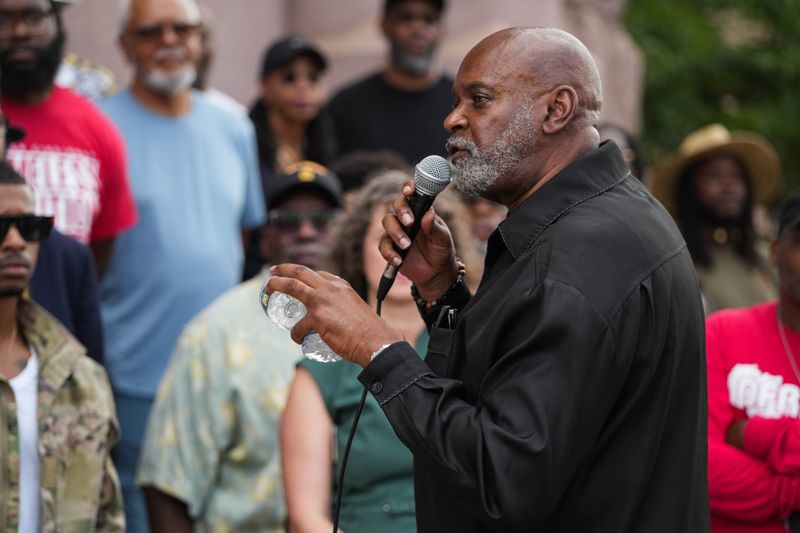
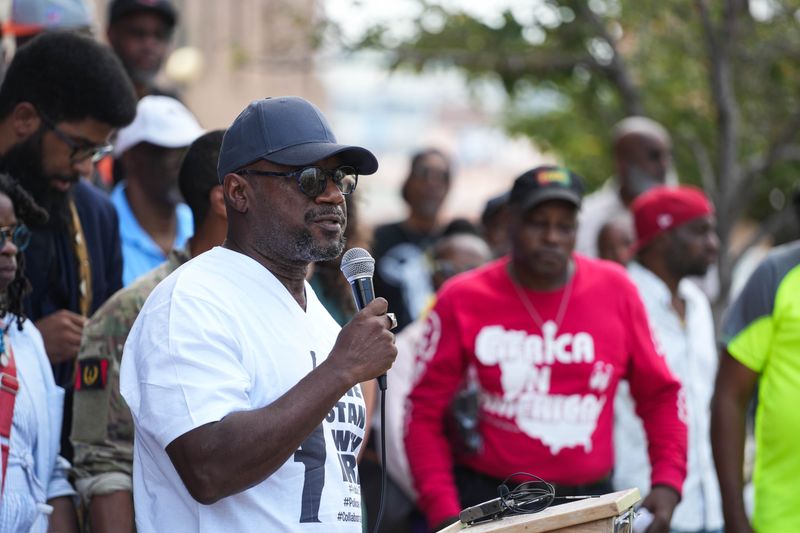
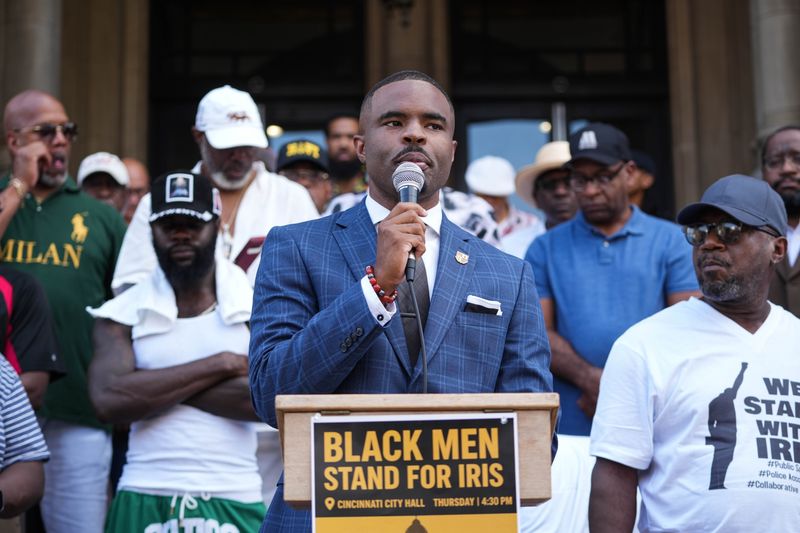
In response to the FOP’s call for her ouster, dozens of Black men stood on the steps of City Hall to show support for Roley.
Rev. Richard Hughes, a senior pastor at New Jerusalem Baptist Church in Carthage, organized the rally, called “Black Men Stand for Iris.”
“This city should thank God we’ve got Iris Roley here,” Hughes told The Enquirer. “She’s keeping a lot of kids off the street, keeping them out of the morgue, out of cemeteries.”
Galen Gordon, president of Cincinnati’s West End neighborhood, said he frequently sees Roley walking around the neighborhood and interacting with people.
“I respect her work,” Gordon said. “I would say some people do not necessarily appreciate the tactics that folks use sometimes. As a resident, I think she’s been great for underrepresented folks in our city.”
What are the taxpayers paying Roley?
According to data provided by the city to Ohio Checkbook, the city paid Roley’s firm $25,000 in 2022. The pay has steadily increased every year since, to $76,250 in 2023, $78,000 in 2024 and $329,000 in 2025. That jump appears to coincide with the firm tackling additional outreach programs, including Government Square.
In April 2025, the city and Roley signed an amended contract worth up to $570,000 and lasting through April 2027. In November, the contract was amended again to raise the pay to $664,330, according to contract details obtained by The Enquirer through an open records request
The money doesn’t all go to Roley, but also to expenses and other people she’s contracted with. She gets a $105,000 annual fee as part of the latest contract.
Among the people she’s hired for counseling work on Government Square is Rechah Showes, whom WCPO in a story identified as her son. Receipts obtained by The Enquirer show Roley submitted receipts showing Showes got paid at least $13,400 as one of four workers on the Government Square initiative between October 2024 and May 2025.
Expense reports show purchases for food, bus passes, and hundreds of dollars in T‑shirts and hoodies for volunteers. Roley in March 2025 submitted an invoice for hoodies and T-shirts for volunteers at a cost of $1,300 to BLG Accessories and Apparel, which has the same Pleasant Ridge address as Roley’s consulting company.
The receipt says, “Thank you for choosing RoSho Awards and Graphics!” RoSho is a company registered to Jesse Roley, according to the Ohio Secretary of State’s business records.
A Jan. 2025 invoice showed $500 worth of Chipotle gift cards distributed at Government Square. Roley, in a report attached to the invoice, said she received a request to feed more than 150 students with $10 Chipotle gift cards.
Contract under a microscope
The city did not put the contract out to bid, a point of concern for critics such as Todd Zinser, a former federal inspector general who runs the Citizen Watchdog blog. Zinser says the city should have solicited proposals, especially after Roley’s duties expanded to include Government Square work.
“The reason that it’s increased in value the way it has, I believe, is because they’ve added on this Government Square initiative,” Zinser said. “That should have been bid out. The core of the issue, I believe, is the fact that these are noncompetitive.”
Strong support inside City Hall
Inside City Hall, Roley remains a popular figure. On one afternoon in February, City Hall staffers, lobbyists and activists greeted Roley with smiles and hugs as she walked the corridors of City Hall. They bring her news or questions about situations they’ve heard, issues at schools, or anything they want her to follow up on.
Councilman Seth Walsh said her presence at Government Square was transformative.
“She shows up at government square, and she gets to know the kids,” Walsh said. “You can see what happens when there wasn’t an Iris there. Iris showing up has had a positive impact.”
Other council members agreed Roley has been indispensable in improving relationships between the police, city and residents.
“I think she has done great work with the city,” said Councilman Mark Jeffreys. “I think she, the city manager, has used her to help address a lot of these issues, including the government square, which I think has been very, very effective.”
What does the future hold?
With her contract running through 2027, Roley is expected to continue playing a central role in Cincinnati’s approach to police accountability. Lynch and others hope the next generation of civic leaders learns from her persistence.
“The Collaborative Agreement is not the Bible,” Lynch said. “It’s not flawless, and police and community actions and reactions don’t always follow the agreement. But we do have to keep trying.”
This article originally appeared on Cincinnati Enquirer: Iris Roley’s 25 years of change: Cincinnati’s ‘essential’ activist
Reporting by Scott Wartman, Cincinnati Enquirer / Cincinnati Enquirer
USA TODAY Network via Reuters Connect