JACKSON TWP. − The TikTok video immediately tugs on your heartstrings, an image of a bespectacled and gray-haired woman sobbing into the camera about the fate of a cat shelter.
Spliced into the social media video is footage of an elderly man working on a sewing machine. An image of cat-themed slippers expected to be handmade by the artisan pops up next. Supporting text implores TikTokers to purchase a pair of slippers to save the cat shelter.

But it’s all a scam.
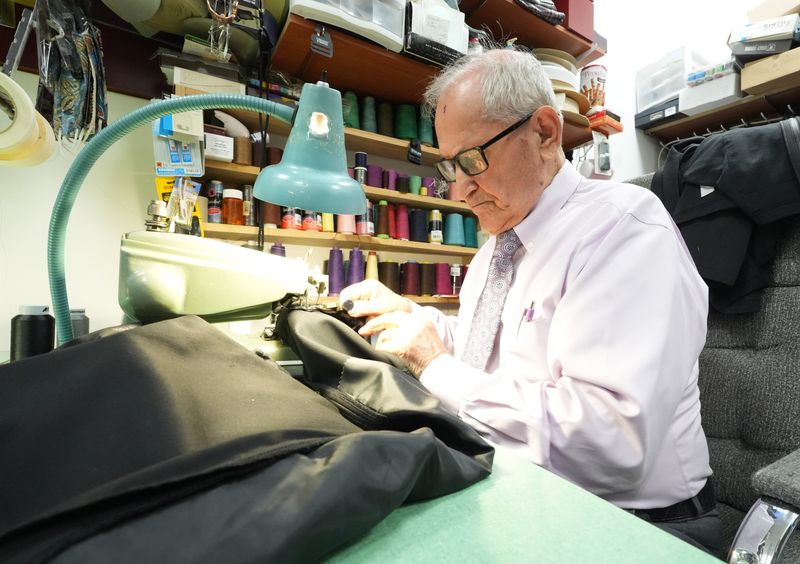
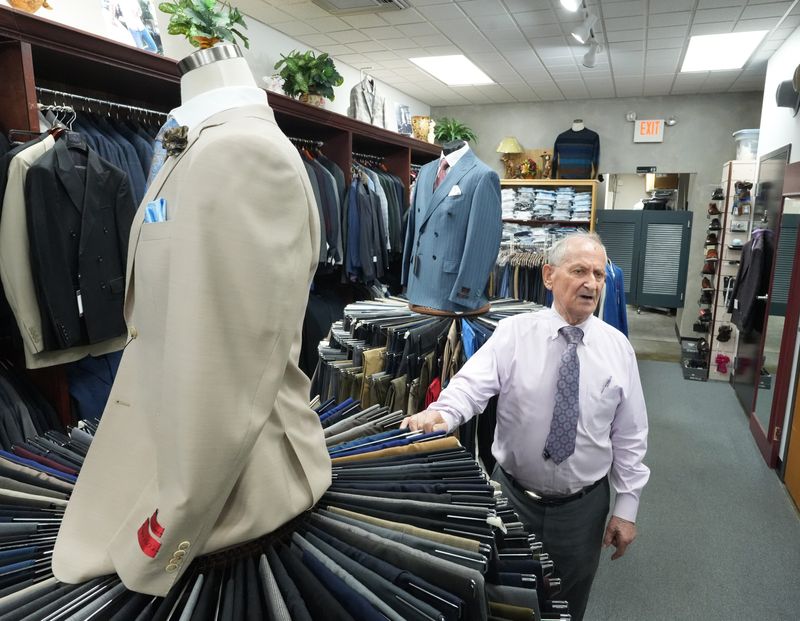
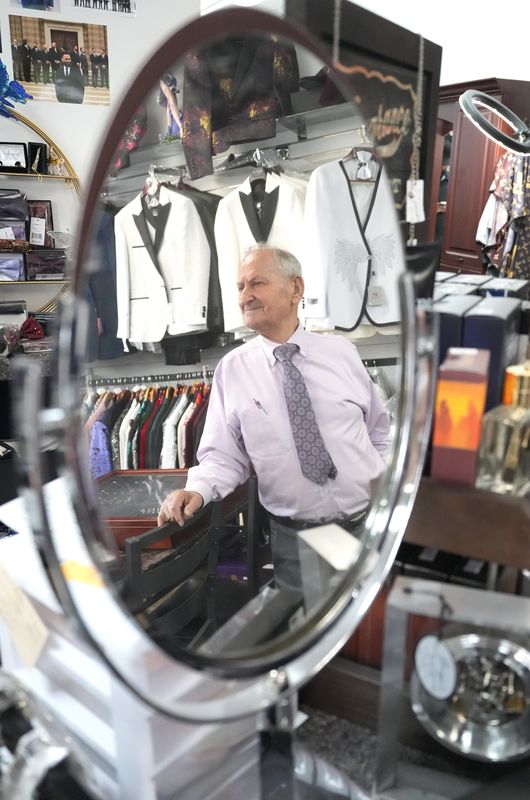
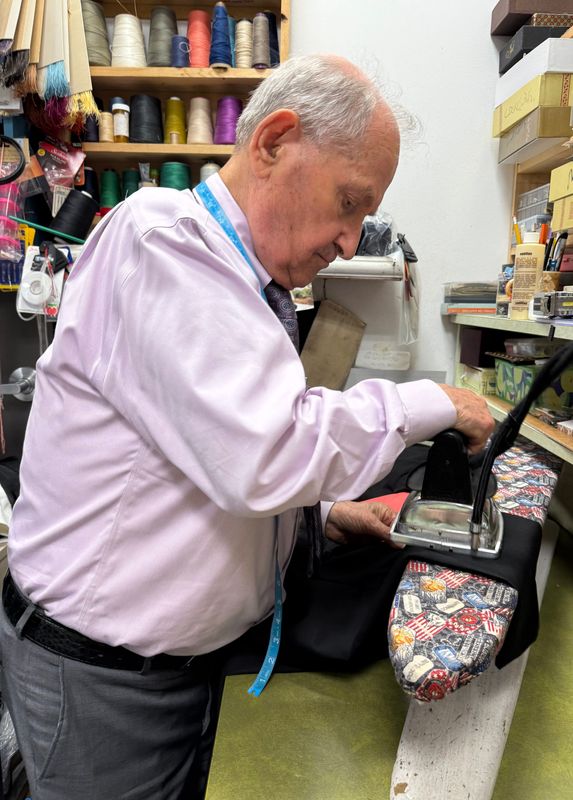
The tailor in the video is 84-year-old George Tsaftarides, who owns and runs George’s Menswear & Tailoring in Jackson Township. The tailoring clip is authentic but swiped from Tsaftarides’ TikTok account. He isn’t crafting slippers, and he isn’t asking for money to save a cat shelter.
It’s not the only time George the Tailor has been misrepresented. Another fictitious video shows Tsaftarides in his shop, claiming he’s working day and night to pay for his wife’s cancer treatments. Cued to romantic pop music, the video says he hasn’t made a sale in two months. Imagery of Jesus Christ is woven into the video, which also seeks money.
Tsaftarides is a victim in a newer type of social media con that plays on emotions and involves scam artists stealing clips from legitimate videos and images, and using them as part of their deception to trick people out of money. It’s a crime that’s difficult to identify and stop, not only because of the more than 30 million videos uploaded on TikTok daily but also because the scammers just post again under a different account when their fraudulent video is removed, legal experts say.
The ruses have left Tsaftarides and his 30-year-old daughter, Daisy Yelichek, frustrated because it’s besmirched the reputation of the decades-old business and caused other headaches while sucking the fun out of TikTok, where the master tailor has garnered 44,000 followers. Tsaftarides uploads short videos demonstrating the bygone trade of tailoring while offering tips and tutorials on sewing.
“I found out about the videos while scrolling through TikTok, and I came across one,” Yelichek recounted. “I watched it and then I saw my dad appear in the video saying he was making slippers. I instantly started looking into the profile and found more profiles just like it using the same scam.
“I also have family members from out of state sending me videos asking if I knew my dad was being used in them. Additonally, some of our TikTok followers were tagging us in the videos.”
Yelichek said this was the first time she had seen this type of online fraud.
Some TikTok users fell for the scam videos and purchased slippers and plush toys only to find out they were made in China and not by Tsaftarides, she said.
“We hate seeing people fall for it and have their money stolen,” Yelichek said.
George the Tailor: ‘Just be honest.’
First learning the trade as a 14-year-old apprentice in his homeland of Greece, Tsaftarides has worked in the tailoring business for more than 60 years. He’s bewildered by the notion of somebody stealing his video clips to falsely make money.
“How come they’re not honest?” he said with a rise in his usually calm voice. “I mean … do something to say that you can create. Don’t steal somebody else’s identity (to make money). That’s thievery, that’s stealing, and I don’t like stealing. I don’t like people stealing. Just be honest.”
The affable Tsaftarides is the TikTok talent while Yelichek creates, posts and administers the videos, including one that attracted 3 million views. George’s Menswear & Tailoring doesn’t monetize TikTok, although the exposure occasionally leads to someone stopping into the business to shop or pay for tailoring work.
“I appreciate everybody that’s found us through (TikTok) and asks questions because we love interacting,” Yelichek said.
Sadness bait: ‘New delivery system for an old con.’
Legal scholars say the scams are a souped up version of what’s been happening online for years.
“The George the Tailor situation is really just a modern twist on a very old scam,” said Jess Miers, assistant law professor at the University of Akron’s School of Law and an avid TikTok user who has watched Tsaftarides’ videos. “Using heartwarming or emotionally-charged stories to manipulate people into giving up their money. It’s the same psychological playbook I’ve seen with fake GoFundMe campaigns for terminally ill children or YouTube videos featuring real animals but with fabricated rescue narratives designed to solicit donations for shelters that don’t actually exist.
“This genre has been called ‘sadness bait,’ and it’s unfortunately common on TikTok,” added Miers, who formerly worked for Google in the trust and safety department.
Tsaftarides isn’t the only victim.
“This kind of fraud is disturbingly common across TikTok and similar services,” Miers said. “What makes George’s case distinct is how scammers are now exploiting the fast-paced, viral nature of TikTok.”
Eric C. Chaffee, law professor at Case Western Reserve University’s School of Law in Cleveland, said that combatting online fraud is fraught with obstacles.
“You can have difficulty finding … and tracking down who perpetrated the fraud,” he said. “… In addition to that, if they’re in a foreign country … getting jurisdiction over that person or bringing them to justice may be challenging.”
TikTok’s large volume of users also makes oversight and enforcement difficult.
“When one of these fraudulent videos gets pulled down, all the (perepetrator) does is create another account,” he said. “It’s sort of like playing a game of Whac-A-Mole.”
Pleading for TikTok to help
Getting TikTok to stop the scam videos has been futile, Yelichek said.
She’s spent many hours documenting the fraud and filing complaints with the social media giant, which has more than 100 million users in the United States and more than 1 billion active monthly users globally, according to The Global Statistics data collection website. Yelichek also filed a report with the Jackson Township Police Department in the spring about the online scams, claiming identity theft and wire fraud.
Jackson police Major Jim Monigold declined to comment on the case and said it’s ongoing.
Problems with TikTok scams targeting George the Tailor have slowed in recent weeks, but Yelichek also isn’t spending as much time on the platform. Measures also have been taken to combat the fraud, including blocking TikTok accounts that have wrongly used video clips of her dad. Making new videos private instead of public also helps fend off problems, but it limits their online audience.
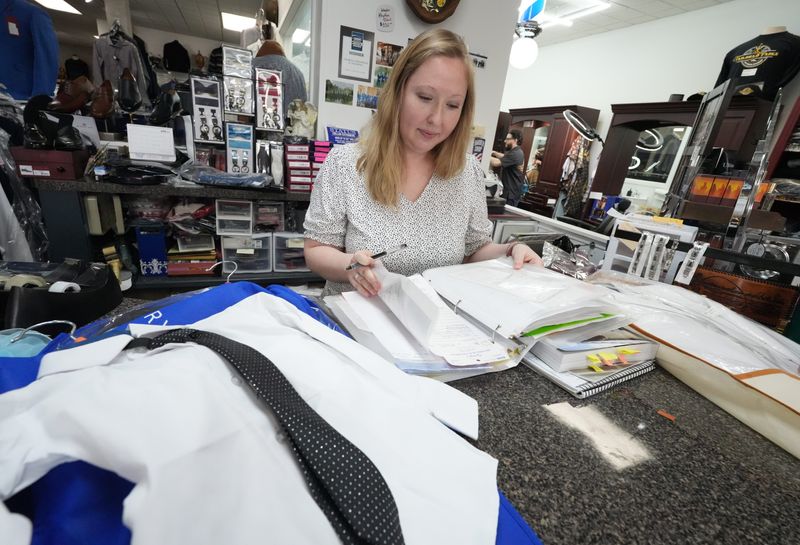
The ordeal has been exasperating and mentally taxing, said Yelichek, who helps out her dad at the menswear and tailoring shop, in addition to being the mother of young children.
“They haven’t been using (my father’s) face as much,” she said. “Now they’re using other people.”
But the damage has already been done, with George the Tailor receiving some online blowback from people not knowing he was a victim. Yelichek tried to clear the air by posting videos pointing out the fraud and disassociating her dad. However, those videos didn’t attract a lot of views or gain any traction online, she said.
She also has social media accounts for George the Tailor on Instagram and YouTube. The same scam videos posted on TikTok also have been on Instagram and other social media platforms using different profile names and different music, she said.
However, the daughter added: “Most of the scammers were on TikTok.”
“I had more luck with Instagram, as they took down the videos that I sent them and were more responsive than TikTok,” she said.
Yelichek has reached out to TikTok repeatedly to get the scam videos removed for violating community standards. But TikTok told her in the spring that a video falsely using clips of her dad to raise money for a fictitious sick wife did not violate community standards, according to documentation provided by Yelichek and reviewed by the Canton Repository.
She’s also unsuccessfully filed detailed copyright infringement reports with TikTok. Scammers “are potentially stealing thousands of dollars from people based on a lie,” she told TikTok.
A message to TikTok’s legal, copyright and intellectual property team in late April reads: “Second attempt. Urgent takedown request − Uauthorized use of (her father’s) image and misrepresentation of (his) identity.” Yelichek also demanded removal of the content under the Digital Millennium Copyright Act.
All of those efforts were for naught, Yelichek said.
Do TikTok scammers get more protection than victims?
Yelichek has even messaged the scam artists directly via TikTok — and received replies.
This was one response: “Hello, I just wanted to say that there is no hate intended in my videos. I am 17 and trying to make some money because the minimum wage here (in) Greece is $5 per hour and you have to work 9-10 hours a day to be able to afford rent. I’m not saying this so you can have empathy. I totally understand your situation but I also want you to understand mine. I don’t live somewhere rich and both my parents have to work from 7 a.m. to 6 p.m. every day to be able to afford their rent and rent for (college). I hope that we are not on bad terms.”
Yelichek responded, explaining that she and her father also work hard at their small business, and the scam videos were harming their reputation. But the scam artist kept posting the misleading video, she said.
Yelichek has compiled an extensive digital file of the scams and misrepresentation of her dad.
But she said that she feels as if the online perpetrators have more rights and protections than her.
She even provided messages from TikTok warning her that the George the Tailor account could be shut down because she violated community standards for commenting online that another account was using their videos without permission. Yelichek said she pointed out in the comments that the videos were spam, and not posted on the real George the Tailor account, while also telling people not to be duped by the scams.
Yelichek is now watermarking George the Master Tailor videos so followers and viewers can detect the misrepresenation and fraud.
What does TikTok say?
TikTok recently responded to the Canton Repository’s email request for comment regarding the misuse of Tsaftarides’ video clips. Melanie Bosselait, a TikTok spokesperson, asked the newspaper to email examples of the scam videos that falsely incorporate clips of George the Tailor, and the newspaper obliged.
A day later, in response to the newspaper’s inquiry, Bosselait said the videos had been removed, which the newspaper verified.
“When we find this type of violative content, we take it down,” the TikTok representative said.
After so much aggravation, Yelichek said she was thrilled to learn that a few of the videos had been removed, but she said other deceptive videos of her father are still posted on TikTok.
TikTok said its community guidelines “prohibit operating spam and impersonation accounts, and we do not allow content that violates someone else’s intellectual property rights.”
“We make it easy for our community to report impersonation accounts to us in our app and online,” TikTok added. “We are transparent about this information and make it readily available on our Help Center and from our app settings.”
The company noted that more than 94% of content removed for violating TikTok’s community guidelines for fake engagement in the fourth quarter of 2024 was taken down proactively.
TikTok is also updating its community guidelines on Sept. 13, which cover the gamut of online user issues, including violent and criminal behavior; hate speech and hateful behavior; harassment and bullying; sexual abuse; suicide and self-harm; dangerous activity and challenges; misinformation; unoriginal content and intellectual property rights; deceptive behavior and fake engagement; and frauds and scams.
TikTok’s very survival is still in question, however.
President Donald Trump has until Sept. 17 to finalize the sale of the short-form video platform or it could go dark again in the United States.
Under a federal law, TikTok must be sold to an approved U.S. buyer because government officials are concerned that TikTok poses a national security threat, believing that ByteDance, TikTok’s Beijing-based parent company, is sharing U.S. user data with the Chinese government, USA Today reported. TikTok has repeatedly denied these claims.
Trump has extended the sale deadline multiple times.
Combatting scammers online isn’t easy
Miers, the University of Akron law professor, said it’s fair to keep in mind that social media platforms like TikTok are flooded with complaints. Safeguards include human content moderators and algorithmic tools, but they can’t catch everything, she said.
Miers said she understands the frustration of victims like Tsaftarides and his daughter.
“It would be really sad to see legitimate businesses (like George’s Menswear) run off TikTok because of scammers,” Miers said.
Chaffee, law professor at Case Western Reserve University, said that state legislatures across the country are passing or strengthening laws aimed at online fraud and misuse.
“Ultimately, Ohio has worked to make sure they have the proper laws on the books, and they’re actually enforcing those laws (and adding new ones) to make the internet as safe as possible,” Chaffee said.
“But … usually, it’s not a matter of there not being enough laws. It’s preventing fraud before it happens.”
‘We have no control over private companies like TikTok.’
Canton police and Perry Township police both said they haven’t dealt with a case like the one involving George’s Menswear & Tailoring.
Authorities are limited on what they can do, Perry Township detective Danielle Paciorek said.
“The problem with internet/telecommunications crime is (that) law enforcement bases its jurisdiction on where the crime is committed,” Paciorek said. “In many cases involving fraud, the activity originates outside of our local area. We will investigate to possibly identify where the crime occurred and who is responsible. Once we are able to determine the appropriate jurisdiction, we rely on that agency to assume the case and pursue prosecution from that point forward.
“Unfortunately, we have no control over private companies like TikTok, so direct platform action isn’t something we can guarantee,” Paciorek said. “However, it can also be reported to the Federal Trade Commission, which is another good step in addressing the issue.”
George the Tailor might stop TikToking
The scams have eroded what used to be enoyment for Yelichek and her father. And she’s even considered shutting down the George the Tailor TikTok account, which she started during the COVID-19 pandemic.
Followers of their TikTok account have urged them not to stop the videos.
“They text us (and say), ‘We learn so much from you,'” Tsaftarides said. “We didn’t know how to sew, we have my mother’s machine, my grandma’s machine and they learned how to sew, and we show people how to do things, and we don’t do it for money. We just like to help people. They love it.”
Reach Ed at ebalint@gannett.com and follow on Instagram at ed_balint and TikTok @edwardbalint
Be on alert for social media scams
Perry Township Police Department detective Danielle Paciorek offered the following tips to the public on social media fraud:
1. Document everything
Take screenshots or screen recordings of the scam posts, messages, usernames, and any comments.
Save URLs to the fake accounts or videos.
2. Report directly to TikTok
Use TikTok’s report feature for the scam account/content.
File a trademark or impersonation complaint through TikTok’s web form for businesses.
Change your passwords and enable two-factor authentication on your real account.
3. Warn the public
Post an urgent video from your official account explaining the scam.
Ask followers to share your video to help spread the warning.
4. Notify law enforcement
Contact your local police department and provide documentation.
If the scam crosses state or national lines, authorities may refer it to the appropriate agency such as the FBI’s Internet Crime Complaint Center.
5. Report to federal agencies
File a complaint with the Federal Trade Commission.
6. Keep monitoring
Respond quickly if people comment or message you about suspicious activity.
This article originally appeared on The Repository: ‘Game of Whac-A-Mole.’ Online fraud plagues Jackson Twp. tailor and other TikTok creators
Reporting by Ed Balint, Canton Repository / The Repository
USA TODAY Network via Reuters Connect