Short North Alliance president Betsy Pandora has a stack of ideas for potential new public art installations on her desk, just waiting for someone to pick them up and fund them in the city’s most prominent and well-developed arts district. The Greater Columbus Arts Council launched a Public Art Suggestion Map, an online form where people are sharing ideas for projects all over Franklin County. A 2022 plan led by Downtown Columbus Inc., the organization helping steward the city’s urban core, platformed the community’s desire for more art there.

In Columbus, there’s no lack of enthusiasm for public art. What’s difficult is finding funding and navigating a complicated approvals process.
Connect with the Columbus you don’t know. Subscribe to Columbus Monthly’s weekly Top Reads newsletter.
In 2025, the arts council issued its first Public Art Strategy, a comprehensive set of recommendations for cultivating a thriving public arts scene. While GCAC’s document is filled with practical guidance, the feasibility of implementing the recommendations remains uncertain. Factors weighing against public art include decreasing levels of funding for the arts at the local, state and national levels and elected officials having to weigh funding public art against competing priorities such as affordable housing.
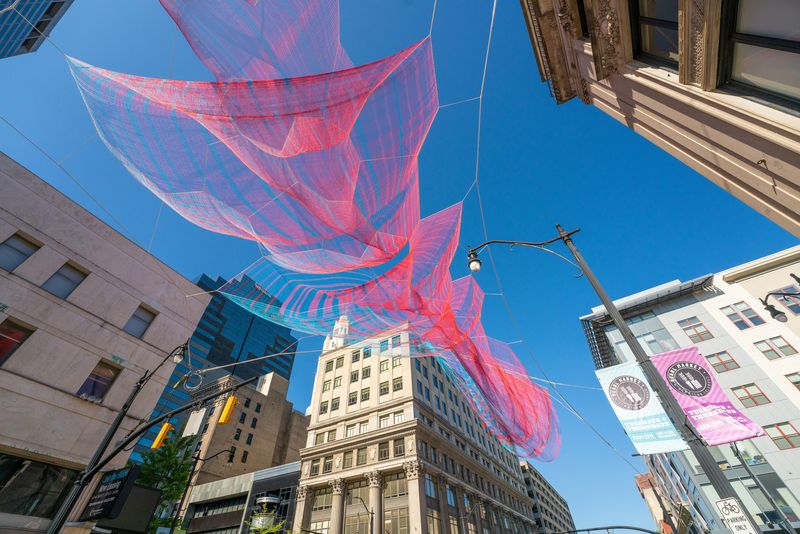
Major public art installations can take years and millions of dollars to complete, particularly if they’re large and structural, says Jami Goldstein, GCAC’s chief strategy officer. That’s true of some of the most recognizable pieces around the city—the Scioto Lounge deer along the riverfront or Current, the vibrant fiber sculpture floating above Gay and High streets. They can also take a good deal of politicking: Current, for example, required the agreement of multiple neighboring property owners.
Every public art project Pandora has been part of has had its own fingerprint in terms of funding and approval. “What creates that complexity is every single time you do it, you almost do have to start from scratch,” she says.
Roadblock: Funding
Funding tends to be the biggest barrier to new public art initiatives, especially in a political climate where funding for the arts has been slashed. One of the Public Art Strategy’s recommendations is to establish a dedicated funding stream for public art in Columbus, an outcome GCAC continues to advocate for.
Often, Goldstein says, in cities that have a dedicated funding stream, money comes from the city’s capital budget. Percent for art is one of the most common arts funding mechanisms across the country, and these policies allocate a small percentage of a city’s budget for new or renovated public buildings to the commissioning and installation of public art. “That’s way down the road for us,” Goldstein admits.
In March, a recommendation from the joint city-Franklin County Funding Review Advisory Committee suggested redirecting the funding GCAC gets from the city’s hotel bed tax to the city’s tourism organization, Experience Columbus, while enacting a cigarette tax to fund local arts. GCAC received $8.68 million, or 39 percent of its budget, from the hotel bed tax in 2025. While there has been uproar across the arts community about talk of defunding the arts, Goldstein emphasizes that the recommended changes are part of a long-term conversation. It’s a long-ish conversation—any new cigarette tax would have to be approved by voters.
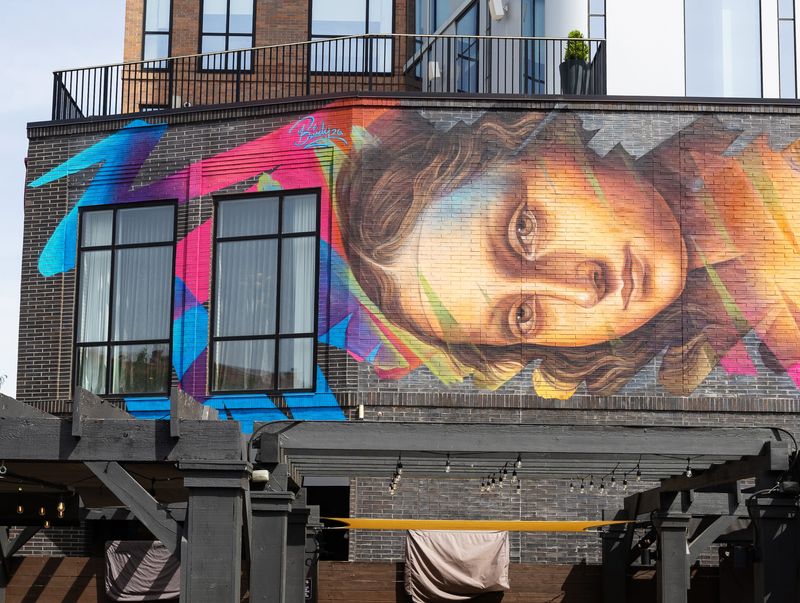
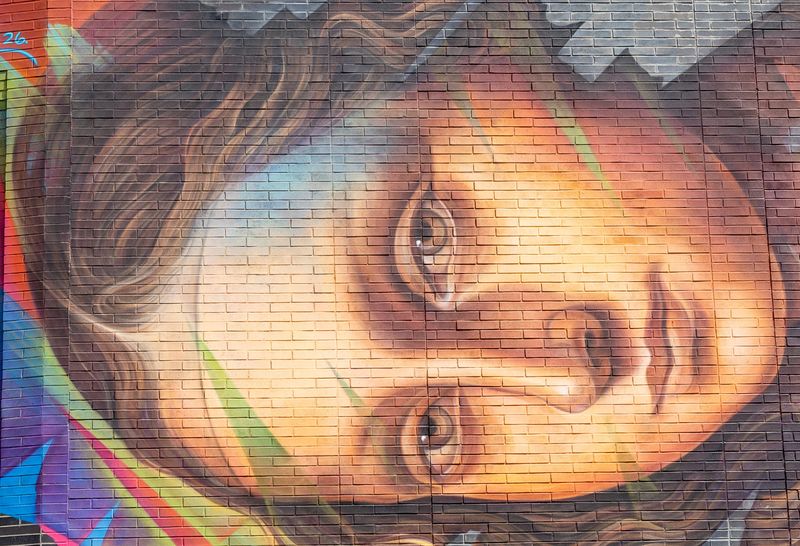
GCAC also receives funding through the city’s ticket fee, a 5 percent admissions fee on arts, cultural and sports tickets. While most of GCAC’s share is earmarked to fund arts organizations and artists, it also has a small budget for public art, including a mural assistance program for artists launched in 2023 that’s on pause this year due to funding cuts. The ticket fees also support projects such as She Moves With Color, a mural painted by artist Mandi Caskey on the second floor of the Moxy hotel in the Short North. It’s an updated version of one of the city’s most iconic pieces of public art: the Mona Lisa mural by Brian Clemons that has lived for more than three decades at Pearl Street and Cedar Alley. The new mural was created with support from the Short North Alliance.
The alliance and similar nonprofit organizations often act as a driving force for public art projects, helping to gather resources and find funding, whether that’s leading fundraising drives, seeking grant support or approaching real estate partners such as developers who want to allocate a share of their construction budget to art.
Incredible New Sculptures Coming to Downtown Columbus
In Columbus, many private developers do invest in public art, Goldstein says, often because they understand the difference art can make in creative placemaking. For some, the love of art is also personal.
For his extensive Gay and High residential and commercial projects, developer and self-described art lover Jeff Edwards of Edwards Cos. wanted an anchor, a work that would define the neighborhood’s sense of space. Janet Echelman’s Current unquestionably fulfills that role, quickly becoming a beloved icon for the neighborhood. It’s the first work of several Edwards says are destined for the Capital Line development set to transform the streetscapes along Gay Street and beyond, meant to encourage people to get out and walk and bike Downtown. Today, people gather under the sculpture in fair weather for public events and photo ops, says Nannette Maciejunes, former executive director and CEO of the Columbus Museum of Art, which manages the installation.
As part of Edwards’ Preston Park project along East Broad Street, a landscaped, elevated walkway over South 4th Street now sports a showstopping, world-class sculpture by the late French artist Jean Dubuffet. Edwards Cos. also has plans to unveil several works in the Gay and High neighborhood later this year, including a light sculpture by artist Spencer Finch on a building exterior, a 40-foot light sculpture by Austrian artist Peter Baldinger on long-term loan from the Columbus Museum of Art, and a sculpture courtyard programmed by Lindsay Gallery, Chaos Contemporary Craft and Brandt Gallery, says gallerist and consultant Michelle Brandt.
“Design matters,” says Kaufman Development founder Brett Kaufman, whose developments in Franklinton have heavily incorporated public art. “It shapes the look, the feel and the energy of a place. It’s what attracts people to neighborhoods, retail and restaurants. And when it draws people into spaces and cities, it also becomes good economic development. I’ve been pushing that idea in Columbus my entire career, and at times it’s been an uphill battle, but I strongly believe it’s true.”
He contends public and private funding both play a critical role. “I’d actually argue the city, state and nonprofits should be leaning in even more than they are today. Most bankers and builders don’t see a direct return on investment in art,” says Kaufman, who has personally funded art in many cases when he hasn’t had a level of public or institutional support that matches the impact the work can have. “I think that’s shortsighted. There is a return, it’s just not always immediate or easy to quantify.”
Public Art, Public Spaces
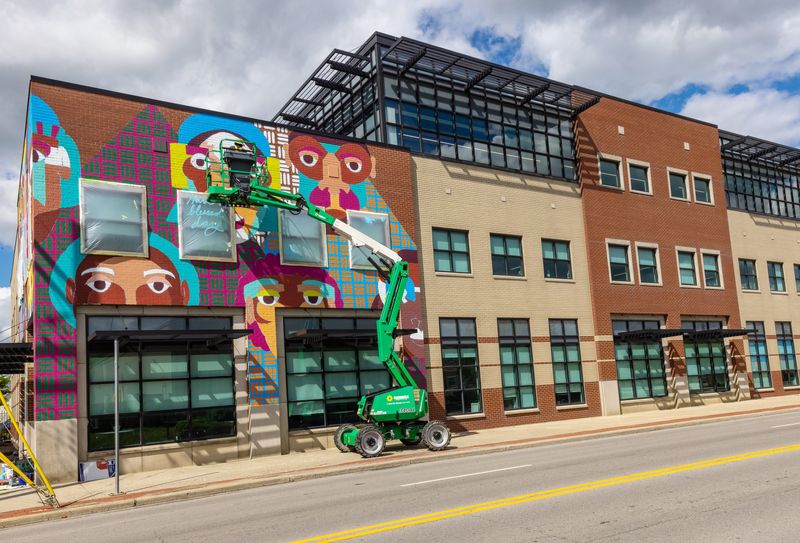
A compelling and natural home for public art is, of course, public places. For its East 11th Avenue headquarters, the Columbus Metropolitan Housing Authority sought proposals from Ohio artists for a mural embodying its organizational values of community, commitment and collaboration. The public housing provider engaged muralist Adam Hernandez to create Whenever, Wherever, We Are, which incorporates patterns and colors inspired by textiles from West Africa and Latin America. “I want people to see themselves in it and know that they have inner power and inner beauty, no matter where they may find themselves in life,” Hernandez said in his artist’s statement.
The city’s Recreation and Parks department named public art as a high priority in its 10-year master plan focused on building new parks, trails and facilities as spaces for creating and celebrating art. Acknowledging that funding is finite and priorities are many, Deputy Director of Housing Strategies Erin Prosser says the city looks forward to working with GCAC to explore options for expanding funding, staffing and support for public art. “The city will continue to balance our investments in public art with additional community priorities including affordable housing, public safety and basic city services,” she says.
The Path Less Traveled
For an upcoming installation at Goodale Park funded by private donors, the nonprofit group Friends of Goodale Park sought proposals from local and national artists for new pieces that reflect the park’s identity, complement the natural environment and engage park visitors through creative expression.
Columbus artist Dillon Beck’s ultra-pigmented sculptural tunnel Traversal was one of four pieces chosen, and it’s slated for installation later this year.
“Public art can be intimidating, because no matter what you do, someone is going to say, ‘I don’t get it, but I don’t like it,’ ” he says. “There’s always going to be that person, but you just have to silence those concerns in your head and realize that your goal is to create something unique and beautiful that stands out, but also works with the surrounding elements.”
Beck’s work is inspired by passageways—tunnels, stairs, pathways. For Traversal, he designed a series of arches that will sit on what’s known as a desire path, a makeshift walkway created over time by people veering off the established sidewalks.
“[The desire path] feels so weirdly rebellious where it’s like— ‘You’ve told me I have to walk on this path, but this one is more beautiful, and I’m going to keep walking this way,’ to the point where there’s already a little trail,” Beck says. “[Traversal is] already on a well-worn path and I’d like to think that over time, it will encourage more people to not only carve their own path through the park itself but, metaphorically, to carve their own path through the world.”
Moving Forward As Best It Can
As the Greater Columbus Arts Council works on solutions to its funding challenges, it is implementing the pieces of its Public Art Strategy that are within reach today, from streamlining its process for installing public art to helping artists and property owners navigate the process.
In April, GCAC shared its City of Columbus Public Art Planning and Flow Chart, which guides artists and interested parties through the necessary project implementation steps including what boards or commissions may have approval power over a project. The agency also is working on developing workshops and short videos to further break down the labyrinthine process of bringing public art into being.
In the education realm, GCAC is engaged in conversations with Columbus College of Art & Design to implement a public art curriculum there within the next year or so, Goldstein says.
Education for Artists
One crucial aspect of supporting public art is providing education, skills training and experience-building opportunities for local artists. It’s all about cultivating an ecosystem that educates artists at every level around the idea of creating public art, says artist Marshall Shorts, who co-founded Maroon Arts Group.
In his King Lincoln-Bronzeville neighborhood, the ARtsway summer internship program provides technical mural education for high-school-aged youths. Partnering with community groups including Maroon Arts Group, All People Arts and Franklinton Arts District, the program mentors young artists on the business of murals and provides hands-on experience in completing large-scale art. Dillon Beck, an up-and-coming artist whose ultra-pigmented sculptural tunnel Traversal is one of four new pieces of public art slated for installation this year at Goodale Park, points to local festivals such as Alley Islands, held each May at Blockfort Gallery and Studios, and 934 Fest as ideal opportunities for first time muralists to experiment and learn the form.
Following Through
Artist Adam Brouillette, a co-founder of Blockfort, says he’s become acutely aware of how many hurdles exist to making public art, from bureaucratic barricades to continual funding cuts. “What happens if we actually double down on art rather than trying to figure out ways to squeeze pennies out of it?” he says. “The [GCAC Public Art Strategy] provides us an exact roadmap of what we need to do … now we need to give it money. And until that happens, that report is just a paperweight.” Shorts agrees, saying public stakeholders need to see the plan through, build sustainability around it, and ensure it’s equitable and supports all neighborhoods—not just the city’s Downtown core. “Does the city have the political will to support this initiative beyond just the research, beyond just having the plan? That will be the real determination of the success of public art in the city, and I think that remains to be seen,” Shorts says.
This story appeared in the June 2026 issue of Columbus Monthly. Subscribe here.
This article originally appeared on Columbus Monthly: Columbus Wants to Be Known for Public Art. Here’s How It Could Do That.
Reporting by Shelley Mann, Columbus Monthly / Columbus Monthly
USA TODAY Network via Reuters Connect