Cincinnati saw its first 1,000-year storm in recorded history on July 17, according to a release from City Manager Sheryl Long.
But despite the classification as a 1,000-year storm, meaning it is statistically unlikely to happen again in the next 1,000 years, some experts are saying the label is “controversial” because these weather events may become a lot more common.

“If you’ve got an observation site that’s got 6 inches in an hour, that is well above that (1,000-year) statistical threshold,” said Aaron Wilson, Ohio’s state climatologist.
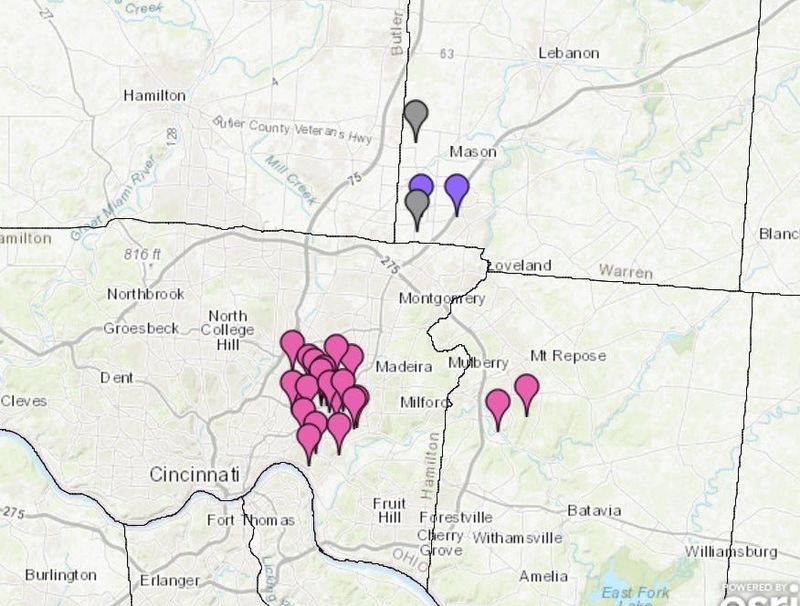
According to the National Oceanic and Atmospheric Administration, to qualify as a 1,000-year storm, Cincinnati would need to see about 3.5 inches of rainfall in an hour. But some areas of the city − including Oakley, Madisonville, Hyde Park, Pleasant Ridge and Mount Lookout − had roughly 6 inches within that time period.
Professor Patrick Ray, a civil engineer at the University of Cincinnati who has worked with the World Bank, UNESCO and other national and international organizations to solve problems related to water and infrastructure, estimates that this is a 25% larger daily precipitation total than the city has ever seen.
“It’s not a little bit bigger. It’s way bigger,” Ray said. “It’s a freakishly big precipitation event.”
For context, between 1871 to present, the largest recorded daily precipitation in the Cincinnati area was 5.2 inches on March 9, 1964, according to historical data from the National Oceanic and Atmospheric Administration.
Until this year, July 17, where that amount of rain accrued within an hour.
Ray and Wilson said the culprit for this “freakshow event” is climate change.
“If climate change is changing your statistics, then the whole notion of periodicity − that it would cycle back on itself, that you’d have some sort of rhythm to how storms happen − that notion is kind of out the window,” Ray said.
Summer heat continues to feed Earth’s water cycle
The science behind storm events like the one Cincinnati saw on July 17 goes back to fundamental rules of thermodynamics, Ray said.
Summer thunderstorms are “dominated by chaos,” he said, making them hard to forecast.
In the summer, there is more heating on the Earth’s surface, causing more water evaporation from the oceans. That water is then pushed up into the atmosphere.
As moisture rises, the air closer to the surface becomes a low-pressure system. But pressure levels vary widely across the planet’s surface, and those differing pressure levels often collide, causing higher wind speeds, according to the National Oceanic and Atmospheric Administration.
Meanwhile, the moisture rising into the atmosphere cools and condenses into clouds, and tiny water droplets build up into heavier ones.
But rather than falling quickly and continuing to move over land, some storms stay put in one area, slowly growing capacity.
“As long as that moisture is available to be fed into that storm system, that storm is going to continue to evolve,” Wilson said.
And then, the rain falls, heavily and more frequently, quickly building up into flooding.
Cincinnati’s urban landscape makes it hotter in the area, and with more heat comes more moisture being pushed up into the atmosphere. This makes the water cycle move faster.
As the planet heats, severe storm events become more common
But as the global temperatures rise due to climate change, these once-in-a-lifetime storms are already becoming the new norm.
“This is not a future problem,” Ray said. “We already deal with much more intense precipitation on a regular basis than our fathers and grandfathers had to, than our mothers and grandmothers had to.”
Increasing temperatures over land and the oceans changes how much moisture evaporates into the atmosphere, leading to a greater potential for heavy rainfall that increases in frequency and intensity.
Essentially, Cincinnati may not need to wait another 1,000 years to experience a storm like the one on July 17, Wilson said.
“I don’t know that we’re afraid enough.”
This article originally appeared on Cincinnati Enquirer: Cincinnati saw a 1,000-year storm. Why more may not be far off
Reporting by Esther Launstein, Cincinnati Enquirer / Cincinnati Enquirer
USA TODAY Network via Reuters Connect
By Esther Launstein, Cincinnati Enquirer | USA TODAY Network