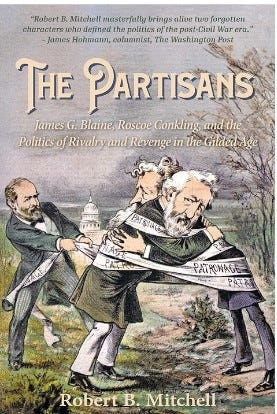
Award-winning author, historian, career journalist Robert B. Mitchell serendipitously visits the historic Roscoe Conkling House at 3 Rutger Park for a conversation about his new book, The Partisans: James G. Blaine, Roscoe Conkling, and the Politics of Rivalry and Revenge in the Gilded Age.
The visit takes place on on June 6 at 12 noon, with a $5 donation appreciated at the door.

Mitchell will treat attendants to dramatic reading of some passages from the book, a talk about what inspired the historian to tell the story and its relevance to American history, and the autographing of copies available for sale.
The Partisans: James G. Blaine, Roscoe Conkling, and the Politics of Rivalry and Revenge in the Gilded Age
The Partisans, according to The Authors Guild, treats the post-civil war political era, marked by the evolving industrial revolution, resulting in remarkable prosperity and America’s storied gilded age.
The tome tells the true story of the “bitter feud” between James G. Blaine, the then Republican Congressman from Maine who once served as Speaker of the House, and Roscoe Conkling of New York, a lawyer and savvy politician who served in both the U.S. Congress and Senate, representing the State of New York, while declined appointment to the U.S. Supreme Court twice. The battles between the two Northeastern leaders “dominated American politics” of the time.
Conkling also appeared as the antagonist in the recent historical Netflix drama series, Death by Lightning, which premiered in Nov. 2025 and focuses on the Blaine-Conkling feud, its influence on the Ulysses S. Grant presidency and role in the assassination of President James A. Garfield.
“The Partisans recounts the two-decade feud between two of the most significant politicians of the post-Civil War era,” said Mitchell. “It began in 1866, when an exasperated Blaine mocked Conkling’s “grandiloquent swell” and “overpowering turkey-gobbler strut” on the floor of the House. Conkling never forgave Blaine for the memorable insults.” The author recounts that, over the next two decades, the legislators faced off on Capitol Hill, at political conventions, and :in the behind-the-scenes struggle for power and influence in the administration of President James A. Garfield that ended after Charles Guiteau fatally shot Garfield in July 1881.”
Three years after the Garfield assassination, Conkling served as spectator to Blaine’s win of the Republican presidential nomination, then narrow loss of the White House to Grover Cleveland, who won the election by approximately 1,000 votes.
Mitchell’s telling aspires “to humanizes a House Speaker and senator whose careers became intertwined for decades and whose enmity for one another probably kept both out of the White House,” according to Washington Post columnist James Hohmann. to humanize the House Speaker and Senator whose malevolence and play for power cast them culprit in the scandals of the time.
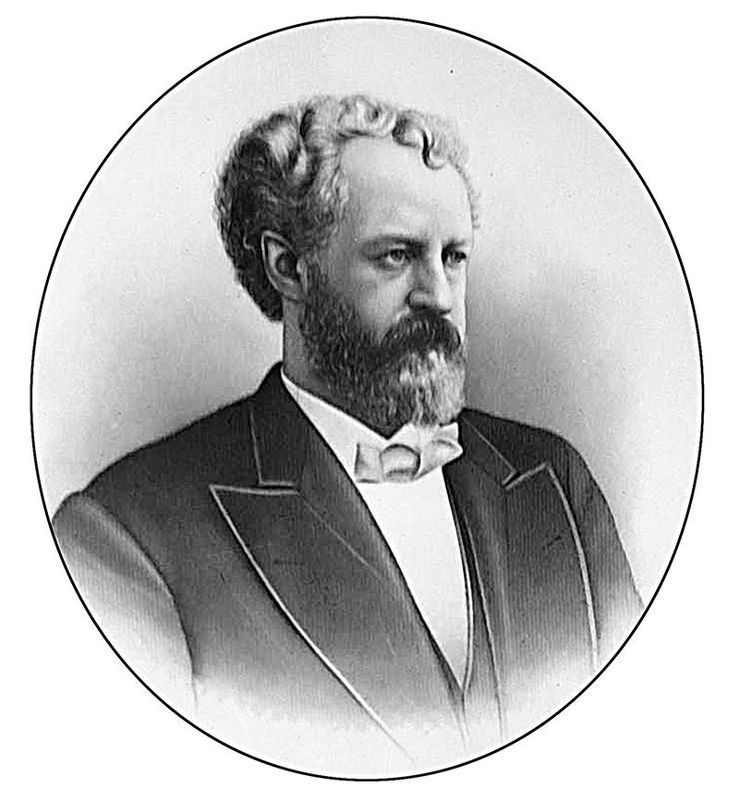
Roscoe Conkling
Conkling settled in Utica, at the age of 17 to study law. He married Julia Catherine Seymour Conkling, where the Seymours were a politically distinguished family in the prosperous canal-front city; her brother Horatio Seymour served as Governor of New York.
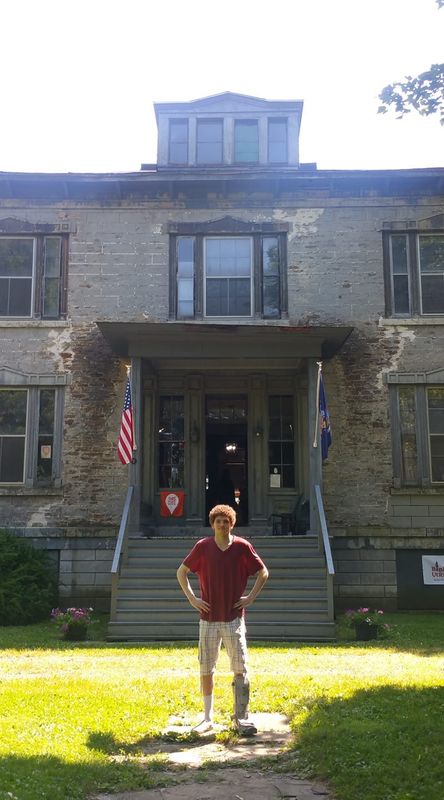
The Conkling House (also known as the Miller/Conkling/Kernan House), is one of a remarkable row of mansions high on a Utica hilltop looking out over the Mohawk River Valley, collectively part of the Rutger Park Historic District.
It is located at 3 Rutger Park and has been owned and maintained by the Landmarks Society of Greater Utica since 2008, where it serves as the organization’s headquarters and event space. Conkling purchased the home, built in the Greek Revival style with touched of Federalist architecture, in 1868 and resided there for over 20 years until his death in 1888.
Julia Conkling was a founder of the Oneida Chapter of the Daughters of the American Revolution, serving as the first regent of the chapter and hosting meetings at her home. Ownership of the Rutger Park mansion passed to the Conklings only child, daughter Elizabeth, who later sold it to Nicholas Kernan, U.S. Congressman and founder of Mohawk Valley Cotton Mills.
The Conkling House was added to the National Register of Historic Places in 1975.
About the award-winning author
Robert G. Mitchell describes his work to say “journalism was my career; history is my passion.” After graduating from Grinnell College with degrees in history and political science, Mitchell embarked on a 25-year newspaper career, covering the U.S. Congress, the 1988 Democratic National Convention, and Operation Desert Shield in Saudi Arabia for the Washington Bureau of Thomson Newspapers before joining the Washington Post-Los Angeles Times News Service, where he was a frequent contributor to the “Retropolis History” blog, as well as the “Civil War 150” section.
Mitchell’s debut book, Skirmisher: The Life, Times, and Political Career of James B. Weaver, dropped in 2008 and earned the author the Benjamin F. Shambaugh Award from the State Historical Society of Iowa in 2009. 10 years later, he followed with Congress and the King of Frauds: Corruption and the Credit Mobilier Scandal at the Dawn of the Gilded Age in Nov., 2017.
All three reads by the historical author delve into debauchery of America’s gilded age and are published by Edinborough Press. They can be purchased from Amazon.com or from your local bookstore.
This article originally appeared on Observer-Dispatch: The Partisans author does talk, book signing at Conkling House, June 6
Reporting by Cara Dolan Berry, Utica Observer Dispatch / Observer-Dispatch
USA TODAY Network via Reuters Connect

By Cara Dolan Berry, Utica Observer Dispatch | USA TODAY Network