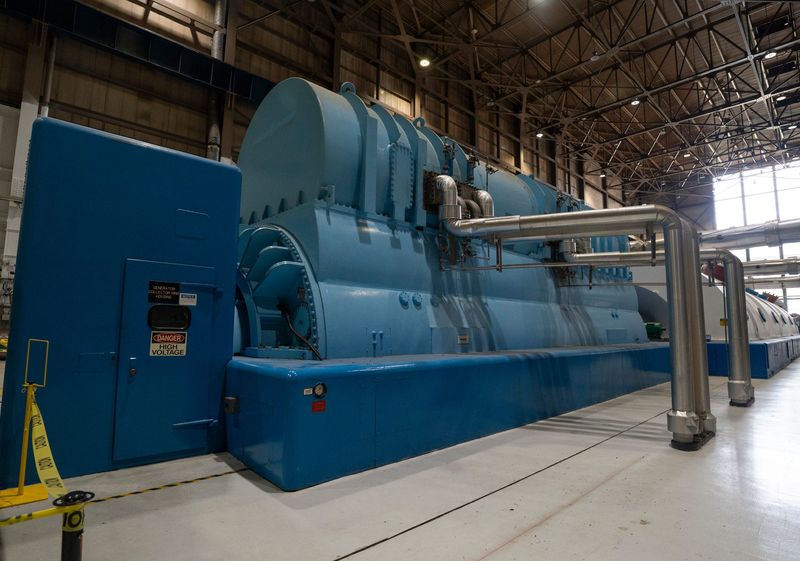
The last time a nuclear reactor was built in New York was 1975 when the state was faced with surging demands for electricity. The 842-megawatt James A. FitzPatrick Clean Energy Center in Oswego County is still chugging along, churning out enough electricity for 600,000 homes.
Same with its Lake Ontario neighbor, Nine Mile Point 1, which opened in 1969 and holds the distinction as the oldest operating reactor in the U.S.

But a decade ago, FitzPatrick and its sister reactors upstate were facing extinction, struggling to compete with the cheap cost of natural gas. Its owners pegged their annual losses at $60 million. The upstate plants, like much of the nuclear industry in the U.S., were facing a slow death.
They were saved by billions of dollars in ratepayer-backed funding in a bailout engineered by former Gov. Andrew Cuomo, who viewed the upstate reactors as a “bridge” to a future when renewables like wind and solar power would provide most of the state’s energy needs.
Now, in a development as unlikely as a New York Knicks championship and one that took nearly as long to realize, nuclear power is making a comeback.
Electricity demands are surging. Homes, vehicles, phones, heating systems. By one measure, annual electricity demand will increase 24% by 2040.
And for many reasons, solar and wind power that were supposed to sideline fossil fuels and the pollution they produce have struggled to fill the gap. The downstate region, which includes the Lower Hudson Valley and New York City, is more reliant on fossil fuels now than it was before the Indian Point nuclear power plant shut down in 2021.
A report issued by the New York State Energy Research and Development Authority recently takes a deeper look at these developments and reflects on the evolving role nuclear power played then and now.
“The electricity needs these plants were built to meet are starkly different from those of the State they power today,” the report notes. “They also offer what was, at the time of their construction, an under-appreciated asset: nuclear power produces no direct greenhouse gas emissions or co-pollutants during operation, and its lifecycle emissions are among the lowest of any generation technology.”
Hochul’s vision for a nuclear New York
To close a widening energy gap, Gov. Kathy Hochul wants to build 5 gigawatts of nuclear power in the coming years, enough to power 4.5 million homes. That would more than double the current nuclear output of 3.4 gigawatts generated at FitzPatrick, Nine Mile Points 1 and 2 and R.E. Ginna east of Rochester.
It will include a new 4 gigawatts in addition to the 1 gigawatt Hochul has asked the New York Power Authority to build upstate.
But challenges remain.
Cost heads the list. The last nuclear reactor built in the U.S. was at the Alvin W. Vogtle Electric Generating Plant in Georgia, a project beset by cost overruns. Opposition groups point to the cement and steel casks of waste nuclear generation creates. And then there are the fears of a nuclear mishap on the order of Fukushima in Japan or Chernobyl in Ukraine.
The debate will be joined in the months ahead.
The Advanced Nuclear Policy Options Paper issued on June 15 is an attempt to frame the discussion, wading into the choices the state will need to make to deliver on Hochul’s 5-gigawatt vision. It’s the beginnings of a roadmap, highlighting the bumps and potholes to avoid so taxpayers don’t end up on the hook for costly mistakes.
The public has until Aug. 19 to weigh in with its own comments here, at the dps.ny.gov website. By the end of the year, NYSERDA will issue a full report.
“Across the U.S., there is a need for clear analysis and thorough examination of the options on how best to pursue advanced nuclear power generation, and this Options Paper provides both – offering a robust basis for public discussion on responsible deployment of reliable, zero-emission advanced nuclear technologies that will inform New York’s next steps toward building a Nuclear Backbone,” NYSERDA Pre president and CEO Doreen Harris notes.Here are five takeaways from a report that runs over 200 pages.
It’s not going to be cheap
If built on a new or greenfield site, the public cost for developing 5 gigawatts could range between $15.4 billion to $23.9 billion over the first 25 years of operations.
But, the report notes, using an existing site with connections to the grid, would run around 20% less. That could mean more neighbors for FitzPatrick and Nine Mile Point on Lake Ontario.
More traditional light water reactors, already widely throughout the U.S., could prove cheaper and could be developed quicker. Small modular reactors yet to become commercially available could prove more expensive per unit until they prove themselves. The report suggests a “wait and see” approach to determine whether a design capable of producing at a lower cost emerges.
Or the state could use a combination of both.
“There are a number of trade-offs between selecting a first-of-a-kind (FOAK) or more mature technology, but for New York State’s first project a more mature technology likely makes most sense,” the report notes.
What are the financial benefits?
By 2050, the annual benefits from the new generation could be between $2.89 billion and $3.94 billion.
“Annual benefits of this order of magnitude could be expected to continue, not just for the initial 40-year life of the nuclear plants but likely well beyond, given the expectation of much longer total project lifetimes including license extensions,” the report adds.
If the state’s current nuclear fleet sticks around through 2050, they would contribute $38 billion to the state’s economy, support 14,000 jobs and $10 billion in tax revenues, a 2025 report by The Brattle Group found.
Any other benefits?
Health and air quality would improve, primarily by reducing reliance on fossil fuels. Nuclear power currently provides 20% of the state’s electricity and 40% of emission-free or clean generation.
It’s estimated that the state’s four reactors spared New York 16.4 million tons of carbon dioxide in 2024. That’s about 20% of emissions produced by cars and other modes of transportation.
And nuclear power plants use a fraction of the land used by solar panels, an issue in upstate New York where towns have come out against solar farms that have eliminated thousands of acres of farmland. Nuclear generation uses around 1% of the land solar panels need to generate the same amount of electricity, the report notes.
“It can also be sited on existing or brownfield sites, resulting in significant land use savings when compared to the build out of new large-scale renewables,” the report notes.
Could Google, Amazon kick in for New York nuclear buildout?
State and federal tax dollars would supplement private investment.
The idea is to eliminate risks for private investors as well as the state.
“As regards cost overrun risk, projects should reduce risk by applying best practice lessons learned from previous projects, such as the development of Vogtle Units 3 and 4 in Georgia,” the report notes.
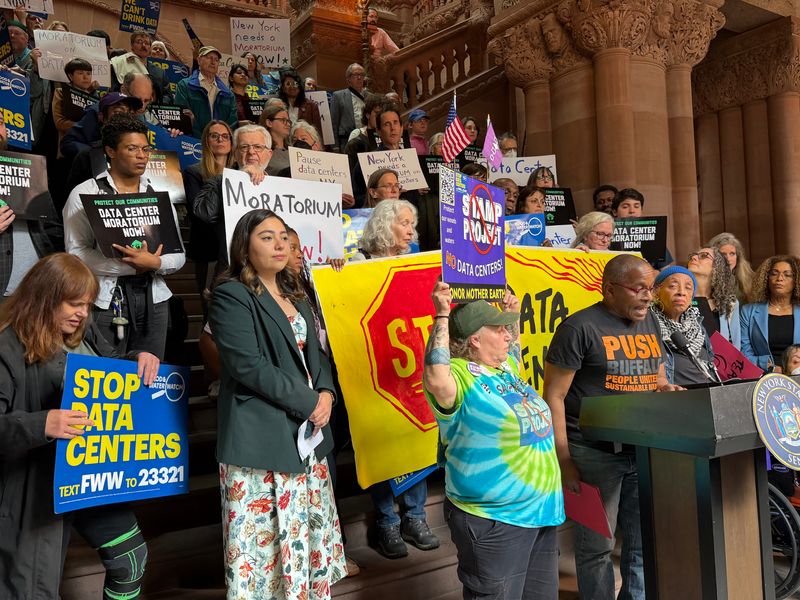
To keep costs down, the report suggests the possibility of buy in from digital service providers — Google, Amazon, Meta for instance — that require large amounts of electricity to run their data centers.
“Some types of large electricity load customers, in particular hyperscalers, could be attractive as offtakers for new nuclear projects due to their willingness, in many cases, to pay premium prices,” the report notes.
Their contribution could reduce state and federal dollars dedicated to the project but would reduce the amount of power available to other customers.
What’s not in the report?
There is no discussion of the waste that nuclear power generates or the costs of storing it at nuclear power plants across the country.
The U.S. Department of Energy shells out billions of dollars annually to the owners for breaking its promise to create an underground repository where spent fuel rods could be stored for eternity. Indian Point alone is home to 127 cement and steel canisters loaded with spent fuel.
Future NYSERDA studies are expected to dive in on the issue.
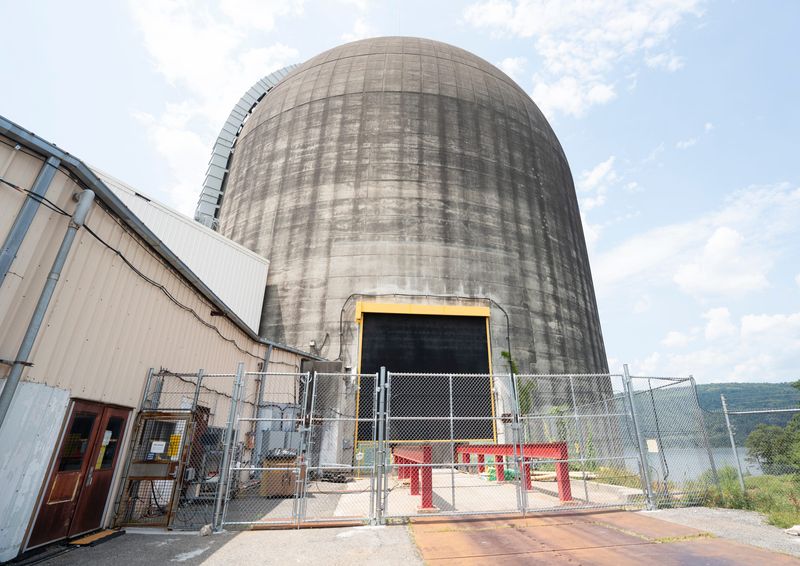
And, speaking of Indian Point. The main report mentions the Buchanan plant just once, mentioning how its shutdown increased fossil fuel use and increased polluting emissions.
Hochul has said she opposes a restart or reopening of a plant that’s in the lates stages of demolition, a position that aligns with fellow downstate Democrats.
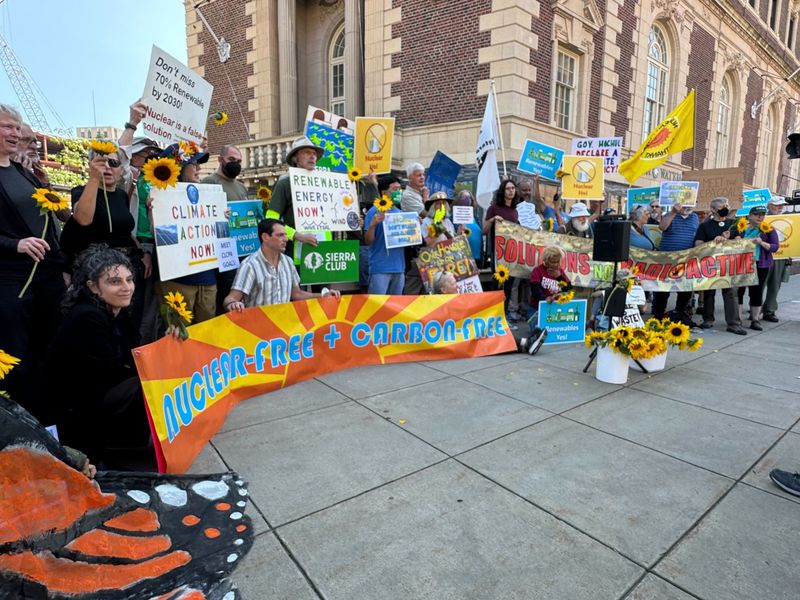
Nuclear advocates think that’s shortsighted.
Dietmar Detering of Nuclear New York said the paper makes a compelling case for the cost savings of building at existing sites. Connections to the grid already exist on property zoned for industrial use. And there will be a trained workforce in place.
Nuclear power generated around the clock would alleviate some of the tight reliability margins during periods of high demand, Detering notes.
“The question is not necessarily whether Indian Point is part of the conversation today,” Detering said. “The question is whether New Yorkers will eventually want to have that conversation. If so, now is the time for communities, local leaders, and residents to begin exploring the opportunity and asking questions.”
Thomas C. Zambito covers energy, transportation and economic growth for the USA TODAY Network’s New York State team. He’s won dozens of state and national writing awards from the Associated Press, Investigative Reporters and Editors, the Deadline Club and others during a decades-long career that’s included stops at the New York Daily News, The Star-Ledger of Newark and The Record of Hackensack. He can be reached at tzambito@lohud.com
This article originally appeared on Rockland/Westchester Journal News: Report reveals key clues about NY’s nuclear future. Exclusive analysis
Reporting by Thomas C. Zambito, New York State Team / Rockland/Westchester Journal News
USA TODAY Network via Reuters Connect
By Thomas C. Zambito, New York State Team | USA TODAY Network