When America called, Iowa was ready.
That summons came 165 years ago, days after a member of a Confederate shore battery in South Carolina, the first state to secede from the Union, lit the fuse that launched a shell toward Fort Sumter.

As the ordnance exploded over the federal installation in Charleston Harbor on April 12, 1861, the Civil War began.
Within days, President Abraham Lincoln called on states loyal to the Union to send troops to bolster a standing army of only 16,000 and put down the South’s growing rebellion.
Iowa was new, sparsely populated and beset with an economic downturn. Yet on May 14, the 1st Iowa Infantry Regiment mustered at Keokuk and made its way to Confederate-sympathizing southern Missouri. There its roughly 800 soldiers joined a vastly outnumbered Union force, totaling about 5,000, in the Battle of Wilson’s Creek on Aug. 10.
That was one of the first engagements in the war’s western theater, one where citizens of Iowa would serve with outsized valor.
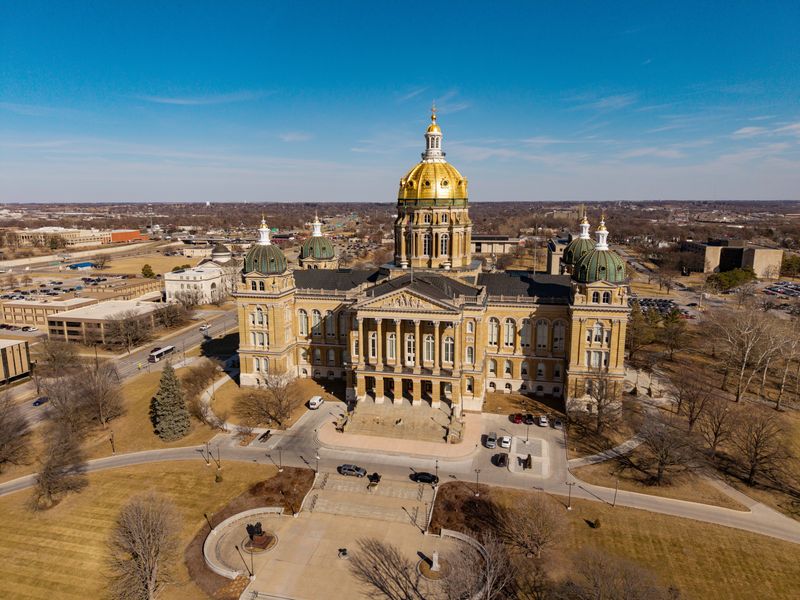
Iowa’s distinguished war record was still fresh in the minds of the leaders and citizens of Iowa when, in 1871, six years after the war’s end, construction began on Des Moines’ gold-domed Capitol. In many ways, the building and its grounds commemorate the Union’s triumph and the spirit that drove Iowa’s participation in the war.
As the United States prepares to mark its 250th year, here is the story of Iowa’s role in the conflict that still shapes the nation and how it is memorialized in the halls and on the grounds of one of Des Moines’, and the state’s, most prominent landmarks.
Iowans despised slavery, treasured ‘radical experiment’
Thirteen Iowans died and 141 were wounded in the rout of the Union forces at Wilson’s Creek. Those numbers would soon seem paltry. The war, initially expected to be a brief campaign, raged on for four years from Virginia to the Arizona territory and claimed as many as 750,000 lives on both sides.
While a few small contingents represented Iowa in the war’s eastern theater, the west was where Iowans mainly engaged. They were a bedrock part of Gen. Ulysses S. Grant’s force as it fought its way through the South to the Mississippi River at Vicksburg, laying a siege that ultimately claimed the strategic city. That victory secured Union control of the river and cut off the Confederacy’s west.
The familiar claim that Iowa sent more men per capita to serve in the Union cause than any other state is a myth born of an error. At some point, reenlistments were mistakenly counted as new sign-ups, said emeritus University of Northern Iowa history professor Kenneth Lyftogt.
But Lyftogt, the author of a trilogy on Iowa’s participation in the war and other Civil War volumes, said those reenlistments indicated Iowans’ dedication to the cause.
As the war dragged on, Lincoln had to resort to a draft to maintain the strength of the Union forces. Very few Iowans were conscripted, since the state maintained robust ranks of volunteers throughout the war.
Lyftogt said Iowans had a strong distaste for slavery and the Southern aristocracy that profited from the so-called peculiar institution.
Iowans “could be as racist as anybody,” he said, pointing to state laws enforcing racial segregation and disenfranchising Black voters that persisted until after the war. But Iowans were proud of the state’s reputation as the initial non-slave state west of Mississippi.
It was “the only free child of the Missouri Compromise,” Gov. James W. Grimes said in 1854. The 1820 Missouri Compromise sought to stave off secession by maintaining parity between slave and free states as they were admitted to the Union.
Many in Iowa were aghast at the 1854 Kansas Nebraska Act that effectively nullified the agreement. The law allowed new states to choose whether to be slave or free, bringing the prospect of slavery to the Great Plains. The issue was at the center of the famous debates between Lincoln and Democrat Stephen Douglas in the 1858 Illinois U.S. Senate campaign that would presage their presidential race to come.
Lyftogt said Iowans who signed up to fight in the Civil War were overwhelmingly smallholder farmers, laborers and tradesman who saw the possibility of slavery spreading to their borders as a threat to their livelihoods.
Another Iowa Civil War scholar, former University of Iowa administrator Thomas R. Baker, wrote in “The Sacred Cause of Union: Iowa in the Civil War” that an equally deep motivation was the widely held view among Iowans that the ideals embodied by America were in danger.
“For many,” Baker wrote, “maintaining unity in the face of internal turmoil would signal the continuing success of America’s radical experiment in self-government.”
Iowa had a strong Democratic minority in its Legislature in 1861 that was skeptical of Lincoln, Baker pointed out. But, called into a special legislative session, they worked with Republican Gov. Sam Kirkwood to provide training and military supplies for the fast-forming Iowa regiments.
The Davenport Daily Democrat and News on the day after the Sumter bombardment expressed its dissatisfaction with Lincoln’s handling of the situation, but also wrote that the Union now had no choice but to fight.
“Get your arms ready; get your own bodies and minds prepared for the contest. Blood is called for; blood alone can carry out the programme; prepare to spill it freely,” the newspaper said.
‘Bravest of the brave’: Assault on Tennessee fort wins Iowans acclaim
Despite a Union loss at Wilson’s Creek, Iowans established themselves as part of the bedrock of the federal forces. They were with Grant as he engaged in his first battle at Belmont, Missouri, and later fought at Pea Ridge in Arkansas, near the Missouri border. The latter kept at Confederate resistance at bay.
But perhaps nowhere did Iowans serve more memorably than at the Battle of Fort Donelson in Tennessee, key to control of the Cumberland River and the capture of Nashville that followed.
The fort stood high above the river, where fearsome artillery was able to turn back the Union gunboats that had pounded low-lying Fort Henry into submission.
The job at Donelson would fall to ground troops, among them Iowa’s 2nd Infantry Regiment.
The 2nd had begun its war in Missouri, seeing little combat. Guarding a military prison at a college near St. Louis, it earned stern disapproval when some members pilfered scientific specimens at the school.
Called to join Grant’s Army of the Tennessee as it prepared to take Donelson, it received orders to march through St. Louis to waiting river transports in near silence, its regimental flag furled in a mark of disgrace. The soldiers of the 2nd and their commander, Col. James Tuttle of Farmington, were aware that their battlefield performance at Donelson would present an opportunity to regain their honor ― and they did.
When the first day of the battle, on Feb. 14, went badly for the Union’s right flank, Grant ordered divisional commander Gen. Charles F. Smith to lead the Union left in an attack on the Confederate fortifications opposite them the following morning. Smith chose the motivated 2nd to head the assault.
More than a third of the 650-member force fell dead or wounded taking the Confederate breastworks. Among them were five of six members of the color guard that bore the regimental flag. The final soldier to carry the flag, Cpl. Voltaire Twombly of Van Buren County, planted it in the captured Confederate position despite being repeatedly wounded. He received the Medal of Honor.
The regiment took shelter in a line of trenches abandoned by the Confederates, enduring a shivering night, and prepared to resume the fight the next morning. But word came that the southerners had accepted Grant’s ultimatum of “unconditional surrender” ― a phrase that became his nickname.
Grant gave the 2nd’s survivors the honor of being the first to parade into the captured fort with their colors. The commander of the western forces, Maj. Gen. Henry Halleck, declared the unit “the bravest of the brave” and Kirkland visited them after the battle. The governoer returned to Des Moines with their blood-stained, bullet-tattered banner.
Yet for the 2nd and Iowa’s other regiments, the fight was only just beginning.
Iowans take outsize losses, win glory at Shiloh
The Battle of Shiloh ― the bloodiest of the war to that time ― followed in April 1862. More than 6,600 Iowans in 11 regiments would serve there, with 2,409 casualties ― nearly a quarter of the Union total.
In what Mark Mathis III, author of “Civil War Reenactment,” described in the Cedar Rapids Gazette as Iowa’s Alamo, the first brigade of the war made up entirely of Iowa units ― including 2nd ― would fight a brutal delaying action. The troops took up positions along a sunken wagon road and, admonished by Tuttle to “remember you are from Iowa,” held off an overwhelming Confederate force until their line collapsed late in the day. So constant and deadly were their buzzing volleys that the advancing rebels dubbed the defensive position “The Hornet’s Nest.”
Though many of the Iowa troops there ended up dying, wounded or captured, their stand bought Grant crucial time as he awaited the arrival of reinforcements who turned the tide of the fight.
Today, the Iowa units’ key role in preventing a disaster is recognized with the largest state monument on the grounds of Tennessee’s Shiloh National Military Park. Smaller monuments for individual Iowa regiments dot every corner of the field. A diorama at Camp Dodge’s Gold Star Military Museum in Johnston recreates the scene.
Iowa units would go on to play prominent roles in the 1863 Vicksburg siege and the 1864 campaign to take Atlanta. Gen. William Tecumseh Sherman, elder brother of Hoyt Sherman, namesake of Des Moines’ Sherman Hill neighborhood, led them. The subsequent March to the Sea would seal Lincoln’s reelection over an opponent whom many suspected would seek peace with the Confederates at the risk of a permanently divided country.
In the waning days of the war, as Confederate Gen. John Bell Hood made a final, desperate effort to recapture Nashville in December 1864 and force Sherman from Georgia. Iowa cavalry played a prominent role in his defeat.
Other Iowans overcame barriers to do their part in the war. Among them: Black Iowa units recruited beginning in 1863. David Brodnax Sr., now chair of history at Illinois’ Trinity Christian College, wrote in a 2007 Annals of Iowa article that some saw combat while stationed with Union forces holding the Mississippi River port of Helena, Arkansas.
Iowa women also played a crucial role. They ran farms and businesses while men served in the Army. They also organized Ladies Aid Societies under leaders including Annie Wittenmyer of Keokuk, who campaigned to improve conditions in Union military hospitals.
Capitol reflects Iowa’s ambitions, war role
When Samuel Clemens, better known as Mark Twain, published “Life on the Mississippi” in 1883, chronicling a recent trip from Louisiana to Minnesota on the river, he highlighted a peculiarity he frequently encountered. Southerners, he wrote, frequently referred to incidents as happening “before the wawah” or “after the wawah” (before and after the war.)
For Iowans, there was no such division, Lyftogt said. The state had entered the Civil War feeling the effects of a catastrophic economic crash that had stymied its growth. By the time the war concluded, Iowa was again thriving. Its population, about 675,000 in 1860, grew almost 77% to 1.2 million in 1870. It was gaining political clout and its reputation as a progressive state that sacrificed mightily for the Union cause drew many migrants, Baker, the “Sacred Cause of Union” author, noted in his epilogue.
So when the state undertook to build its permanent Capitol beginning in 1871, the spirit of hard-won triumph imbued the project. The building was, by the standards of the day, exceptionally monumental. Its 275-foot-tall, gold-plated central dome ― one of the building’s five ― was second in height only to the Statehouse of the far-more-populous Empire State of New York. Its Palladian style became a template for late-19th century seats of government in other states, including Minnesota, Michigan, Indiana and Rhode Island, Linda Nelson Johnson wrote in her 1989 book “The Iowa Capital: A Harvest of Design.”
“Iowans were proud of their accomplishments and believed their Capitol to be a reflection of their progressive state,” Johnson wrote. “The Civil War had forged a sense of community combined with a desire for individual achievement. Both were expressed in murals, sculptures and other artwork within and around Iowa’s new Capitol building.”
The war is even a part of the foundation, with the Capitol’s keystone laid over a vault containing documents including copies of the Emancipation Proclamation; the joint resolution of Congress ratifying the 13th amendment that abolished slavery; and a roll of honor of Iowa soldiers and roster of Iowa regiments serving in “the war for suppression of rebellion.”
Gov. Samuel Merrill, himself a Civil War veteran, spoke at the laying of the keystone in November 1871.
“God has preserved us even amid the fires of Civil War ― out of it we have been taken surely chastened but purified and made better. The Union was saved because we believed God had a greater mission for this republic to perform,” he said.
The alcoves on the rotunda’s first level long held Iowa units’ battle flags, including the 2nd Infantry’s scarred banner. The Iowa Historical Society removed them to storage in recent years as they became increasingly fragile.
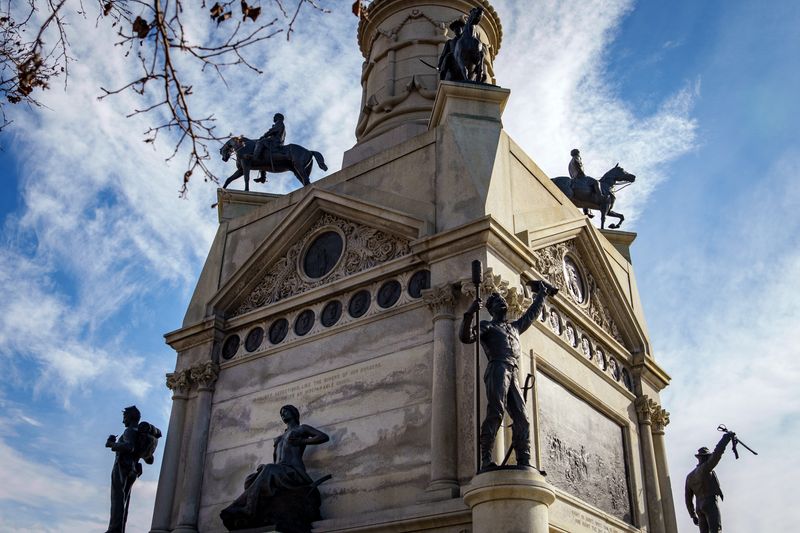
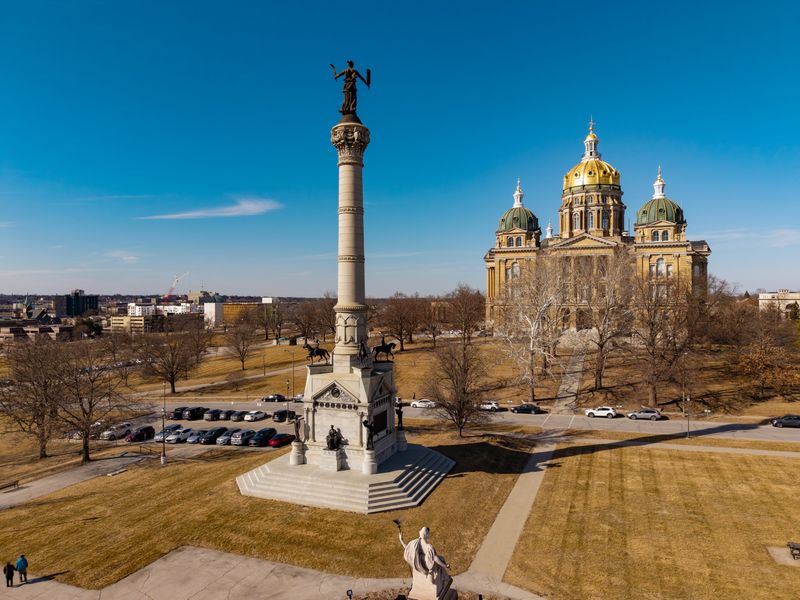
Even more dramatic, the largest single piece of sculpture on the Capitol grounds is the Soldiers’ and Sailors’ Monument, built on the site of the Old Capitol after that building burned in 1892. Dedicated in 1896, it is an almost comprehensive commemoration of Iowa’s role in the war.
A frieze on the east side depicts the 2nd Iowa Infantry’s advance. On the west side, another shows the homecoming of the troops at the war’s end.
On the south side sits a figure depicting history; on the north, a bare-breasted personification of Iowa that was quite controversial at the time.
On the corners are statues of an infantryman, sailor, artilleryman and cavalryman, each drawn from actual war dead. The infantryman is particularly poignant: Shelby Norman,18 when he died at Wilson’s Creek, is smiling as though just returned from the war and clutching a small bouquet of flowers in his left hand.
Above the corners are equestrian statues of four great Iowa generals: Grenville Dodge of Council Bluffs; John M. Corse of Burlington; Marcellus M. Crocker of Des Moines and Samuel Ryan Curtis of Keokuk.
Medallions represent nearly three dozen other notable Iowa service members ranging from privates to generals. A 22-foot-tall statue of Victory holding palms representing peace and victory tops a tall, graceful column that elevates it 135 feet above a bluff on the edge of the Des Moines River valley.
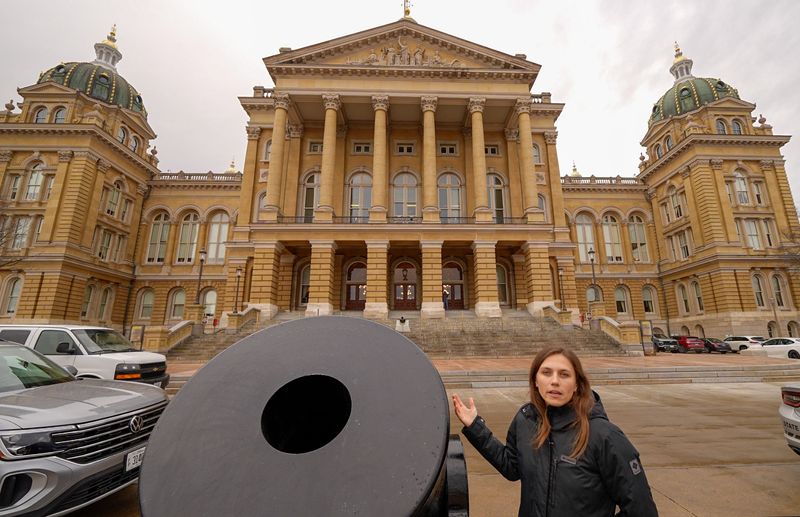
On the west front of the Capitol, facing downtown Des Moines, are a statue of a seated Lincoln reading to his son Tad and pieces of Civil War artillery.
The volume of Civil War imagery in the Capitol was so great that when the Capital Improvements Commission in 1902 made its report to the governor and Legislature, it tactfully cautioned against a proposal to add a mural of the Battle of Gettysburg.
“We acknowledge that no opportunity should be omitted to recognize the debt owed by the people of the state to the men that risked and lost their lives in preserving the Union,” the commission wrote. It noted that the battle wasn’t one in which Iowa units fought and that perhaps some chapter of Iowa’s history could be represented.
Long-vanished Grand Army of the Republic lives on in rotunda
In Iowa following the Civil War “you couldn’t be elected dogcatcher if you didn’t have a miliary resume,” said Lyftogt. The influence of the Grand Army of the Republic reflected that. Representing veterans of the war, it was the only private group allocated office space in the Capitol.
The GAR had more than 400,000 national members at its height and lobbied for pensions for Union veterans. It is credited with the establishment of the Memorial Day holiday and held state and national encampments annually.
The office occupied its place of honor in the Capitol until that last of the war’s veterans, who’d been drummer boys when they served, died in the 1950s. But a reminder of its presence holds the most prominent spot in the building.
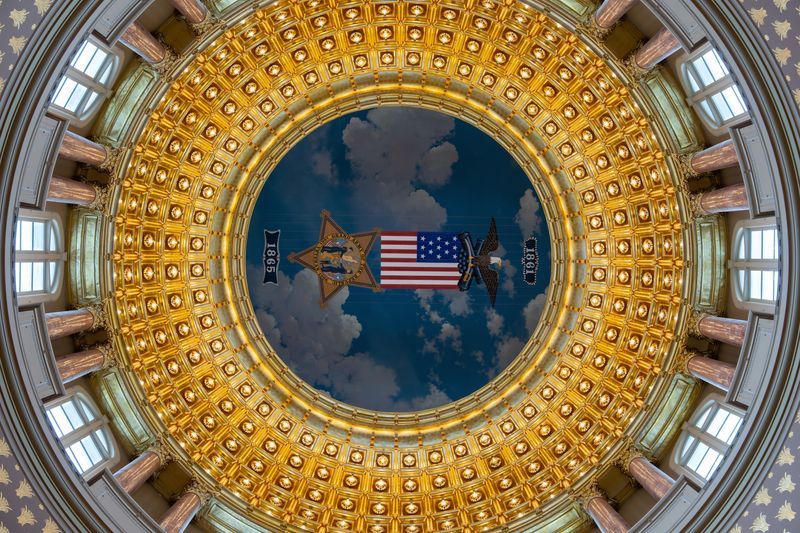
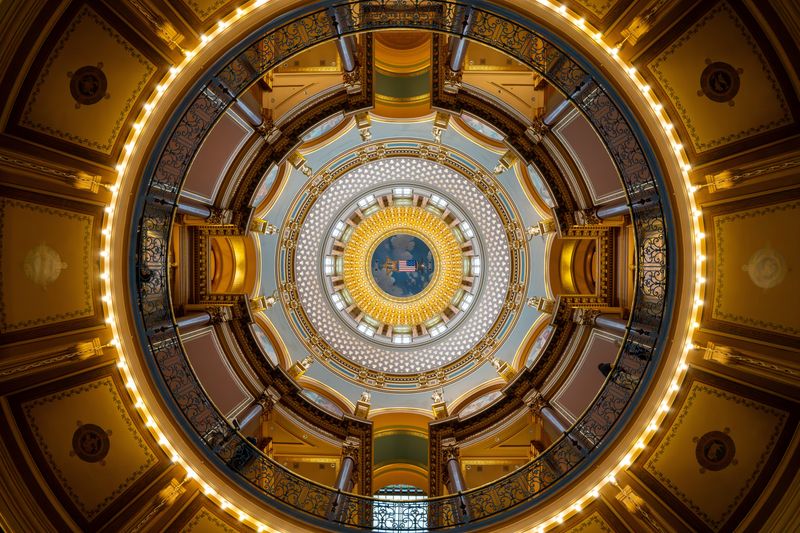
It’s a much larger-than-life-sized depiction of the badge worn by GAR members. Looking like a fresco at the peak of the rotunda, it hangs on a lattice of piano wire 20 feet below a painted backdrop of blue sky and clouds.
An eagle perches on a sword from which hangs a 13-star U.S. flag and, below that, a five-pointed star bearing an image of goddess Liberty. Before her, two figures ― a soldier and sailor ― clasp hands in fraternity. The dates of the war, 1861 and 1865, are emblazoned above and below.
Occasional Capitol tour guide Kelsie Willert, who works in the Capitol’s legislative services office, said it was the work of Joe Czizek. He was a Capitol interior decorator and created it in honor of the GAR’s 1926 national encampment, held in Des Moines.
During that encampment veterans, many in their 80s, took on one more battle.
The Ku Klux Klan, which terrorized freed slaves during Reconstruction, had been resurgent since D.W. Griffith’s 1915 film “Birth of a Nation” depicted them in a heroic light. Some of its members had made an unsuccessful bids the spring before to take over the Des Moines School Board, and the Klan remained a political force across the Midwest.
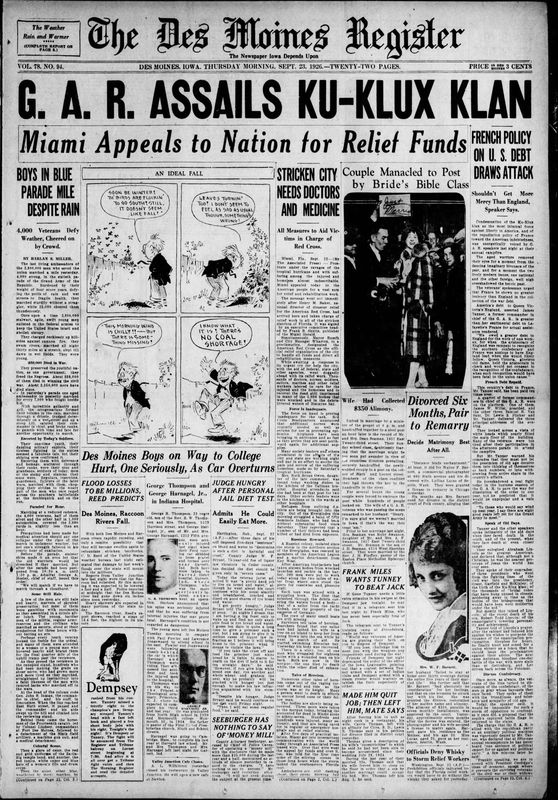
The GAR veterans, gathered on the encampment’s opening night in Des Moines’ chief auditorium, repudiated the glorification of the South’s “Lost Cause” and cheered their leaders when they denounced the Klan as “the most inimical force against liberty in America,” the Des Moines Register reported.
Forecast heavy rain threatened to wash out a parade planned for the following day. But the veterans who’d come from across the nation were undeterred.
“We will march if we have to march through a cloudburst,” GAR chief of staff Adm. George A. Horsley declared.
The following afternoon, bracing against the weather and old age, 4,000 GAR members, accompanied by veterans of later wars, marched past 25,000 spectators a mile up Grand Avenue to the Capitol.
An inscription on the side of the Soldiers’ and Sailors’ Monument still pays tribute to the Iowans’ conviction: “Right is right since God is God. And right the day has won.”
(This story was edited to correct information.)
Bill Steiden is the business and investigative editor for the Register. Reach him at WSteiden@registermedia.com.
This article originally appeared on Des Moines Register: Visit the Iowa Capitol where pride in state’s Civil War record abounds
Reporting by Bill Steiden, Des Moines Register / Des Moines Register
USA TODAY Network via Reuters Connect