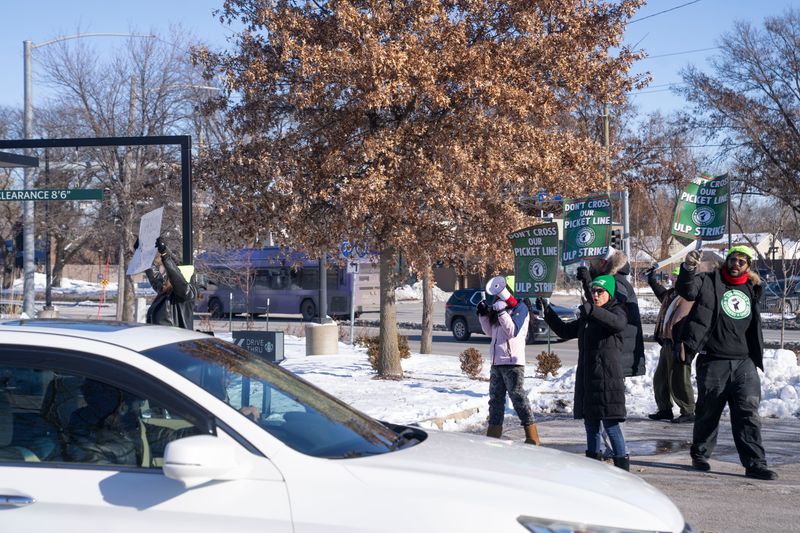
They are calling it “The Red Cup Rebellion” and striking baristas at Starbucks’ Merle Hay Road store in Des Moines and Clinton Street store in Iowa City will likely have matching red cheeks following their first day picketing the nation’s largest coffee chain.
The union, Starbucks United, said the Des Moines and Iowa City stores were among more than 145 unionized locations in more than 100 cities across the U.S. where baristas were scheduled to walk out Thursday, Dec. 4, as morning temperature struggled to rise above single digits.

About 15 workers were on each of the picket lines, which formed about 7:30 a.m., though the one at the Iowa City store disbanded around 9:30 a.m. so that students among the union members could attend classes while others handed out fliers on the University of Iowa campus.
Picketers at the Merle Hay store were slated to remain until 12:30 p.m., the daily schedule set by the union. Supporters from other unions joined them from time to time and a small tent provided a space for periodic warm-ups.
The Iowa City store was closed but the Des Moines location remained open, with what strikers said were managers from other area stores filling in for the baristas.
Starbucks spokesperson Jaci Anderson said in a prepared statement that the strike, which officially began last month, has had a minimal impact so far on the company’s operations. The Des Moines and Iowa City stores were not among those that initially walked out, and Iowa’s other two unionized stores, in Davenport and Bettendorf, have yet to undertake job actions.
“Regardless of the union’s plans, we do not anticipate any meaningful disruption,” Anderson said. “When the union is ready to return to the bargaining table, we’re ready to talk.”
The union, which says it represents 11,000 employees at about 550 of the chain’s estimated 17,000 U.S. locations, has been on strike since Nov. 13, the company’s traditional Red Cup Day marking the start of the holiday season with the giveaway of reusable cups. Baristas at the union stores are calling for better hours and pay and the resolution of alleged unfair labor practices.
Repeating previously released company talking points, Anderson in her statement contended the strikers are a small minority of Starbucks workers, most of whom are happy with their pay and benefits.
“The facts are clear, Starbucks offers the best job in retail, with pay and benefits averaging $30 per hour for hourly partners,” she said. “People choose to work here and stay here — our turnover is less than half the industry average, and we receive more than a million job applications every year.”
Jacob Scroggins, who helped organize the union at the Merle Hay store, said, “As soon as Starbucks invests in us, we can return to investing in our customers.”
“We will be out as long as it takes to get them to the table,” said another barista, Asia Williams.
Union members said they are receiving payments from the union’s strike fund while they are off the job.
Union, Starbucks disagree on strike effects
The strike began with picketing at locations in 65 cities and has gradually expanded, a Starbucks Workers United news release said.
Starbucks has disputed some of the union’s numbers, contending that only 49 stores experienced any disruption in the initial wave of picketing and that 13 on the strike list never closed at all.
Starbucks also counters that the number of union members is about 9,500, not the 11,000 claimed by Starbucks United, and that the union represents less than 4% of the company’s workforce.
Starbucks and the union began negotiations on a contract in February 2024. During the 2024 holiday season, unionized Starbucks baristas went on a five-day strike, which closed some stores in Los Angeles, Chicago and Seattle. During the strike, the company said there was no significant impact on store operations.
In April this year, Starbucks Workers United delegates voted to reject Starbucks’ proposal of guaranteed annual raises of at least 2%. According to the union, the company did not offer changes to economic benefits such as health care or any immediate pay hike. That proposal represented “an incomplete framework,” the company said at the time.
Starbucks workers are seeking their first agreement since the initial, successful vote to organize a store in late 2021 in Buffalo, New York.
The Starbucks on Merle Hay in August became the fourth store in Iowa and the first in central Iowa to vote for union representation.
In a news release, Charlie Wishman, president of the Iowa Federation of Labor, AFL-CIO, suggested Starbucks customers can show support for the strikers by joining the picket lines, signing a “No Coffee, No Contract” boycott pledge, donating hand warmers and handing out warm food and beverage to the picketers.
Jessica Risch of the Iowa City Press-Citizen contributed to this article.
Kevin Baskins covers jobs and the economy for the Des Moines Register. Reach him at kbaskins@registermedia.com.
This article originally appeared on Des Moines Register: Unionized Starbucks baristas in Iowa join national strike
Reporting by Kevin Baskins, Des Moines Register / Des Moines Register
USA TODAY Network via Reuters Connect