A pioneering Brazilian microbiologist whose work helps farmers replace chemicals with less expensive, more environmentally friendly alternatives says she bucked intense societal and academic pressure to become a soil scientist.
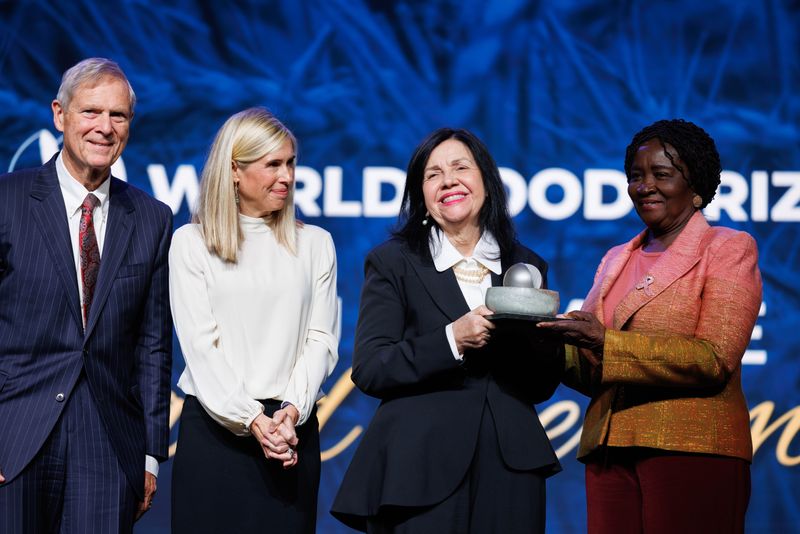
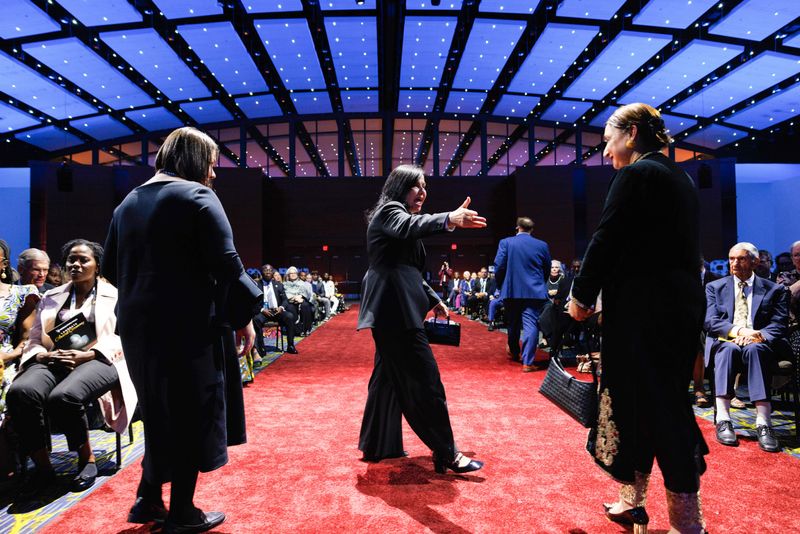
“I followed my heart and my belief in productive, yet sustainable agriculture,” said Mariangela Hungria, who received the $500,000 World Food Prize on Thursday, Oct. 23, at a Community Choice Event Center ceremony in Des Moines. Gov. Kim Reynolds, World Food Prize Foundation CEO Tom Vilsack and Vice President of Ghana Jane Naana Opoku-Agyemang were among those attending the ceremony.

Called a “transformative leader,” Hungria created biological seed and soil treatments that enable wheat, corn and other major crops, including soybeans — Brazil’s top agricultural export — to source nutrients through soil bacteria, significantly increasing yields while reducing the need for synthetic fertilizer.
Hungria said hers and others’ work are taking Iowa native and World Food Prize founder Norman Borlaug’s dream of a Green Revolution into a “new vision, a microgreen revolution, driven by biological inputs.”
“Today, I see farmers everywhere seeking more sustainable practices,” she said, especially Brazilian farmers, “who are responsible for our global leadership in the use of biologicals.”
Borlaug received the 1970 Nobel Peace Prize for research that led to the creation of drought-resistant, high-yielding wheat varieties. He is credited as the “father of the Green Revolution,” who saved a billion people from hunger.
Here’s what to know about Hungria’s acceptance of the World Food Prize, which wrapped up activities Friday, Oct. 24.
Soil microbiology ‘an afterthought’ when Hungria decided to pursue research
When Hungria decided to become an agronomist 45 years ago, the World Food Prize Foundation said soil science was dominated by men “and fertility was defined by chemicals and soil microbiology was an afterthought.”
Hungria wanted to take a different path — to use naturally occurring bacteria to provide nitrogen to plants, reducing the need for expensive chemical fertilizers, cutting costs and environmental harm.
After earning a doctorate degree, Hungria spent decades building a field of study that focused on elite strains of rhizobia, a “symbiotic bacteria that forms nitrogen-fixing nodules” on legume roots, the foundation said. Hungria tested her effects on crops in the field and identified varieties that “responded best to the microorganisms.”
Hungria’s work saved farmers billions of dollars each year, cut CO2 emissions
Hungria’s work cuts farm costs while reducing agriculture’s environmental impact, the foundation said.
“The microbial inoculants she helped develop are now applied to more than 40 million hectares in Brazil and have spread to farms globally,” the foundation said. “Microbial inoculation is now used on 85% of Brazil’s soybean fields, more than 30 million hectares, the highest adoption rate in the world.”
“Her innovations save Brazilian farmers an estimated $25 billion annually, prevent 230 million metric tons of CO2 equivalent emissions and boost yields beyond what synthetic fertilizer can achieve,” the group said.
Gebisa Ejeta, chair of the World Food Prize selection committee, said “Mariangela Hungria’s pioneering scientific achievements and dedication to sustainable agriculture have made her a transformative leader in global agriculture, guiding groundbreaking projects and innovations on nearly every continent.”
Hungria: Women’s roles in agriculture unrecognized for centuries
The foundation said Hungria has been a “staunch advocate and mentor for women in science. She guides her students with rigor and compassion, sharing her experience as a scientist and a mother to inspire others navigating this balance.”
Hungria said that “women’s roles in agriculture have been invisible and unrecognized” for centuries.
“Yet in most countries, we are the one cultivating the land, saving the best seeds and passing down nutritional knowledge through generations,” she said. “I’m sure that we will lead the agriculture of the future, one that produces enough food … protects the planet and restores soil health.”
World Food Prize advocates recognized for work to ‘confront world’s greatest challenges’
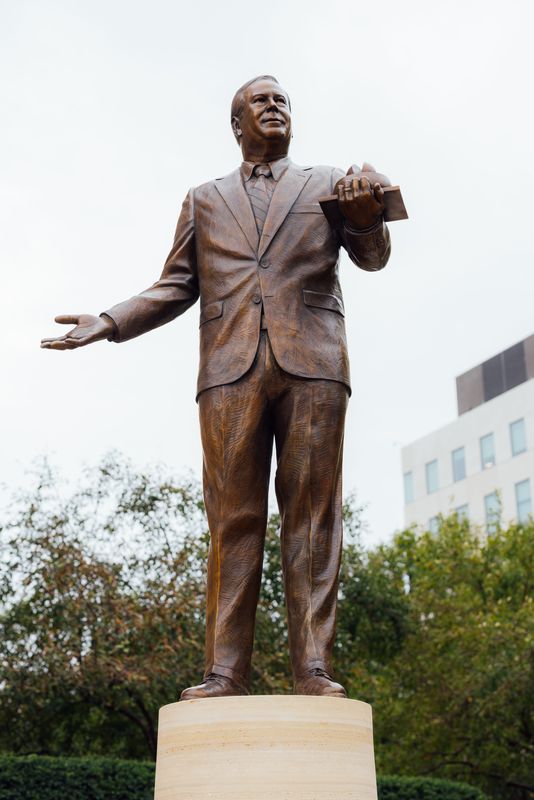
In a private ceremony opening the World Food Prize’s events, the foundation unveiled a bronze statute that honors John Ruan III, a Des Moines businessman who served as the group’s board chair from 2000 until his death in 2021.
The statute, created by sculptor Benjamin Victor, depicts Ruan carrying the World Food Prize into the Hall of Laureates, “symbolizing his instrumental role in shaping its legacy,” the foundation said.
“This statue stands as a lasting tribute to a man who believed deeply in the power of bringing people together to confront the world’s greatest challenges, and because of that belief, his impact will continue to inspire generations to come,” Vilsack said in a statement.
Ruan, along with Ken Quinn, the foundation’s former president, and current President Mashal Husain helped lead the $29.8 million renovation and development of thenfoundation’s headquarters, formerly the Des Moines Public Library.
Quinn also was honored during the week. The Council for Agricultural Science and Technology gave the former U.S. ambassador to Cambodia its first Lifetime Achievement Award for providing “diplomacy, agricultural development and international leadership” over nearly six decades of service.
CAST, an Ames nonprofit group, was formed in 1972 to be a voice for agricultural science, representing academia, government and industry.
Donnelle Eller covers agriculture, the environment and energy for the Register. Reach her at deller@registermedia.com.
This article originally appeared on Des Moines Register: Mariangela Hungria followed ‘my heart and my belief’ to become a transformative ag leader
Reporting by Donnelle Eller, Des Moines Register / Des Moines Register
USA TODAY Network via Reuters Connect