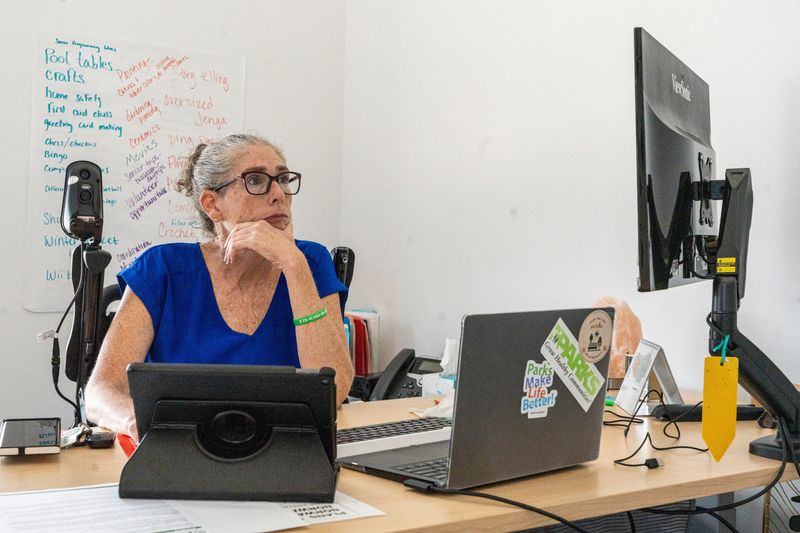
Sometimes we take our voices for granted. The ability to command a room, have hushed conversations with loved ones, or even something as simple as answering the phone — these are all things Robin Leaper had to learn anew after amyotrophic lateral sclerosis took away her ability to speak.
“You don’t know how much your voice matters to people,” Leaper, 53, said. “It has a connection that people miss when it’s gone.”

Leaper, who has been the director of Norwalk Parks and Recreation since 2019, visited the doctor after she had slurred speech and began choking on food. Initially, she passed off the symptoms as stress.
“Before I left, (the doctor) told me not to google the list (of potential diseases) he gave me, because I ‘seem like a really nice person,’ and Google can be a rabbit hole, and he didn’t want me to worry,” Leaper said. “So what did I do? I, of course, googled all the diseases on my list and hoped it wasn’t the terminal one.”
A visit to the neurologist confirmed what Leaper had been dreading. She was diagnosed with ALS in July 2023.
ALS, also known as Lou Gehrig’s disease, stands for amyotrophic lateral sclerosis. It is a disease of the nervous system that affects nerve cells in the brain and spinal cord, according to the Mayo Clinic.
While symptoms vary from person to person, the disease generally begins with muscle weakness that worsens over time. Early signs of ALS may manifest as trouble walking, hand weakness or clumsiness, slurred speech or trouble swallowing and twitching in the arms, shoulders and tongue, the Mayo Clinic says.
As time went on, Leaper’s symptoms steadily progressed. The disease slowly took away mobility, and with it, her ability to speak. By November of 2024, Leaper was using AI and other speech apps full time.
But Leaper was determined to retain her ability to communicate. It was a major part of her job, after all, and a signifier of an independence that would diminish as her motor neurons continued to die.
Rediscovering her voice
Through the ALS Association of Iowa, Leaper was able to connect with Bridging Voice, a New York-based nonprofit dedicated to supporting ALS patients with communication. Founded in 2019, it currently supports over 4,000 ALS patients across the country — and it does it all remotely.
“We were created because we really saw a gap between the amazing assistive technology that was being created,” Executive Director Karina Nagin said. “But ALS patients either didn’t know about it or they weren’t getting it, or when they did, it wasn’t being used … because they didn’t have the support.”
The nonprofit first discovered AI start-up Eleven Labs through a client who had used the service to clone his voice, Nagin said. Their interest was immediately piqued.
Eleven Labs uses voice cloning technology, as opposed to the more common voice banking method. Voice banking entails users recording certain phrases before they lose their voices, whereas cloning takes clips of the user speaking and recreates their voice and stores it, allowing them to speak more or less freely.
In order to create her Eleven Labs voice, Leaper used old voicemails and clips of herself speaking at city Parks and Recreation board meetings.
The company was created in 2022 by Piotr Dąbkowski and Mateusz Staniszewski. The men had become fed up with the quality of voice dubbing in the films they were watching. Dubbing, for non-cinephiles, is the process by which a film’s original audio is replaced with audio in a different language. Oftentimes, these secondary language options are poorly AI generated, greatly reducing the quality of the viewing experience.
So, Dąbkowski and Staniszewski decided to do something about it, according to the company’s website. What began as a passion project grew into something far greater. The text-to-speech technology, which converts written text into spoken words, developed by Dąbkowski and Staniszewski is now being used for all sorts of things, from the founders’ original mission of dubbing in films, to voiceovers and audiobooks.
Bridging Voice reached out to the company, and a partnership was born. Launched in August of 2024, the collaboration between Bridging Voices and Eleven Labs allows ALS patients around the world to access Eleven Labs’s voice cloning technology free of charge, where normally there would be a $1,200 yearly fee.
Nagin said a little over 1,500 ALS patients across the nation are using Eleven Labs’s technology. Leaper is one of just 27 users in Iowa.
Overwhelmed with emotion
When she heard her own voice pouring out of her speakers on November 22, 2024, a mere 24 hours after she had sent the recordings off to be cloned, Leaper said she was shocked.
“It sounded exactly like me,” she said. “I was excited because people would still get to hear my voice when I speak.”
Indeed, Leaper’s Eleven Labs voice is nearly indistinguishable from her own, save for a few rushed commas and ill-timed pauses. The program will run on any device with an internet connection, says Leaper. She uses it on her phone, computer and iPad, as well as on a dedicated speech device called Tobii Dynavox, which has eye tracking technology she will utilise when she is no longer able to type.
That day was extra emotional for Leaper, as she was set to speak at the City State Bank Norwalk Fieldhouse.
“I quickly copied my speech into the (Eleven Labs) program and played it back,” Leaper said. “I had to listen to it several times so I wouldn’t cry during the actual speech.”
Leaper wasn’t the only one struggling to maintain a dry eye that afternoon.
“Everyone at the ceremony, including my mom, was shocked to hear my voice,” she said.
Although Leaper’s life has changed since her diagnosis, she still finds ways to remain joyful.
Her most used tactic? Gratitude. It’s not always easy, but Leaper says she has many things to be grateful for, chief among them family and faith.
“When I start to get sad about my diagnosis, I turn to gratitude,” Leaper said. “I find ways my God has blessed me, and I say ‘thank you.’”
Leaper’s children are another steadfast presence in her life that keep her grounded when things get tough. She also enjoys spending time outdoors, which she says is one of the many reasons she loves her job.
Pitfalls of progress
Even though Leaper is grateful for the technology, she says it is not without its trials and tribulations.
“At times, it is frustrating because it takes time to type out my answers,” Leaper said. “My mind works faster than my fingers type, so sometimes I miss words and then my sentences don’t make sense, or autocorrect gets me.”
Leaper keeps a document with answers to some of the questions she is most frequently asked in order to conserve both time and energy. The document notably includes her diagnosis timeline and her reaction to being diagnosed with ALS.
She and her children also have been learning sign language since her diagnosis, often opting to communicate that way instead of via the computer programs she uses to communicate with while at work. Leaper finds the break from typing refreshing, saying the act of signing exercises her fingers.
Navigating life with ALS is challenging, but Leaper is doing her best to spread awareness so that one day it might be easier.
Leaper says the fight for ALS awareness is more important now than ever. Proposed funding cuts to research grants by the Trump administration would choke the flow of money toward ALS research, thus slowing the progress toward a cure almost indefinitely. According to the ALS Association, the cuts could set research back by decades.
“I encourage people to be advocates or donate so they can find a cure,” said Leaper, adding that organizations like ALS Association, Team Gleason and I Am ALS are good resources for those looking to get involved.
“ALS isn’t incurable,” Leaper said. “It’s underfunded.”
Norah Judson is a reporter for the Register. Reach her at njudson@gannett.com.
This article originally appeared on Des Moines Register: ‘It sounded exactly like me’: AI allows Norwalk woman with ALS to speak with her own voice
Reporting by Norah Judson, Des Moines Register / Des Moines Register
USA TODAY Network via Reuters Connect