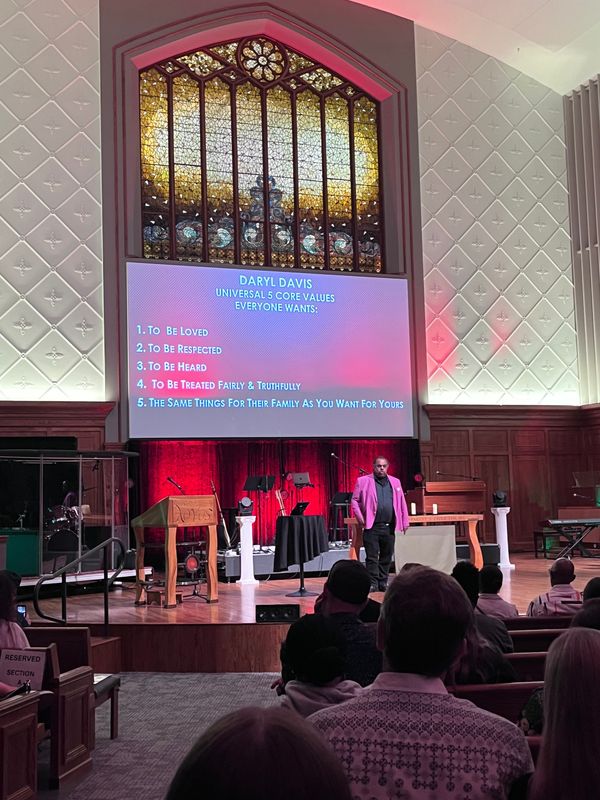
The Lutheran Church of Hope+Elim celebrated Juneteenth by hosting Daryl Davis, an R&B and blues musician and activist, to speak about how to build bridges and have impactful conversations with others during times of unrest and disagreement.
The event, held the evening of June 19, kicked off with introductory speeches from the church’s lead pastor, the Rev. Brian Brown, and Lutheran Church of Hope’s senior pastor, the Rev. Mike Housholder, who emphasized that Christians should share the gospel and proclaim justice when confronted with injustice in the world.

The church’s worship team also sang a number of songs before Davis’ keynote speech, including “Lift Every Voice and Sing,” which is often called the Black national anthem. Around 250 attendees filled the pews, clapping and dancing along to the songs.
Davis then began his speech by recounting his early childhood, which was spent abroad in several different countries as an “embassy kid,” meaning one of his parents served in the Foreign Service and represented the U.S. overseas.
He said foreign schools in the early 1960s while he was growing up contained much more diversity than American schools, and he did not even know what the concept of racism was until coming to the U.S. and experiencing racial discrimination for the first time.
This included personal experiences, such as someone throwing a glass pop bottle at his head during a Boy Scouts parade, as well as on the national scale when he heard of the assassination of Martin Luther King Jr. in 1968.
It is from these experiences, Davis said, that he set out to answer the question, “How can you hate me when you don’t even know me?”
However, Davis said he did not approach this question with anger, but instead with a genuine feeling of wonder.
“Rather than get furious, I got curious,” Davis said.
This led Davis on a nearly 50-year long endeavor to have “courageous conversations” with those who seemed to oppose him in every way, including members of the Ku Klux Klan and American Nazi groups. Davis said he would frequently attend Klan rallies, sometimes traveling hours or even members into his home to have conversations with KKK members to try to answer the question he formulated from his childhood.
Over the years, Davis found success with these tough conversations and said hundreds of Klan members have left the KKK because of getting to know him and hearing him out.
A more recent example that Davis shared was when he met a head KKK member who shot at a Black man during the 2017 “Unite the Right” rally in Charlottesville, Virginia, which saw alt-right neo-Nazis and Klansmen opposing the removal of a Robert E. Lee statue from a park. There were also a number of counterprotestors at the event, and violence ensued, leading to several deaths and injuries.
Davis called the head member and went to his house to talk about American history. After doing so, Davis said he invited the man to go to the newly opened National Museum of African American History and Culture in Washington, D.C., to learn factual American history and not the propaganda that informed his bigoted views.
Eventually, the two men and the Klansman’s wife grew so close that Davis was invited to their wedding, where he walked the wife down the aisle in place of her father, who was too ill to attend.
While it is difficult to change the mind’s of those who have had a certain ideology cemented into their brains, Davis said having these conversations and respecting people’s right to speak while not necessarily respecting what they say is key to combatting the rise of white supremacy and division in the nation.
According to the Southern Poverty Law Center, an American civil rights and legal advocacy nonprofit, there were over 1,200 hate and antigovernment groups in the country last year.
“Yes, it takes patience. Yes, sometimes you’d hear things, and see things, and I’d be like, ‘I don’t believe this,'” Davis said. “But in the end, it’s worth it.”
Isabelle Foland is a communities reporter for the Register. Reach her at ifoland@registermedia.com.
This article originally appeared on Des Moines Register: Daryl Davis emphasizes bridge building, respect at Juneteenth event
Reporting by Isabelle Foland, Des Moines Register / Des Moines Register
USA TODAY Network via Reuters Connect
By Isabelle Foland, Des Moines Register | USA TODAY Network