Iowa lawmakers have struck a deal to deliver an approximately $4 billion property tax cut over six years, as Republicans at last overcame their differences to take action on their top-priority issue during the legislative session’s final hours.
The final package would implement a 2% growth cap on local governments’ general levies, with exceptions for new construction, and a 10% homestead tax exemption up to $20,000, which would be adjusted for inflation.

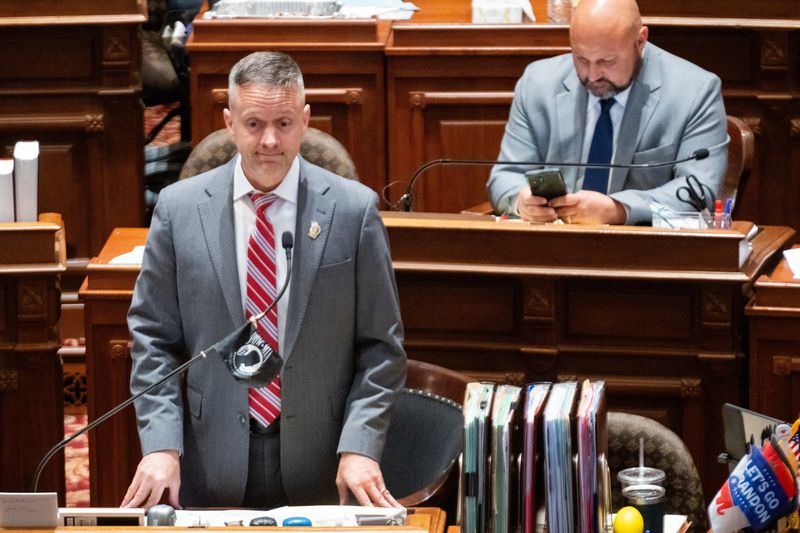
“I want to say this to all Iowans: this general assembly came here with a purpose,” said Sen. Dan Dawson, R-Council Bluffs. “And the unified purpose (of) the Iowa House, the Iowa governor and the Iowa Senate was to provide property tax relief for Iowans. Today, we deliver on that promise.”
The wait for a vote on a final compromise package kept worn-down legislators tethered to the state Capitol well into the afternoon Sunday, May 3, topping off their marathon weekend adjournment push.
But the pressure was on for lawmakers to take action this year after ending the 2025 session with no vote on property tax legislation.
Gov. Kim Reynolds and House and Senate Republicans each began 2026 by unveiling their own plans to cut property taxes. All three plans circled limits on local revenue growth, but Republicans could not agree over how to best approach cutting property taxes.
For months, each chamber dug in on their own proposals — keeping leaders at the negotiating table as the session stretched into overtime past April 21, when lawmakers stopped receiving per-diem payments.
Senate Republicans pitched a “deeper” reboot of Iowa’s property tax system with provisions that granted more flexibility to local governments, while the House favored a simpler, easier-to-digest slate of changes.
But legislative leaders finally broke through with a compromise to bring legislation to a vote before ending the session.
The plan was released as an amendment to Senate File 2472 on Sunday afternoon and lawmakers are in the process of voting on the package to send it to Reynolds for her signature.
Sen. Herman Quirmbach, D-Ames, criticized the “chaotic fashion” in which the bill was put together, saying lawmakers didn’t have adequate time to read the proposal, let alone share it with local government officials to get their feedback.
“I’ve only just now gotten an 83-page copy of the amendment that we’re talking about right here today,” he said. “The paper’s still warm from the printer. We should have had this a long time ago.”
But the Senate’s 41-1 vote to pass the bill showed strong bipartisan support for the proposal, with several Democrats praising provisions of the bill.
“The reason that I’m going to support this bill is that the key thing to me is it looks out for the property tax residential individuals,” said Sen. Bill Dotzler, D-Waterloo.
The House passed it with a bipartisan 61-22 vote.
Rep. Aime Wichtendahl, D‑Hiawatha, a former Hiawatha City Council member, blasted the bill as a “one‑size‑fits‑all” approach that she said wouldn’t lower Iowans’ property tax bills, labeling it a “Frankenstein of a bad bill.” She said it would “join the long line of failed attempts” to deliver results.
“After an all-night marathon session, we finally got to see the long-awaited property tax compromise bill, and honestly it has all the vibes of a college student waiting all semester to start their final project just two hours before the deadline. And honestly, I have to give this project, this property tax bill, a failing grade. This bill fails because it fails the majority’s own goals.”
Rep. Carter Nordman, R-Dallas Center, who chairs the House Ways and Means Committee, defended Republicans’ approach to crafting the bill and said it was not a last-minute effort, but rather had been carefully crafted with months of input from taxpayers, local officials, House and Senate lawmakers and the governor.
“I firmly believe this legislation puts the Iowa property taxpayer first,” Nordman said. “… This is significant reform that delivers real, tangible relief and certainly for the Iowa taxpayer.”
What’s in the final property tax plan?
The 2% cap does not tie revenue growth limits to inflation, an approach favored by local government officials who said a strict limit wouldn’t keep pace with their rising expenses and could force them to make service cuts.
But it also contains exceptions for several levies that will not be included in the cap, making it less strict than the version House Republicans initially proposed.
Multi-residential properties, such as apartments, gradually would be taxed on a larger share of their value, up to 6% more than single-family homes after three years.
This is a much smaller increase than the Senate’s original proposal to reverse sweeping 2013 tax cuts on multi-residential properties, including apartments, nursing homes and assisted-living facilities.
Developers, during a public hearing held by House Republicans on the Senate bill, warned landlords would pass on a sharp tax increase to tenants by raising rents and insisted it would stymie new housing development.
The plan does not include a gas tax increase, despite senators’ arguments that local governments still need reliable funding to maintain Iowa’s roads and bridges and that lawmakers cannot keep cutting revenue without eroding services.
While the U.S. war with Iran drives up oil prices, lawmakers felt now was not the time to further raise the price Iowans pay at the pump.
And lawmakers moved to rein in tax-increment financing districts, which redirect future property tax increases from new developments to fund public improvements, including infrastructure. The bill imposes a 23-year sunset on all future TIF districts.
It includes Reynolds’ proposal to create tax-deductible savings accounts for first-time homebuyers.
Marissa Payne covers the Iowa Statehouse and politics for the Register. Reach her by email at mjpayne@registermedia.com. Follow her on X at @marissajpayne.
This article originally appeared on Des Moines Register: Iowa lawmakers reach last-minute deal for $4 billion property tax cut
Reporting by Marissa Payne and Stephen Gruber-Miller, Des Moines Register / Des Moines Register
USA TODAY Network via Reuters Connect