Repeat felony offenders in Iowa will face steeper sentences under a pared-down “three strikes” law that passed the Legislature and is awaiting Gov. Kim Reynolds’ signature.
House lawmakers voted 66-20 on Saturday, May 2 to pass House File 2542, sending it to Reynolds for her approval. Earlier in the day senators passed the measure in a 39-6 vote.

Lawmakers worked over the weekend to adjourn the 2026 legislative session.
“This is a bill that will keep our communities safer,” said Sen. Mike Bousselot, R-Ankeny.
The bill says anyone convicted of a third felony would be sentenced as a habitual offender and would face a mandatory seven-year prison sentence. After serving a minimum of seven years, they would become eligible for parole.
Currently, Iowa’s habitual offender law requires a minimum of three years in prison for a third felony conviction, but the sentence can be deferred or suspended.
Rep. Steven Holt, R-Denison, said he’s pleased with the final bill. He noted that the habitual offender designation is optional under Iowa’s current law but would become mandatory with the bill.
“Now we will truly have a three strikes, you’re out standard in Iowa,” he said. “We are closing the revolving door.”
House Republicans had proposed a far more expansive bill earlier in the session, which would have created a mandatory 20-year sentence, with no parole, for people convicted of multiple felonies or certain misdemeanors.
The final version of the bill represents a compromise with the Senate, where legislators voiced concerns about the cost of the proposal and its stiff penalties toward some people convicted of lower-level crimes. Under the final bill, only felony convictions count toward the habitual offender designation.
Bousselot said most violent crimes are committed by repeat offenders and that it is “a valid and just public policy goal” to keep those people off the streets.
“We believe that there are ways to accomplish that goal without unintended consequences that could come along with the proposed policy,” he said.
No one spoke against the bill during Senate debate.
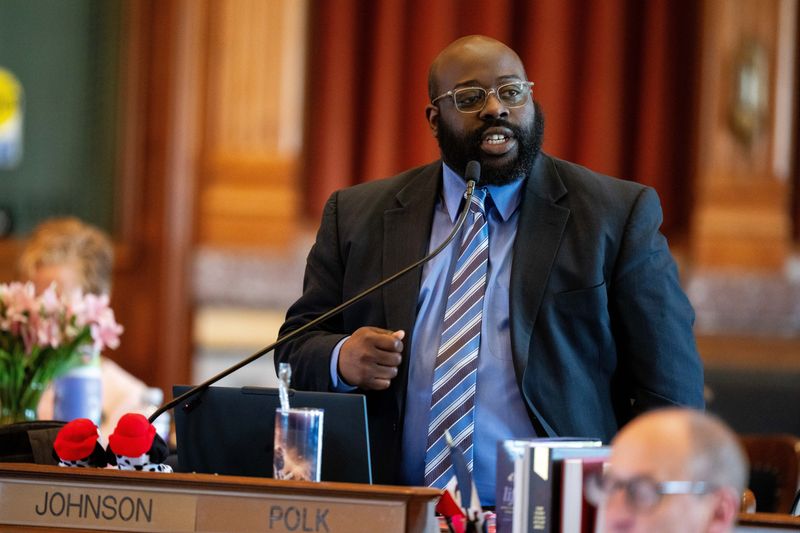
During debate in the House, Rep. Rob Johnson, D-Des Moines, criticized the legislation for creating additional costs to the prison system, which will have to house more inmates. Instead, he said Iowa should invest in community-based alternatives to incarceration, drug courts, mental health services and reentry programs.
“Mandatory minimums do not deter people from committing crimes,” he said. “They do not reduce any recidivism rates. But one thing that they have proven is that they pack out prisons and they blow up our corrections budget. And it disproportionately devastates some communities — communities that are sometimes already overrepresented in our criminal and legal systems.”
House Republicans’ ‘tough on crime’ push goes against national trends
House Republican leaders signaled at the beginning of the legislative session that they would pursue a “tough on crime” approach, with the steeper sentencing the centerpiece of their effort.
Lawmakers also passed a separate bill, Senate File 2399, that raises Iowa’s bond amounts for the first time since 2017 and requires judges and magistrates to justify in writing if they set a lower bail than what is recommended.
Holt said that with the totality of the changes to Iowa’s criminal justice system this year, “we will have taken real and tangible steps to make Iowa an even safer place to be.”
“Career criminals should pack their bags and find another place to be criminals because we are slamming the door,” he said.
Iowa’s stricter sentencing laws come as some states, and the federal government, have rolled back their own harsher sentencing for repeat offenders.
The Iowa Department of Corrections consistently reports operating above its capacity for inmates. As of May 2, Iowa’s prisons were 27% overcrowded, with 8,897 inmates compared with a capacity of 6,990.
At the same time, the department says Iowa’s recidivism rate at its lowest point in a decade: 32.8%.
FBI data show property crime and violent crime have also fallen in Iowa over the last five years.
Lawmakers set to ban warrant resolution clinics after Polk County shooting
Republicans were also set to act in the final hours of Iowa’s legislative session to ban warrant resolution clinics — which allow people with outstanding warrants to meet with a judge, schedule a new court date and have their warrant lifted.
The Polk County Attorney’s Office and other agencies hosted an April 3 warrant resolution clinic, which was attended by Sharneeka Evans, who had her warrant withdrawn and was accused one week later in the slaying of Ashley Marie Hall of Des Moines.
Republicans argued that warrant resolution clinics subvert the justice system and encourage people to avoid turning themselves in.
Democrats agreed that the Polk County Attorney’s Office should have handled the clinic differently and looked harder at Evans’ criminal history before recommending her warrant be recalled, although they said the process could be overhauled rather than prohibited.
Hall’s father has said he doesn’t blame the clinic for his daughter’s death.
The House voted 71-20 on April 29 to pass the bill, House File 2787. The Senate sent it to Reynolds’ desk with a 31-12 vote on May 3.
“It is undeniable that there was one warrant clinic held, and afterwards, one murder. It is my hope that we can continue to work together to find ways to expedite justice for the victims of crimes as well as for the punishment of offenders,” Bousselot said. “But this was a failed experiment and somebody lost their life, and this is the response that is appropriate from the state.”
Sen. Tony Bisignano, D‑Des Moines, said lawmakers shouldn’t hinder local efforts to cut jail time and the property tax costs that fund jail stays.
“It’s in the heat of the moment as a legislature to seize the opportunity for a headline to squash what Polk County was trying to accomplish to get peoples’ warrants cleared and get on with their lives,” he said. “These weren’t people (with) violent felonies that they were dealing with. It’s just unfortunate.”
Des Moines Register Statehouse reporter Marissa Payne contributed to this article.
Stephen Gruber-Miller covers the Iowa Statehouse and politics for the Register. He can be reached by email at sgrubermil@registermedia.com or by phone at 515-284-8169. Follow him on X at @sgrubermiller.
(This article was updated to add new information.)
This article originally appeared on Des Moines Register: Iowa lawmakers approve pared-down ‘3 strikes’ law for felony offenses
Reporting by Stephen Gruber-Miller, Des Moines Register / Des Moines Register
USA TODAY Network via Reuters Connect