

By Derek Smith

Long before Elon Musk introduced his now-famous Tesla, the entrepreneurial spirit of William C. Anderson had invested itself in manufacturing electric vehicles in Detroit, Michigan. A staggering one hundred and one years earlier, Anderson’s pioneering efforts in EV technology laid some groundwork for the electric vehicle industry we know today.
Anderson was born on August 3rd, 1853, in Milton, Ontario, Canada. His parents were Hiram Anderson and Ann Cummings, both born in the Halton Region of Ontario. He was the middle child of five siblings.

In the 1860s, the Anderson Family embarked on a brave new chapter in their lives. They left their Canadian home and settled in the United States, their first stop being Lexington, Michigan.
Lexington was a busy community. Its residents found employment in sawmills, linen mills, furniture manufacturing, boat repair, water port services, and several hotels, bars, and restaurants. The Anderson family operated a farm tool and equipment business there.
After completing his business school education in 1874, William joined his father in their family business, Anderson & Company. The business dealt with agricultural implements, cutters, sleighs, buggies, carriages, wagons, etc. The business reinforced young Anderson’s curiosity for marketing and mechanics, laying the foundation for his future in transportation and manufacturing.
After conducting business in Lexington, Michigan, for a few years, the Andersons moved their enterprise to Port Huron, Michigan. In 1875, Hiram and his son William rented a building that the Sunday Commercial had previously occupied and stocked with their merchandise. The Sunday Commercial was a local newspaper owned by the Talbot brothers.
The Anderson family would purchase a home on the corner of Kearney and St Clair Streets, an area now occupied by McLaren Hospital.
Under the leadership of William C. Anderson and his father, Anderson & Company flourished. The business secured distributorships for several prominent farming supply brands, gained recognition from farmers across eastern Michigan, and established itself as one of Port Huron’s leading enterprises.
This success would allow William Anderson to purchase his own home.
Into that home, on January 5th,1880, he would move his new bride, Ida Beard, a
daughter of one of Port Huron’s leading businessmen, James Beard. They were married that day in the rectory of Port Huron’s Grace Church.
Together, they would have two daughters, Agnes Lynelle, born in 1882, and Mary Hope, born in 1885.
By 1882, the business had grown exponentially, and a new property was acquired to meet its growing needs. A vacant building at 316 & 318 Huron Ave, in Port Huron, was purchased for $4500.00, and a renovation was completed for $7000.00.
At 8000 square feet and two stories high, it was the most significant agricultural wareroom in Michigan, Ohio, and Indiana.
Anderson &Co. established branches in Minden and Marlette, Michigan, and maintained dealers across the country who sold the company’s products on a commission basis.
Sales for the year 1882 amounted to $200,000, which is over six million in today’s dollars.
In November 1884, Hiram Anderson retired from the firm, and their enthusiastic bookkeeper, David Goodwillie, and Williams’s brother-in-law, Frank Beard, would purchase an interest in Anderson & Co.
William Anderson’s new goal was to start a business solely owned. So, he sold his interests in Anderson & Co. to the partners in 1892 and opened a company making carriage tops and other accessories for horse-drawn carriages. The new company would be Anderson Carriage Manufacturing, located at 310 and 314 Michigan Street in Port Huron.
Frank Beard, David Goodwillie, and Campbell formed Beard Goodwillie and Company and continued sales out of the 310-314 Huron Avenue address.
Despite his initial success, Anderson faced significant challenges from a recession and increasing competition from Detroit. However, he saw these obstacles as opportunities for growth.
To quote Winston Churchill, “A pessimist sees difficulty in every opportunity. The opportunist sees opportunity in every difficulty.”
Following his instincts, Anderson closed the Port Huron facility in 1893 and established a new plant in Detroit, the Anderson Manufacturing Company. This decision in 1895 marked the beginning of his journey into the electric vehicle industry.
He built a two-story factory, about the same size as the facility in Port Huron, in the Milwaukee Junction area at the confluence of the Detroit & Milwaukee Railroad and the Grand Trunk Railroad.
He brought two partners, William Pungs and lumber baron William A Locke.
In 1898, Loche and Anderson had money issues with the company’s treasurer, Pungs, who was forced to resign. Loche moved in to fill Pung’s role.
In May 1899, the company’s name changed to the Anderson Carriage Company, with Anderson, Locke, and Cyrenius A. Newcombe, a department store magnate, as shareholders.
William Phelps McFarlane, the long-time plant manager, would be elected secretary in 1900.
By 1902, William Anderson was becoming a man of considerable wealth. He had a fine two-story home built for him at 65 Rowena, a wood block paved street that would later become Mack Avenue. Anderson would ride the two miles to work on one of his prized thoroughbred horses, his faithful dog trotting alongside.
By 1903, the Anderson Carriage Company had become one of the largest manufacturers in Michigan. Its facilities were in two buildings, each two stories and almost 55,000 square feet.
William C. Anderson’s influence extended far beyond his business ventures. His social circle expanded to include Thomas Edison and Henry Ford, two iconic figures in electrical innovation and automobiles. These friendships enriched his personal life and underscored the magnitude of his influence in the industry.
Like Studebaker’s entry into the electric car business in the early 1900s, Anderson started making automobile bodies for local manufacturers. As this business grew, he advanced the idea of making his brand of electric vehicles.
In October 1906, George M. Bacon, an engineer who designed a successful electric vehicle for the Firestone family, entered William C. Anderson’s office. There, they discussed the manufacture of electric cars. William C. Anderson’s innovative spirit was duly impressed with Bacon’s experience and knowledge in the electric car industry, leading to the creation of an electric prototype, the Model A Victoria, in just four months.
The prototype, dubbed “the Model A Victoria,” achieved 140 miles on a single charge and had an average speed of just over 12.5 mph.
Bacon became a full-time employee and was charged with designing and building the Anderson Carriage Company’s new “Detroit Electric” vehicle brand.
On September 9th,1907, the Anderson Carriage Company burned to the ground; however.
Anderson would still deliver its first Detroit Electric on September 30th, 1907.
As a result of the fire, Anderson shipped only ten vehicles that year.
In December 1907, a new steel-reinforced concrete building, three floors high and 27,000 square feet, was completed to replace the old building.
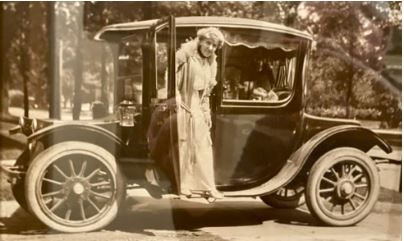
Over the following months and years, the Anderson line-up of electric vehicles developed a reputation for being well-built, comfortable, and easy to drive. Many of its customers were doctors and women who found it easy to manage and operate, using it for shopping and other short excursions around town. The car did not require hand cranking, as did most combustion engine vehicles in those years, and the ride was smooth and the start instantaneous.
Many vehicles featured plush trim, abundant upholstery, delicate curtains, and polished brass fittings, which helped to grow this market.
Between 1908 and 1910, two thousand five hundred fifty Detroit Electrics were built.
Henry Ford, who manufactured Model T’s just down the street, purchased a Model C Coupe for his wife, Clara, in July 1908. Other owners included the wives of Thomas Edison, John D Rockefeller, Henry Joy, owner of the Packard Motor Car Company, Mamie Eisenhower, and even the infamous Lizzie Borden.
At this time, Ford’s Model T was selling for 850.00, while Anderson’s cheapest electric car, a chain-driven Model L Roadster, was $1400.00.
On October 27, 1909, to satisfy his continuous need for electrical components, Anderson purchased the Elwell-Parker Electric Company of Cleveland, Ohio, the world’s largest manufacturer of electrical motors. Along with the company came plant manager M.S. Towson, who would prove a valuable employee to the Anderson Company over the following years.
The Detroit Electric Model 60 had a top speed of 20 mph and a range of about 80 miles. It was powered by 14 six-volt Edison batteries, which varied the car’s speed by transitioning via a controller from a parallel to a series configuration, depending on which of the five selected speeds.
Thomas Edison gave Anderson exclusive use of his nickel/iron batteries, which used potassium and lithium hydroxides as electrolytes. Edison guaranteed a four-year rating capacity. If correctly maintained, the battery’s life has extended past five years, and some 100-year-old batteries are still functional today.
Part of the success of the Detroit Electric depended on the ability to charge and maintain those 14 batteries.
Anderson built charging stations to address this need and made agreements with two private ones, much like Tesla does today with its thousands of charging stations.
1909, the Anderson Carriage Co. established a Chicago branch, where Detroit Electric was well received. Other factory branches were organized in New York, Kansas City, Cleveland, and Buffalo. Anderson’s experience creating company dealerships during his days in the carriage and farm implement business served him well as he set up new markets and distribution networks.
In 1911, the company was reorganized as the Anderson Electric Car Company to reflect its
move from carriages into its now main automobile-making activity. They had a nine-member board of directors, which included Anderson, Locke, Newcombe, and Bacon. (vi)
The following year, the Anderson Electric Car Co. became the leading producer of electric cars in the U.S.A., with 978 units shipped.
The Detroit Electric cars featured battery packs in the front and rear, curved side glass, which helped eliminate blind spots, and aluminum bodies, which reduced some of the car’s weight caused by the heavy battery packs.
Production exceeded 4,500 units in 1914. Two years later, however, as World War 1 continued in Europe, manufacturing fell to 3,000 cars.
1916, Anderson purchased the Chicago Electric Motor Company even though production numbers continued to fall. Through the end of the war in 1918, the company averaged just 2000 vehicles per annum.
In 1918, William C Anderson retired, leaving the company in the good hands of M.S. Towson, formerly of Elwell-Parker, who joined the Anderson Co. after its acquisition in 1909.
While Anderson remained president, Frank Price and George Bacon took over the company’s management.
As the company entered the 1920s, it placed an added emphasis on manufacturing car bodies for medium-priced car companies in the Detroit area, including the 1921 Lincoln L.
In 1922, M. S. Towson, now a significant shareholder, reorganized its production of body-building activities into the Towson Body Co. Towson would inherit all of Anderson’s remaining body contracts, including Lincoln body types 101-107. Additional agreements were signed with Packard and Detroit-based builders Velie and Davis.
The recession began in 1929 and would negatively impact only the electric car industry.
Combustion engine vehicles were selling for far less than their electric cousins.
Henry Ford sold 15 million Model Ts from 1908 to 1927, some priced under $500.00.
At a time of high unemployment, little or no social assistance, falling wages, and families struggling to feed themselves, purchasing an electric car was impossible for most Americans.
New oil discoveries on America’s West Coast drove the cost of gasoline down, making combustion cars cheaper to drive. As a result, demand for electric vehicles continued to fall rapidly.
The average weight of Detroit Electric was 2526 pounds, while that of gas-driven combustion cars was 800 pounds. The new car market opted for cheaper, faster, and more powerful gas-powered vehicles.
Detroit Electric continued to produce a handful of orders through the 1930s, but most of its business came from the production of small delivery trucks.
The Detroit Electric would never heal from the effects of the depression. A. O. Dunk, a car company liquidator, would acquire it in 1929.
Dunk attempted to reorganize the company under the name Detroit Electric Vehicle Mfg. Co. and managed to keep it in business for several years until he died in 1936.
The last Detroit Electric would be completed in 1938, and the firm dissolved, having outsold, outproduced, and outlasted all its competition in electric vehicle manufacturing.
About 13,000 Detroit Electric models would be delivered during the company’s lifetime.
William C Anderson passed away at his home on Lakeshore Drive in Mt Clemens after suffering a cerebral hemorrhage on November 9th, 1929, 11 days after the stock market collapse.
His 76 years on this earth were filled with love for his family, his never-ending quest for learning, his passion for growth and discovery, and that insatiable curiosity about the world that follows great inventors every day of their lives.
