

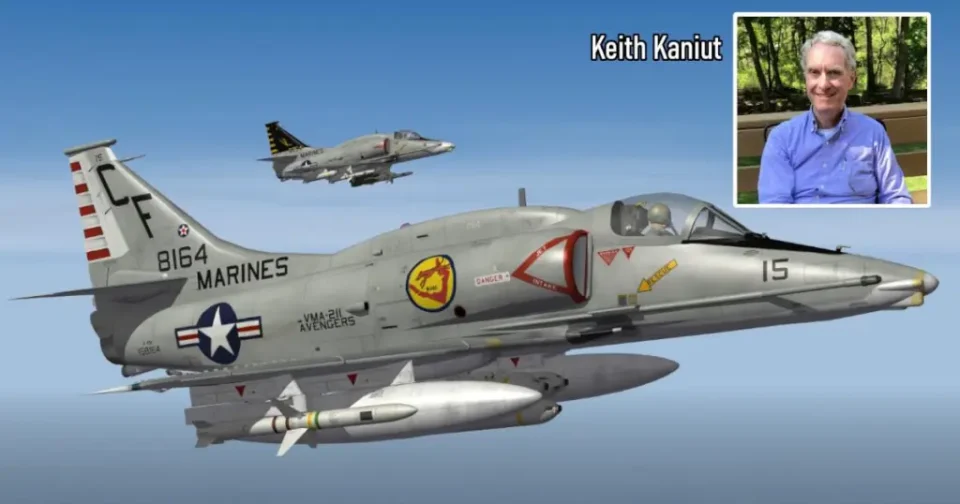
By Keith Kaniut

When I was a student Naval Aviator in flight training in Kingsville Texas in the late 70’s, one of my flight instructors was a Marine A-4 Skyhawk pilot. His call sign was “Lucky”. We wondered whether he was good at cards or in Vegas. Then one day he told his story and we understood. That call sign was well-earned. By all the normal laws of physics and chance, he should have been singing with the heavenly choirs. Instead he had lived to tell about it and was trying to make sure that no one else ever repeated his mistake.

Captain Lucky earned his Naval Aviator wings and transitioned to the single-seat A-4 Skyhawk flown by the Marines. The Skyhawk was subsonic, had less range and carried a smaller payload than its larger Navy contemporaries but it was durable, agile, and fun to fly. The Marines used it for short range close air support of the ground troops. The planes would be “forward located” at an airfield close to where the ground troops were operating and when needed, they could scramble and arrive quickly to make the enemy’s day less pleasant.

Captain Lucky joined his first Marine Corps squadron shortly after the end of the Vietnam War and like all freshly-minted Marine Skyhawk pilots, he still had a lot to learn. The Skyhawk’s mission was to drop bombs and break things. It had a relatively primitive bombing computer and bombsight and you needed a lot of practice to reliably and accurately deliver the unguided bombs and rockets on target. Pilots trained as frequently as the squadron budget and scheduled practice target areas’ availability permitted.
Senior pilots briefed and led these training flights of two to four aircraft. On a typical daytime training mission the aircraft launched in formations of two aircraft but at night you launched alone and flew to a nearby rendezvous point to join up on the Lead aircraft. The Flight Lead aircraft flew a 25-degree angle of bank left-hand turn with the 3:00 o’clock position of the circle located at a designated distance and compass direction from the briefed navigation beacon (ex: radial 150 @ 25 miles.) Lead’s first responsibility was to stay at the briefed altitude and airspeed at the rendezvous point until all aircraft were joined up.
The remaining aircraft flew to the rendezvous point, looked for the lead aircraft and joined up. The advantage of a multi-plane formation was that the Lead aircraft could do all the navigation and radio communication while the other aircraft just flew formation, maintaining their position by lining up the leading edge of the wing and the trailing edge of the rear stabilizer (Each aircraft type used slightly different alignment points.). The multiple aircraft close formation wasn’t used in a combat area where enemy fighters or ground defenses (Surface to air missiles) were present. Instead, we used a more widely-separated combat formation that allowed every pilot to visually scan for threats in all quadrants. These ground-attack aircraft typically did not have a air-to-air radar capable of detecting enemy aircraft. The pilots depended on their eyes and those of their wingmen – very much the same as in both WWI and WWII!
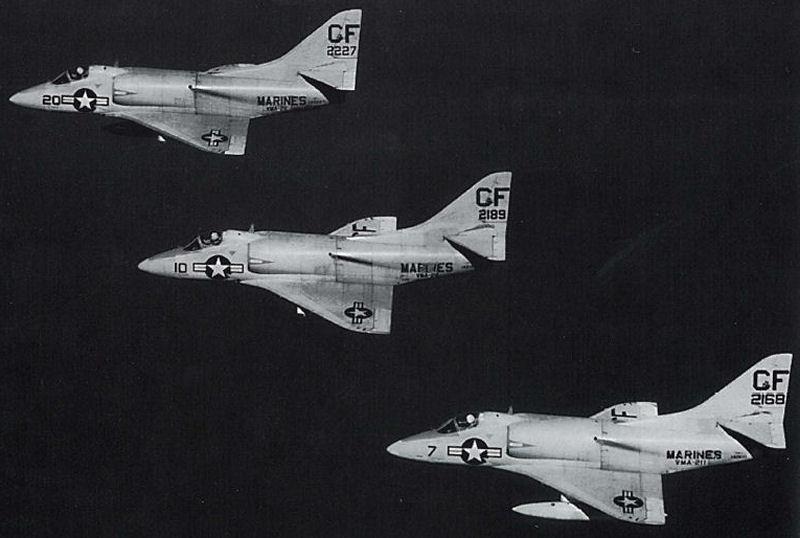
To join in formation, the wingman flew first to align with the Lead aircraft’s wing leading edge, and then moved closer until he could look straight across the trailing edge (back) of the horizontal stabilizer (horizontal tail).

One night Captain Lucky (then a 1/LT) launched with three other Skyhawks to practice their night bombing. They were flying out of a Marine Corps Air Station near Beaufort, South Carolina and the rendezvous point was over the bay at 3,000 feet MSL below a low cloud layer. As one of the junior pilots Captain Lucky launched last so when he arrived at the rendezvous point the other aircraft were already joined up on the Flight Lead. Captain Lucky began his rendezvous. It was pitch black under the overcast – no stars or moon to illuminate the horizon. There were some scattered lights from ships but that just made it harder because in the low visibility you couldn’t tell whether they were ships or stars and it was disorienting if you didn’t trust and fly your instruments.
He focused on flying into the proper position to start the join-up. It was hard to see the proper alignment with the wing because of the multiple aircraft joining up. He worked hard to maintain his airspeed while trying not to lose sight of the other aircraft. This was much harder than any previous flights.
Suddenly Captain Lucky woke up. It was as dark as the bottom of a coal mine. Where did that thought come from? What the heck! The Skyhawk wasn’t airborne. It was motionless, upright (thank God) and quiet except for the sound of water flooding into the cockpit, coming up through the floor. He still wore his oxygen mask and could breathe but his feet and legs were already underwater. The cold water must have been what awakened him. He thought – I flew into the water and I’m sitting on the bottom!and How do I get out of here?!
He tried to remember the Emergency Procedure for escaping an aircraft underwater. Was there one? Should he try to eject? Nobody expected you’d survive crashing into the water as he’d done. He figured the closest procedure was the one for “ditching”. He quickly released his four-shoulder harness and lap buckles and thought about the order of the next steps. If he got these wrong, he’d never make it.

First, with one hand on the life vest inflation toggle, he took a deep breath and with the other hand, pulled the canopy eject handle. This released the latches and pushed the canopy open enough for him to escape. The water immediately rushed in as he inflated his life vest and he prayed he wouldn’t get stuck on anything as he exited the cockpit. He kicked clear of the cockpit and felt himself rising to the surface. He remembered to exhale as he ascended to prevent bursting his lungs. Within a few seconds he was bobbing on the surface of the bay.
The details of the subsequent rescue were a little fuzzy – at least in the retelling a few years later when Captain Lucky told the story to me and my fellow flight students. No one could explain how he survived flying into the water at almost 250 mph! I guarantee that his cautionary tale on how Not to do a night rendezvous left a lasting impression. We never forgot his two lessons: “Altitude is Life!” and “Always Watch your altitude!!”
