Voters will face a ballot question this fall that would make it harder for Iowa lawmakers to raise income taxes.
Senate Joint Resolution 11 cleared the Iowa House in a 57-21 vote on Sunday, May 3, giving approval to put a proposed amendment to the Iowa Constitution before voters that would require a two-thirds majority vote of the state Legislature to increase income taxes.

It has now passed two consecutive General Assemblies and can be placed on the Nov. 3 ballot.
Currently, all legislation in Iowa, including tax changes, requires a simple majority of the Iowa House and Senate. Requiring a two-thirds supermajority would significantly raise the difficulty of increasing taxes.
The measure would discourage the reversal of Republican-led income tax cuts passed in recent years, which have lowered Iowa’s rate to a 3.8% flat tax.
It would apply to proposed changes to Iowa’s individual and corporate income tax rates, as well as rates on legal or special reserves.
Both the Iowa House and Senate passed the same language in 2024, and this year’s vote allows the measure to be placed on the ballot, where a majority of voters will decide whether to add it to the Iowa Constitution.
Riled-up Democrats take issue with Republican-backed tax policy
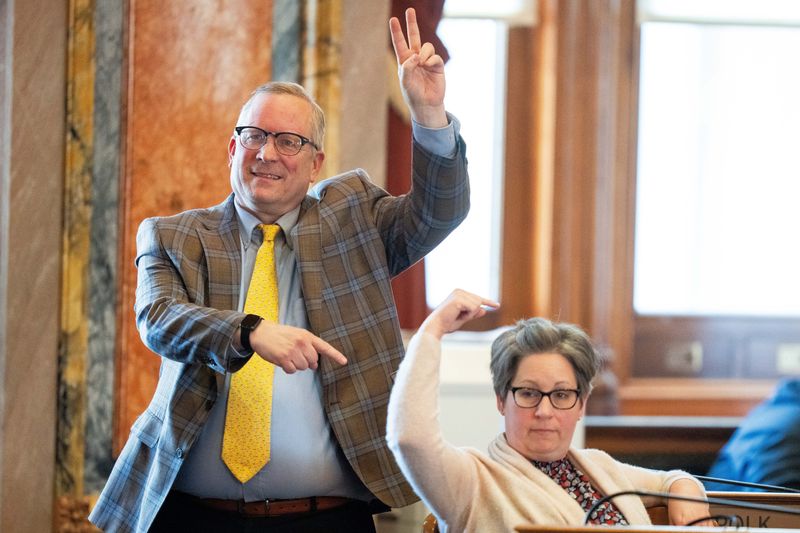
House Democrats introduced a flurry of amendments to unleash their discontent with the measure and other policies the GOP-led Legislature enacted during a morning otherwise mostly spent waiting for votes on the final budget bill and property tax legislation.
In a nearly hour-long debate, those failed changes would have required a two-thirds vote by each chamber across two General Assemblies to increase taxes on grocery food items and health care; raise lawmakers’ pay, state fees or spending on Iowa’s education savings account program that diverts public dollars toward private school expenses; raise corporate income tax credits; hike individual income tax rates (stripping the corporate income tax language from the measure); or use money from Iowa’s Taxpayer Relief Fund.
Democrats also pitched an exemption from the two-thirds requirement any increase to taxes on those earning more than $1 million that Republicans rejected.
Rep. Dave Jacoby, D-Coralville, said those proposed amendments from his caucus shared a theme of “protect(ing) Iowans from unnecessary taxation.”
“Democrats want a vote of the people,” Jacoby said. “Democrats want to get it right. The budget is in a mess. This constitutional amendment does not protect our middle-class and hardworking Iowans. … We’re protecting tax loopholes, not protecting taxpayers. This amendment as written is unworthy of being on a November ballot.”
Rep. John Wills, R-Spirit Lake, said this measure gives Iowans the protection of a two-thirds majority to increase their income tax, should they choose.
“You’re acting as if it’s just going to automatically take place and be law, be part of the constitution,” Wills said. “No. Iowa voters will decide next November. I think that’s a great thing.”
Opponents raise concerns about state budgeting under GOP
Pam Mackey Taylor, representing the Iowa chapter of the Sierra Club, said during an April subcommittee hearing it would hinder future lawmakers’ ability to manage state finances.
A March estimate from Iowa’s three-member Revenue Estimating Conference predicts Iowa will take in $8.47 billion in revenues in fiscal year 2027, which begins July 1.
Before adjourning, Iowa lawmakers must consider a $9.65 billion budget for the coming fiscal year, which would leave a $1.2 billion gap between spending and revenues.
Republicans plan to make up the difference by drawing money from Iowa’s Taxpayer Relief Fund, which holds about $4 billion.
The revenue drop is caused primarily by the state’s recent income tax cuts, and Republicans maintain they’ve always intended to use the relief fund to supplement the budget until revenues recover.
Mackey Taylor said it is “precarious to use the reserve funds for one-time expenses at the current rate.”
“This constitutional amendment would tie the hands of future legislatures and how they’re going to handle the state’s finances when the revenues are not meeting the expenses, when the reserve funds are drained and when the public expects the services they are getting, wanting or needing from state government to be met and cannot be paid for with existing revenues,” she said.
Supporters call the measure a ‘prudent safeguard’
Tyler Raygor, Iowa state director for Americans for Prosperity, said during a subcommittee the measure is “a prudent safeguard against reckless spending and over-taxation of Iowans.”
“We think requiring broad consensus rather than narrow majorities promotes fiscal responsibility and also protects against impulsive tax hikes that could have devastating effects on our economy and the Iowa families and businesses whose hard-earned dollars would be taken,” Raygor said. “And we think that this approach strikes a perfect balance between the needs of government and the budgets of Iowa families and businesses.”
Wills defended the GOP’s budgeting practices.
“What we have happening right now was planned,” Wills said. “This is exactly what’s supposed to be happening. We are in good fiscal shape. This notion that we’re in a fiscal death spiral is phooey.”
Marissa Payne covers the Iowa Statehouse and politics for the Register. Reach her by email at mjpayne@registermedia.com. Follow her on X at @marissajpayne.
This article originally appeared on Des Moines Register: Iowans vote this fall whether to make it harder to raise income taxes
Reporting by Marissa Payne, Des Moines Register / Des Moines Register
USA TODAY Network via Reuters Connect