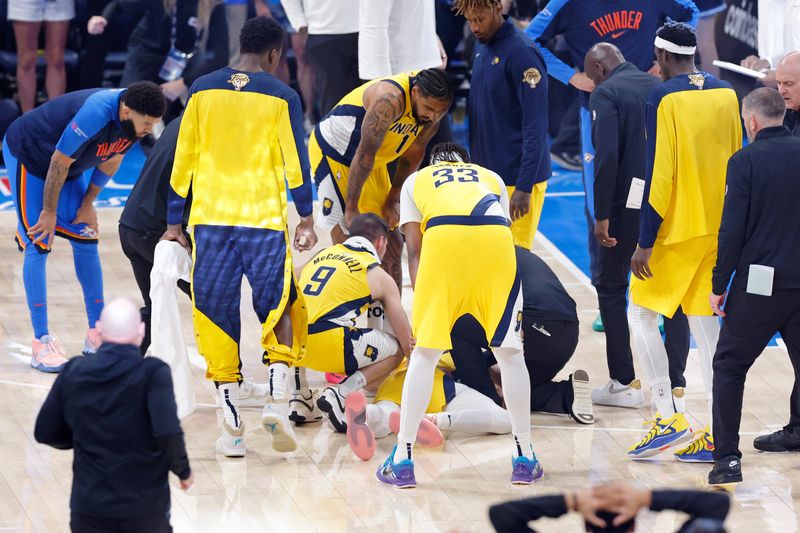
The injury itself, the pain it caused and the aftermath it was sure to unleash was bad enough. Horrible, even. Truly gut-wrenching, in the makes-your-insides-literally-hurt sort of way.
But as Tyrese Haliburton laid prone on the Paycom Center floor in Oklahoma City, just minutes into not only the biggest game of his life but the biggest sort of game basketball can offer, there was something else that made it especially demoralizing and heartbreaking.

The fact that Haliburton, dealing with a troublesome calf strain, was almost certainly warned about this exact possibility. The worst-case scenario. The career-upending risk he was taking by playing the stretch run of the NBA Finals.
Because, as the former Iowa State star laid there, pounding the floor with his fist and writhing in pain, he knew what had happened. He knew that balky calf muscle had stressed his leg, and that it gave way without warning in the first quarter of Game 7 because his Achilles tendon had ruptured.
He took the risk to win a championship for himself and his teammates. To deliver a title to basketball-obsessed Indiana. To realize a childhood obsession.
Instead of being rewarded for that risk with a ring, he had to watch from the locker room as his Pacers simply couldn’t keep up with Oklahoma City, which then celebrated its first-ever championship on that same floor where Haliburton’s dream met a nightmarish end.
“What happened with Tyrese, all of our hearts dropped,” Indiana coach Rick Carlisle told reporters after the game. “He authored one of the great individual playoff runs in the history of the NBA with dramatic play after dramatic play.
“It was just something that no one’s ever seen and did it as 1 of 17 (players on the team). You know, that’s the beautiful thing about him. As great a player as he is, it’s always a team thing.”
The “team thing” is undoubtedly what sent Haliburton out on to the floor in the first place, despite knowing what a calf strain in the Finals did six years prior to Kevin Durant.
The same injury. The same prognosis – an entire lost season ahead and an uncertain future beyond.
Because an Achilles injury is one of the few remaining that modern sports medicine has not conquered. It’s almost universally a year-long recovery process and there’s no guarantee a player will return as he was.
It’s certainly not impossible. Durant and Kobe Bryant both returned from Achilles tears to remain All-Stars, and they both were in their 30s when the injury occurred. Haliburton is just 25 and has never been daunted by difficult odds or the hard work needed to overcome them.
He’ll be back, and I’d guess at an All-Star level. Maybe even as an MVP candidate. He’s young enough, talented enough and determined enough to make this the setback that becomes a comeback that can define Hall of Fame careers.
But it remains acutely awful that these are the circumstances he finds himself in, born largely out of unselfishness, collective ambition and unrelenting competitiveness.
Simply, it stinks. But it’s also far from the end of the story.
Let’s dive into a couple more topics that members of the Register’s Cyclones text-message group are asking about.
What are the chances lawmakers or the Board of Regents will make any adjustments to funding options for the state schools’ athletics programs?
It would be a welcome development for Iowa State athletics if there was a money tree it could shake from either the university system or from the state government, but I think that’s much less than a 50/50 proposition.
Given the funding levels we’ve seen from the state of Iowa for higher education – and the bigger uncertainty on how universities are being handled currently by the federal government – I think it’s highly unlikely we see department-changing money making its way from the Capitol or the BOR to the Jacobson Athletic Building.
In a world of DOGE, it’s difficult to imagine the state of Iowa wholesale abandoning its position that athletics departments at Iowa and Iowa State should be self-sustaining. Even with a new $20 million revenue-sharing line item every year, the gobs of money the Big Ten and (to a much lesser extent) Big 12 deliver to both universities from massive TV contracts doesn’t exactly make them wholly sympathetic figures at the statehouse, either, I’m guessing.
Talking to people in and around Iowa State athletics, there’s a wish that might change in this new college sports landscape, but certainly not an expectation.
I think maybe there could be a path to a more moderate middle ground. Like, say, a university president being given the discretion to use, let’s say marketing dollars from the university proper, to help fund revenue sharing. Because, technically, revenue sharing is buying name, image and likeness rights from student-athletes, which, again technically, falls into a marketing bucket.
It’s not a difficult argument to make that the athletics departments at Iowa and Iowa State are some of the most effective marketing either university has.
At least that’s how I, a humble sports writer in the “toy department” of the newspaper, see the political landscape for this. Though it’s worth noting with Gov. Kim Reynolds opting not to seek another term, we’re about 16 months away from an election that will put a new person in Terrace Hill.
Could that change the political calculus on this topic? Could that be a campaign issue?
Given that, it’ll be interesting to see how much noise universities and, maybe more important, potential voters make on this issue in the run-up to November 2026.
I heard yesterday that walk-ons are going to be a thing of the past. Is that true? Athletes will no longer have an opportunity to compete as walk-ons?
No, it is not true that walk-ons will cease to exist in a post-House settlement and revenue sharing world. It is likely true, though, that those opportunities and their numbers will decrease.
Gone are the scholarship restrictions of yesteryear and in are roster limits, 105 in football’s case.
Which means programs could have 105 players on scholarships, though the expectation is most will be around the 85 previously allowed as the cost of scholarships for players 86-105 likely far outstrips their value when dealing with a $20.5 million revenue-sharing cap.
So that generally means there will be about 20 walk-on spots for a football program. That’s about half (or a little less) than typically were on an Iowa State football roster.
It’s also worth noting that the system implemented by the House settlement is almost certainly going to be challenged in court (likely on a number of different fronts). So this setup isn’t necessarily a long-term one. And who knows what happens if Congress decides to try to legislate a system that gives the NCAA an anti-trust exemption.
But, for now, walk-ons are going to be down significantly in number.
Iowa State columnist Travis Hines has covered the Cyclones for the Des Moines Register and Ames Tribune since 2012. Contact him at thines@amestrib.com or (515) 284-8000. Follow him on X at @TravisHines21.
This article originally appeared on Des Moines Register: Cyclones mailbag: Tyrese Haliburton, RevShare help from the state and fate of walk-ons
Reporting by Travis Hines, Des Moines Register / Des Moines Register
USA TODAY Network via Reuters Connect