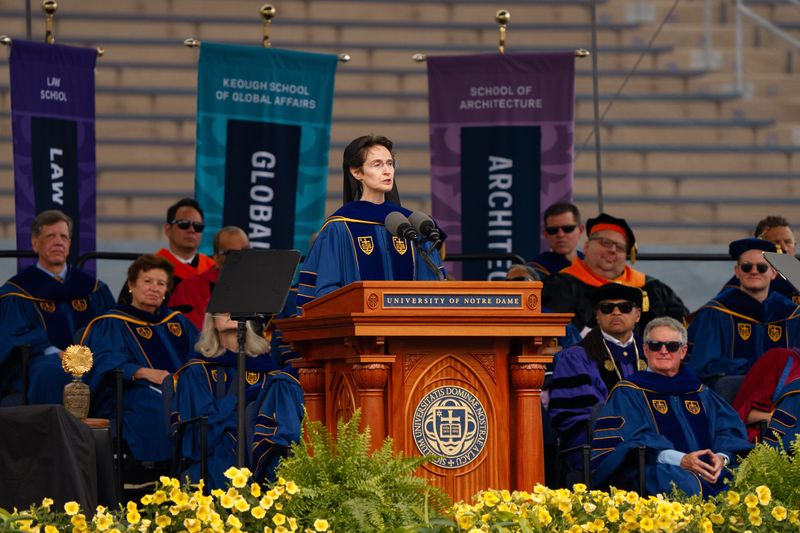
NOTRE DAME — Sister Raffaella Petrini, president of the Pontifical Commission and president of the Governorate of Vatican City State, emphasized hope as the 3,335 University of Notre Dame graduates stepped out into a world that “undoubtedly presents a very difficult setting” Sunday, May 17.
Petrini colored a picture of looming dark clouds pierced by the powerful light of hope. She repeated something Pope Leo XIV said, “Hope is generative.” She urged the graduates to be beacons of hope, to cultivate hope and to be people of hope.

“We must continue to be pillars of hope,” Petrini said. “To hope in life means to believe as certain what we still cannot see or touch.
“We entrust in ourselves to the love of a father who created us because he wanted us with love … and wants us to be happy. Christians are always called to communicate hope.”
Wintesses of hope
Petrini is the first woman in the history of the Vatican to hold the roles of president. She was appointed in February 2025 by Pope Francis.
During the commencement, she and six others were awarded a honorary doctoral degree by provost John McGreevy.
“As difficult as academic doctoral degrees are to earn, honorary doctoral degrees are even more difficult,” McGreevy said. “Honorary doctoral degrees are not awarded for demonstrating the potential to improve the world, or rather, for actually improving it.”
Just as hope may be generative, Petrini said, hope offers the graduates a time of new beginnings strengthened by their interdisciplinary knowledge, personal roles and strengths. She believes this new beginning presents an opportunity to put into practice all the things they have learned.
“Hope is active,” Petrini said. “You will be witnesses of hope if you nurture and generally desire to [alleviate] poverty, injustice and oppression that burden the lives of so many in material and immaterial forms.
“In this way, what you have achieved here on campus will rightly serve the virtual justice,” she said. “You will be witnesses of hope if, wherever you are, you strive to create a sense of human solidarity that counteracts selfish competition and cures the virus of individuals because the primary concern that drives you is the common word. Then your actions will be guided by the desire to heal what is broken, to forgive what has fallen, to create safe spaces for mutual sharing, where human fragility is embraced. Hope is collaborative.”
Warmth in a cold world
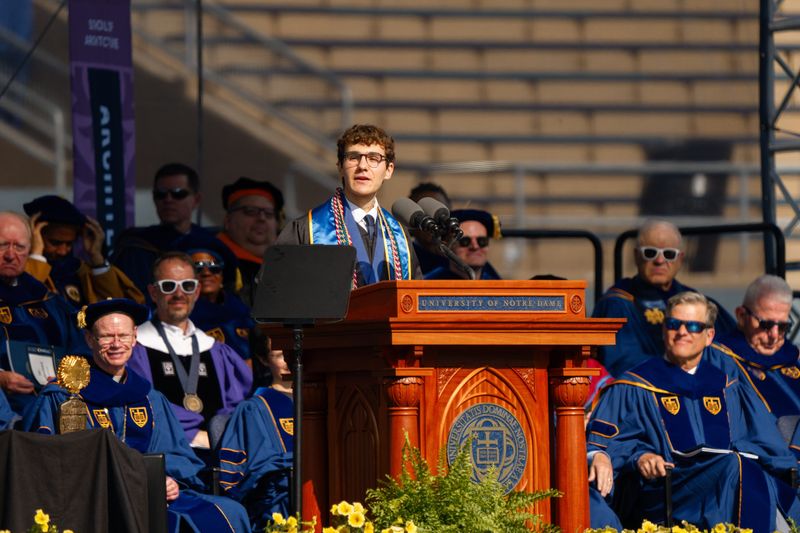
Notre Dame’s valedictorian, Martin Soros, spoke of cultivating warmth despite the frigid temperatures of fragile humanity.
In 1842, the Rev. Edward Sorin founded Notre Dame.
“He arrived in the middle of a cold winter, welcomed by two frozen lakes,” Soros said. “As he gazed upon the rigid landscape, he wrote, ‘Everything was frozen and yet it all appeared so beautiful.’”
In January, Soros and a friend took it upon themselves to build an icy chapel on Notre Dame’s North Quad — St. Olaf’s ice chapel, as it became known. He said they worked using any materials they could find: recycling bins, bunkbed ladders and even a car hood. The days passed and more snow continued to fall. Classmates began to show up and help.
“On a frigid Monday night, we came together for Mass — students, staff, members of the South Bend community,” Soros said. “In 19-degree weather, we huddled around this chapel made of ice.
“In this moment we discovered that we had built more than just a structure,” he said. “Together, we had built a community.”
His message left the crowd with a chill. Cultivate warmth in a world “paralyzed by the cold of indifference.”
Soros told the crowd that he had felt this cold in himself, and he bet that those listening have, too. His example was one many people could likely resonate with.
“I think of all the times I’ve been walking down the street, focused on my destination when I come across a man sitting on the curb,” he said. “I immediately become uncomfortable. I start fidgeting. I glance in the other direction. I pretend he isn’t there.
“I’m afraid to look at his fragile humanity for fear that he will see mine,” Soros said.
He believes this cold is not a threat but an opportunity for people to create sacred spaces of encounter.
The commencement ended with a concert by the High Kings. Students swayed and stood to throw their caps in the air. As faculty and administrators left, some students danced — one group of young women graduates danced the Rockette Kick line — and others took group photos.
Email Tribune staff writer Juliane Balog at jbalog@usatodayco.com.
This article originally appeared on South Bend Tribune: Sister Raffaella Petrini told Notre Dame grads hope is the way forward
Reporting by Juliane Balog , South Bend Tribune / South Bend Tribune
USA TODAY Network via Reuters Connect