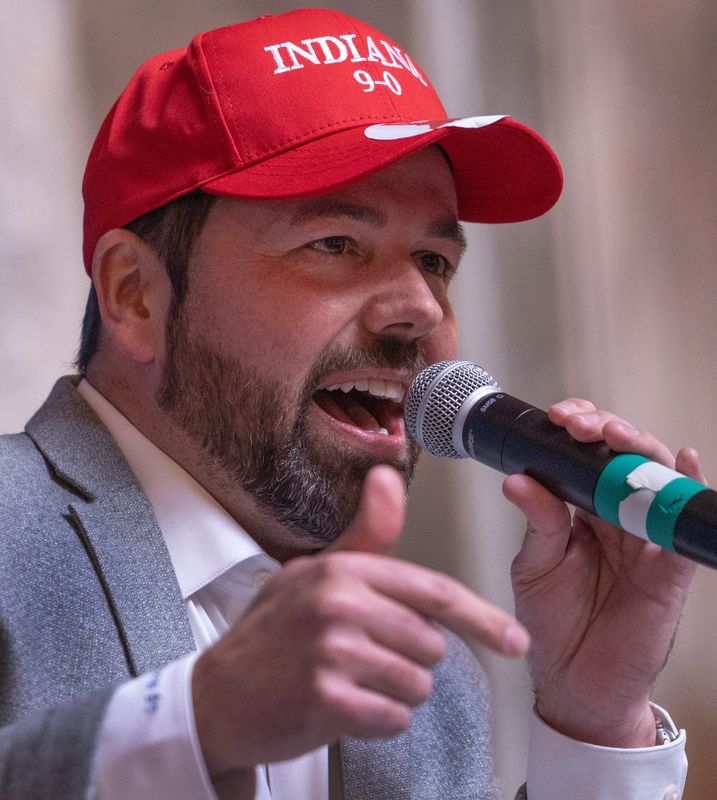
It’s ironic that Lt. Gov. Micah Beckwith agreed to address a rally intended to save Indiana’s heritage. Beckwith and his ilk are the ones gleefully destroying it.
Beckwith teamed up with Save Heritage Indiana, a group that says it exists because “Indiana’s identity is eroding under mass migration and weak enforcement.” He recorded a video for the group’s provocative Aug. 1 Fishers rally calling for mass deportations, a cause that dovetails with Beckwith’s summer-long tirades against Islam.

IndyStar’s Jacob Stewart has written that Save Heritage Indiana reflects the future of the Republican Party. Contributing columnist Michael Hicks has compared it to the 1920s-era KKK. The group itself professes a desire to return to Norman Rockwell’s post-World War II America.
“It’s small towns where neighbors know each other, schools that put local families first, and jobs that pay enough to raise their kids right here,” Save Heritage Indiana says on its website. “It’s Friday night basketball, Fourth of July parades, County Fairs, and potlucks after church. These things don’t just happen by accident, they are passed down.”
That version of America resonates, especially within the MAGA movement. But you don’t need to be MAGA to feel nostalgic. Save Heritage Indiana is describing an authentically American experience and it’s OK to say so.
The group goes wrong, though, when it lays blame for the demise of our civic ties at the feet of immigrants. I think often of my grandfather, George Laws, who lived today’s conservative ideal of an American life. He served in the Navy during World War II, became a volunteer firefighter in his neighborhood, spent decades working for General Motors and retired at a relatively young age with a pension.
That was perhaps the quintessential midcentury American life. It’s exceedingly rare now. We eroded it, starting with a retreat from public service. We accelerated the decline by dismantling our institutions.
The economics writer Noah Smith recently described the rise and fall of our “Leave It to Beaver” era:
The United States used to have a bunch of institutions that bound us together and forged us into a unified society. Many American communities were centered around churches; these facilitated networking, helped people find spouses, provided community services like day care and mutual aid, and homogenized values and culture at the local level. During the World Wars (and to a lesser extent, the Vietnam War), the military was very large and threw together Americans from various social classes. In the early postwar decades, corporations were also a unifying institution. Mass media provided us with shared cultural context. Even public transit put people of various backgrounds in close social contact on a daily basis.
In the half-century from around 1970 to 2020, those unifying institutions became much weaker. Church attendance slowly declined and then fell off a cliff in the 2010s. The military shrank into a small, professionalized volunteer force. Corporations ended their brief flirtation with lifetime employment, and outsourced many of their roles. Mass media fragmented in the age of the internet. Public transit dwindled in importance as Americans moved to the suburbs and drove.
It’s essentially the same story Save Heritage Indiana is telling but without a convenient scapegoat.
My grandfather’s lifestyle didn’t go extinct over immigration. The most obvious through line is technological change — and the choices we made about how to absorb it. Advanced weaponry reduced the need for soldiers, automation reduced the need for workers and the internet splintered our shared reality.
Our remaining, weakened institutions are under attack from those, like Beckwith, who profess to long for our lost communities. Beckwith and the broader far-right conservative movement go after virtually everything with the word public in it — higher education, K-12 schools, libraries and even a percussion ensemble.
To be clear, conservatives have legitimate concerns about our public institutions. I share many of them. But instead of delivering a return to the 1950s, conservatives summoned President Trump, our real-life Gozer the Gozerian, who is destroying every last remnant of the America they claim to love.
That destruction appeals to many Hoosiers because at least conservatives acknowledge the inherent goodness of traditional communities. Progressives can’t combat Save Heritage Indiana by mocking its imagery. They need to tell their own story about how we revive the best parts of the post-World War II era without dismissing the entire period as hopelessly problematic.
For people of good faith across the political spectrum, the path to reclaiming community leads to strong institutions. We need to rebuild the ones that can be saved and create new ones designed to bring us together in the digital age.
The institutions Beckwith attacks and the traditions Save Heritage Indiana romanticizes are the same thing: civic identity built through shared values and public service.
That’s absolutely worth reviving. It’s going to take a positive vision for the future instead of a wrathful view of the past.
Contact James Briggs at 317-444-4732 or james.briggs@indystar.com. Follow him on X at @JamesEBriggs.
This article originally appeared on Indianapolis Star: Immigration didn’t kill the tight-knit America we remember | Opinion
Reporting by James Briggs, Indianapolis Star / Indianapolis Star
USA TODAY Network via Reuters Connect
By James Briggs, Indianapolis Star | USA TODAY Network