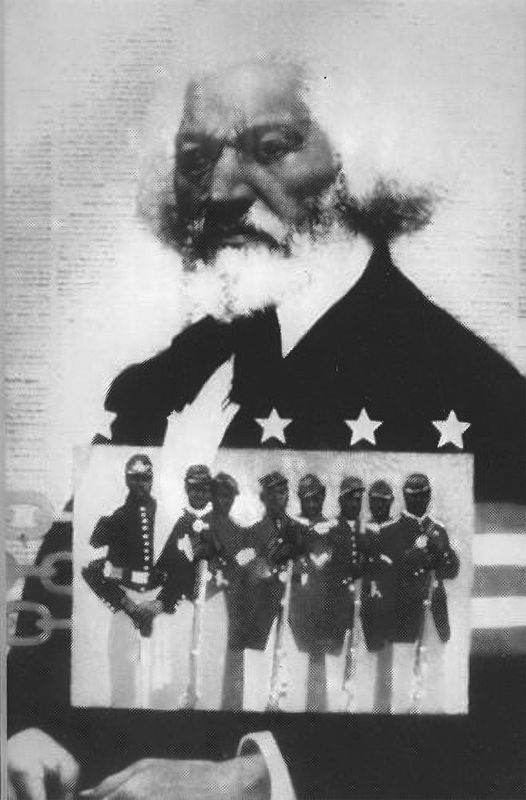
MUNCIE — Frederick Douglass spoke twice in Muncie.
The first time was at the original Wysor Opera House on Sept. 8, 1880. The great orator, abolitionist and former slave was in town stumping for James Garfield’s presidential campaign and Albert Porter’s Indiana gubernatorial bid.

In the decades after the Civil War, Douglass routinely campaigned for national GOP candidates, appearing in Midwestern and New England cities every four years. He backed Republicans who pledged support for equal rights and the advancement of African Americans.
After visiting Richmond and the Levi and Catharine Coffin House in Fountain City, Douglass made his way to Muncie by train. He was greeted at Union Station by a cheering crowd of hundreds, including a delegation from the Garfield and Porter Club — an all-Black political organization formed that year to support Republican candidates.
Among the delegates were Foster Fry and James Ferguson, Munsonians well known in the Magic City during the late 19th century.
Both men had arrived in Muncie together in 1862. They were born into slavery in northern Kentucky in the 1840s. When the Civil War broke out, Fry and Ferguson took advantage of border state chaos and fled bondage alongside another slave named William West.
I couldn’t find a definitive account of their escape. In one telling, Hoosier abolitionists smuggled the three freedom seekers into Indiana across the Ohio River via flatboat. Once ashore, they traveled north along the Underground Railroad. West eventually made his way to Anderson, while Fry and Ferguson sought refuge in Muncie.
In another account, an unnamed white man snuck the trio into Indiana across the Ohio. In New Albany, he urged them to continue on to Maryland by way of Indianapolis.
After arriving in Indy, Fry realized the man was not an Underground Railroad conductor, but a trafficker who intended to sell them to Baltimore slavers. The three split: Fry and Ferguson left for Muncie. West went another direction and was never seen again.
In yet a third version, the three hid out in Missouri for a while, bouncing between Underground Railroad safe houses. Eventually, Fry and Ferguson headed back east to Indiana, while West went his own way.
However they arrived, Foster Fry and James Ferguson were living and working in Muncie by mid-1862. Labor was in high demand then. They both landed jobs as hod carriers, a form of construction day labor that hauled heavy loads in a box-and-pole contraption called a hod.
Not long after they arrived in Muncie, Abraham Lincoln issued the Emancipation Proclamation. In addition to freeing enslaved people in Confederate states, the proclamation also authorized Black men to serve in the Union Army. Upon hearing the news, Foster Fry went to Indianapolis to sign up.
Once there, Fry met a wealthy man who had been drafted. His name isn’t mentioned in any of the sources, but he offered Fry $1,500 to take his place. This was a common practice in the North among some wealthy drafted men who could afford to pay substitutes. Fry enlisted on the Indy man’s behalf but was never paid for the substitution.
Fry served with honor in the 8th U.S. Colored Infantry, rising to the rank of corporal. His unit saw action in Virginia during the sieges of Suffolk and Petersburg, where he was wounded in battle.
He returned to Muncie after the war and got a job as a wagon driver. In April 1868, Fry married Martha Brazleton, a former resident of Cabin Creek in nearby Randolph County. Fry joined the Williams Post of the Grand Army of the Republic, a Union veterans organization. He was also a member of Bethel A.M.E. and the freemason Widows Son’s Lodge No. 22.
Sometime in the early 1880s, Foster Fry started working as a porter at John Ervin’s saloon in the first Wysor Opera House building, opposite the courthouse.
Ervin, a fellow war veteran, ran a popular and classy joint. In 1881, the Morning News described it as a “well conducted liquor house, where gentlemen can resort for refreshments … secure from the insults and crowding of loafing bullies and bummers.”
Anyone tipping back at Ervin’s place would have encountered Foster Fry, making him one of the most recognizable Munsonians of the 1880s and 1890s.
Fry’s friend James Ferguson was equally well known. He spent the war years in Muncie as a laborer. Sometime in the 1860s, he married a woman named Mary (maiden name unknown). The couple had three children: Capitola, Maude and Flora. Mary died of diphtheria in 1879, at the age of 29.
By the early 1870s, Ferguson had become one of Muncie’s most sought-after chefs, prompting wealthy physician and landowner Dr. Robert Winton and his wife, Elmira, to hire him as their personal cook.
In 1876, Ferguson branched out on his own and opened his first restaurant. In a 1900 Morning Star interview, he said that despite the fact that some “people wouldn’t come to my place because I was colored … I had a big trade, and I appreciated their patronage.”
His first restaurant was a popular lunch counter in Walling Hall, located west across High Street from the courthouse. He opened a second restaurant in the Senate Block, a building that still stands at the southeast corner of Jackson and Walnut streets. He opened other restaurants later on Main and East Jackson.
Ferguson specialized in several dishes but was most known mostly for his oysters, shipped fresh daily via railroad. By the late 1890s, he was known affectionately around town as “Uncle Jimmy.”
Fry and Ferguson appear frequently in newspaper articles of the early gas boom era. In addition to welcoming Douglass on behalf of the Garfield and Porter Club, the duo routinely organized civic events for the city’s Black community. In September 1887, for instance, Fry and Foster planned the city’s Emancipation Day celebration, known today as Juneteenth.
Foster Fry died of influenza on Jan. 13, 1899. He was buried at Beech Grove Cemetery. The Muncie Morning News remembered him as “one of the best-known men in the city, highly respected by all who knew him.”
James Ferguson died four years later on Aug. 7, 1903. The next day, the Muncie Morning Star recalled that “he was one of the best cooks that was ever in the city … he was a generous-hearted old man and always had a happy word and smile for everybody.”
His funeral at Bethel A.M.E. was packed with Munsonians, “crowded with friends, both white and colored, who wished to pay a last respect.” A huge funeral procession delivered Ferguson to Beech Grove Cemetery.
For me, the story of James Ferguson and Foster Fry trace out a defining arc of American history, made real through everyday lives of people living right here in the Magic City.
Chris Flook is a Delaware County Historical Society historian and senior lecturer of media at Ball State University.
This article originally appeared on Lafayette Journal & Courier: ByGone Muncie: Fry and Ferguson of the Magic City, escaped slaves
Reporting by Chris Flook, Muncie Star Press / Lafayette Journal & Courier
USA TODAY Network via Reuters Connect