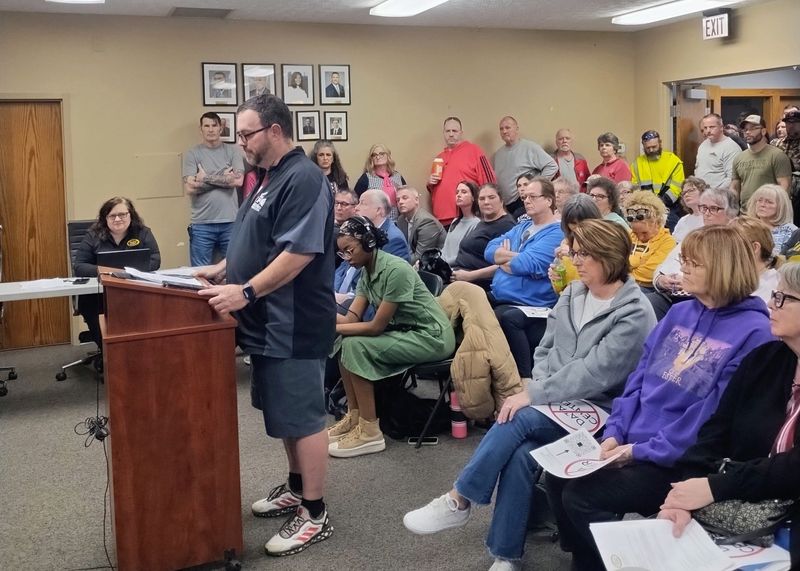
MOUNT ORAB, Ohio ‒ Residents of this rural Southwest Ohio village filled a cramped, gray room with their worries, frustrations and prayers.

The topic at this February village council meeting: data centers.
The room only held 33 people; dozens more spilled into the hall or watched from outside. Packed, hours-long meetings became a common occurrence in Mount Orab and other Ohio communities after data centers began popping up across the state.
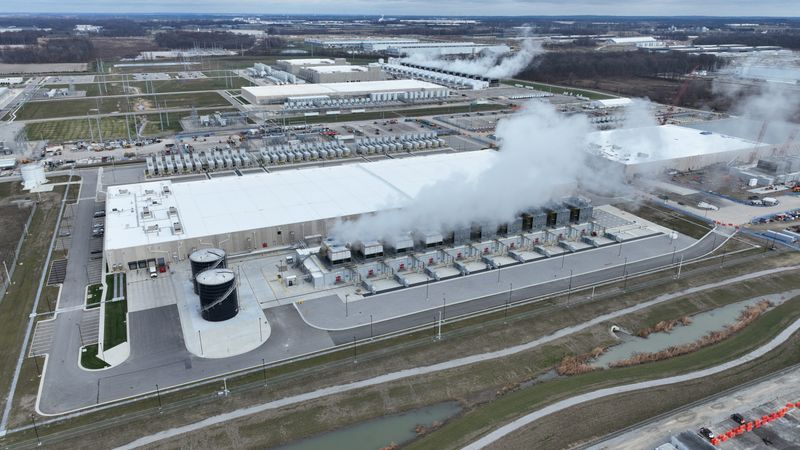
There are 232 data centers in Ohio, the sixth most in the country, according to a list of all current and under-development listings provided by Data Center Map, a global data center directory. Some are small enough to fit inside office buildings. Meta’s New Albany data center, which the company is expanding, is built on 766 acres of land ‒ more than a square mile.
These campuses store data and power websites, social media and artificial intelligence. They’ve faced criticism for draining local resources and not employing many people once they’re built.
“This is the issue for our generation,” said Danei Edelen, 62, who lives roughly a mile away from the site of Mount Orab’s potential data center. She’s worried about the center’s impact on residents’ health and the environment.
“There haven’t been studies on these things, and you don’t have your kids or your schools be the guinea pig,” she said.
At one time, data centers were welcomed by Ohio officials as an investment in the future of AI and technology. Proponents say building the centers provides union construction jobs, local income taxes and new business from construction crews.
Pushback from residents began as isolated incidents of NIMBY-ism. Now, it’s grown into organized action that politicians can no longer ignore, including a push for a statewide ballot measure to ban large data centers. The issue has scrambled party lines, leaving pro-business Republicans and pro-union Democrats struggling to find a solution.
NDAs, ‘quiet’ deals and communities that ‘cannot fight back’
An April poll from Bowling Green State University showed most of the 1,000 Ohio respondents believe data centers are bad for home energy costs and the environment. More than 70% of respondents favored temporarily banning new centers until the effects are better studied.
In Mount Orab, where 39% of the village’s roughly 5,000 residents live below the poverty line, residents who opposed a potential data center formed a group called Southern Ohio for Responsible Development. It’s drawn support from both Republicans and Democrats in the village, the group’s president said.
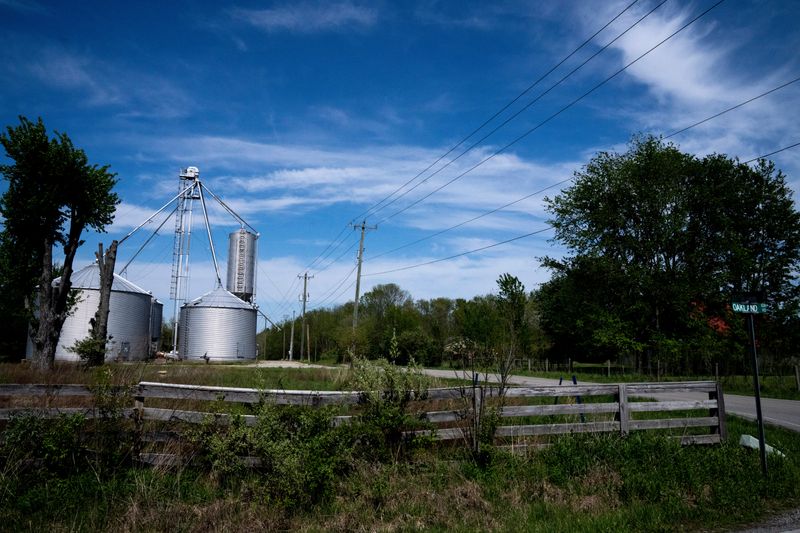
In 2024 and 2025, Brown County’s port authority sold roughly 864 acres of farmland to a Delaware company, DB Stu LLC, for over $45 million, according to a state auditor’s report. DBT Stu LLC also owns adjacent farmland, according to property records, making its total site around 1,187 acres.
Village officials, most of whom are no longer in office, signed nondisclosure agreements that kept details of the land sale and potential development from the public.
Secrecy and a focus on rural areas are part of tech companies’ “playbook,” said Christina Colegate, a member of Southern Ohio for Responsible Development who also lives near the site.
“They’re not going to put this in Indian Hill and Terrace Park,” she said, referring to two affluent Cincinnati suburbs. “They’re going to put it out in marginalized communities. They’re going to put it into communities that legally cannot fight back.”
Pressure from the group and other residents has led to change. Council voted to approve a temporary zoning code moratorium on data centers in March, joining at least 15 Ohio communities that have enacted or are considering temporary moratoriums. Mount Orab’s expires at the end of August.
Similar concerns surfaced in the opposite corner of the state. In Perry Township, a Canton suburb, Keith Brown and his neighbor, Shauna Shutt, noticed when a large swath of land southwest of Canton was cleared of trees in 2025. Brown, who distributed nearly 200 anti-data center yard signs by late April, said initial inquiries to government officials received vague responses.
Shutt said she felt the township kept it “very quiet,” and both had concerns about the data center’s proximity to their residential neighborhood, less than half a mile away.
“Not that it shouldn’t be done, but we don’t know enough to put it right here,” Brown said.
Panattoni Development Co. purchased the nearly 105 acres in February 2025. The California-based developers submitted a site plan – dubbed “Project Hall of Fame” and described as an industrial development – to a subcommittee of the Stark County Regional Planning Commission in October.
After The Canton Repository reported in January that the development was a hyperscale data center, residents began voicing concerns about the lack of early public transparency and potential impact on the environment and utilities.
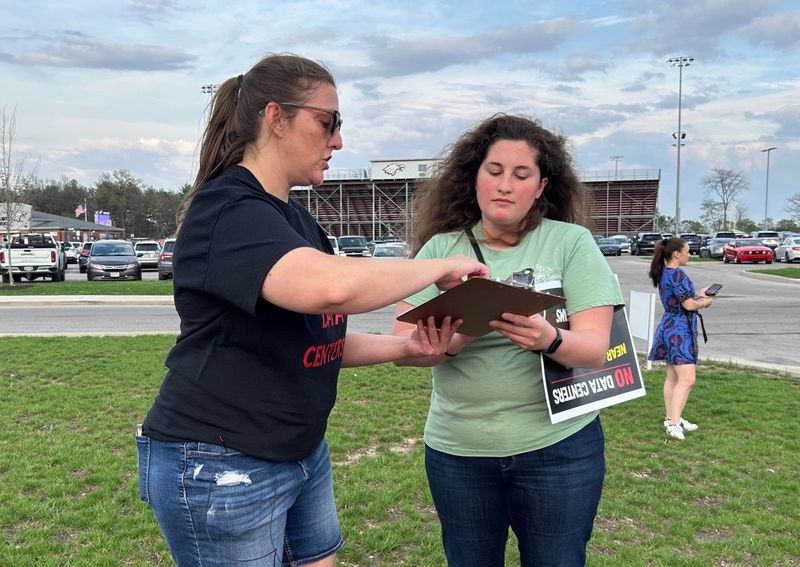
On April 15, the developers and township hosted an open house at Perry High School with handouts about the township’s limited authority and the project’s economic benefits. Several residents said they left dissatisfied. Other attendees held signs protesting the data center or collected signatures for a statewide ballot measure.
“We understand the desire to be involved in decisions that impact the community,” the township handout stated. “However, under Ohio law, development does not go through a public vote.”
The previously farmed property is opposite a steel mill and has been zoned industrial since 1981. Construction is expected to involve 670 trade workers and generate more than $5 million a year in income tax revenue, to be split between Perry Township and Canton.
Adam Kramer, Panattoni’s head of data centers, said Stark County has the “generational talent” across trades, like HVAC and electric, that is needed to support this kind of infrastructure.
Even with a proposed 75% property tax abatement, Kramer said, the data center will be the largest single taxpayer in the county. He declined to confirm the end user, but local officials have said it will be Amazon.
Data centers create political tightrope for elected officials
As the data center fight escalates, state lawmakers are getting an earful from their constituents.
Representatives from the Ohio House and Senate announced a new committee on May 13 dedicated solely to data centers. The panel will hold hearings at the Ohio Statehouse to gather information about public utilities, environmental impacts and economic benefits, among other issues.
The committee follows efforts by the House to create a task force with similar goals.
“There are people who want data centers no matter what, and there are also people who don’t want data centers no matter what,” said Rep. Gary Click, a Vickery Republican. “It’s such an emerging technology that the vast majority of people are in the middle and just have questions.”
Beyond the committee, however, consensus is much harder to reach.
The House is currently deadlocked on whether to scrap a sales tax exemption for companies that build data centers. Lawmakers eliminated it in the state budget passed last year, but Gov. Mike DeWine vetoed that measure and kept the tax break in place.
House Speaker Matt Huffman, a Lima Republican, and other critics of the exemption say technology companies no longer need the extra incentive to come to Ohio. Proponents, on the other hand, believe it’s necessary to spur development.
The impasse underscores an emerging reality: The fight over data centers doesn’t fall neatly along party lines.
Some Republicans, who tend to be pro-business, are wary of giving handouts to big tech companies worth billions or trillions. Democrats who are normally skeptical of corporations don’t want to cross labor unions that benefit from the construction jobs.
House Speaker Dani Isaacsohn, a Cincinnati Democrat, said data centers create union jobs that help people support their families. “That is what we’ve said we wanted for decades,” he said. “We cannot turn away from those realities.”
Data centers are also becoming a major issue in the race for governor between Democrat Amy Acton and Republican Vivek Ramaswamy. It was the first question pitched to Ramaswamy at an April Turning Point USA event, and he said there’s a middle ground where tech companies and farmers can both benefit. Days earlier, Acton told reporters that data centers can work for Ohio if there’s transparency and input from communities.
Despite the political debate, lawmakers are trying to tackle different pieces of the puzzle:
Sen. Bill Blessing, a Colerain Township Republican, plans to pitch a licensing fee for data centers that would fund renewable energy generation. But he’s skeptical that the Legislature will tackle major changes before the election, even though data centers are “popping up like dandelions.”
“If it didn’t have very muscular financial interests behind it, I think data centers would have been reined in a long time ago,” Blessing said. “You have Big Tech, which effectively has limitless amounts of money, and I think that tends to make members fearful of going toe-to-toe with them.”
Proponents: Data centers plagued by ‘misconceptions’
Proponents of data centers contend the benefits are clear – though they acknowledge there’s a messaging problem.
In Ohio, data centers directly or indirectly contributed to 84,490 jobs in 2023, according to data compiled for the Data Center Coalition, a membership association for the industry.
Mike Knisley, a labor consultant and former secretary-treasurer of the Ohio State Building Trades, said he doesn’t fully understand the vitriol toward data centers, especially at public meetings. But some of that, he suggested, might stem from how projects have been communicated ‒ or not communicated ‒ to residents.
Nondisclosure agreements have also surfaced in other projects, like Intel’s semiconductor manufacturing facility in New Albany and Amazon data center facilities in Central Ohio. Other projects used “trade secret” protections to shield information from the public.
Two Ohio House Republicans introduced a bill to ban certain local officials from entering into NDAs after the issue boiled over in Mount Orab.
“The owners did this on themselves, and it’s something they’re going to have to deal with, and they’re going to have to adjust their presentation,” Knisley said.
Dan Diorio, vice president of state policy for the Data Center Coalition, doesn’t necessarily disagree. Data centers need to educate the community about what Diorio called “misconceptions” around concerns like water discharge, high electricity bills, and light and noise pollution.
Relaying to residents how data centers will use resources wisely and bring in revenue has become a focus of the industry,” Diorio said.
Union members, who stand to benefit from data center construction, also want to change public perception. Their pitch to residents centers around jobs.
“We don’t work for any of these data center companies, but we work for our membership, and we want to make sure our membership is going to work every day,” said Brett McElfresh, president of East Central Ohio Building and Construction Trades Council.
The council, which represents over 8,000 workers in Stark and surrounding counties, participated in the Perry Township open house and made a presentation to Canton City Council.
Data centers have the potential to create “generations worth of work,” McElfresh said. He also emphasized the centers’ importance in operating cloud storage, which is necessary for health care and financial systems.
More than 10,000 tradespeople are currently employed to build and maintain data centers throughout Ohio, according to the trades council.
Frustrated Ohioans aim to be ‘voice of change’
Absent more state action, Ohio will have a patchwork of local policies that regulate data centers.
Local officials are seizing more control over future projects with moratoriums and zoning changes.
In Cincinnati, City Council recently approved a temporary zoning change on over 22,000 parcels of land − mostly in industrial areas and Downtown − that would regulate their future construction. The city announced plans for a zoning study to review the current footprint of existing data centers, where new ones could go up and what policies are needed to maintain control over them.
But some Ohioans aren’t willing to wait for the Legislature or local officials to act.
A group of southwest Ohio residents pitched a constitutional amendment to ban the construction of data centers with a peak load of more than 25 megawatts. With the rise of artificial intelligence, new data centers tend to have capacities ranging from 100 to 1,000 megawatts, according to the Electric Power Research Institute.
Advocates got the OK to start collecting signatures in April and hope to put the issue on the November ballot. It’s a tall order for an entirely grassroots effort. They must get more than 413,000 signatures from at least half of Ohio’s 88 counties by July.
Jessica Baker, a petitioner for the amendment, said she’s fielded a flood of messages from people who want to volunteer and sign. The group has installed county leaders to help gather signatures and set up signing locations at parks, businesses and local events.
Despite the tight timeline, Baker said they have no choice but to push for November. If the amendment doesn’t make the ballot and pass this year, she said, companies will start building their proposed mega data centers.
“They may see the construction boom as an economic plus, but what happens after that?” Baker said. “What happens when the facilities they are building are outdated as quick as my iPhone? We feel like they’re just unloading a tech dump on us.”
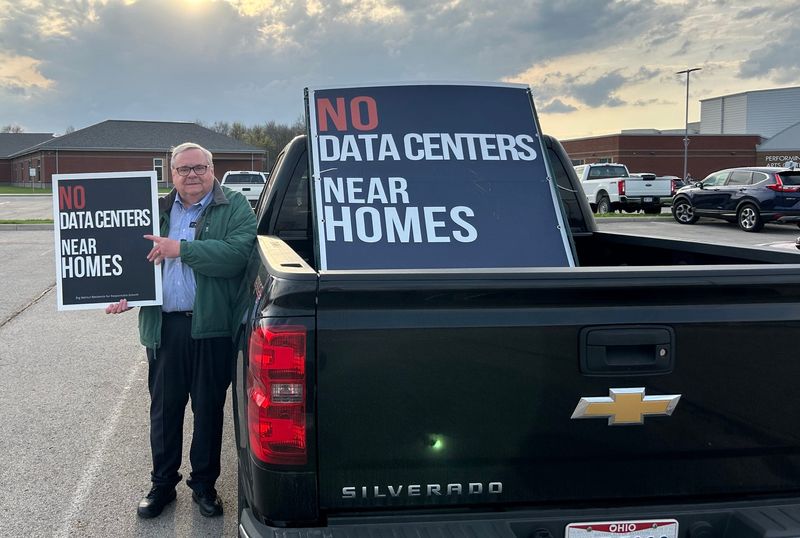
On a warm spring day in April, Alicia Doty, of Sunbury, collected signatures for the amendment ahead of a city vote to place a moratorium on data centers until Jan. 31, 2027. One of the signers was Larry Thode, who displays a sign in his truck bed that reads, “No data centers near homes.”
Sunbury residents packed meetings for weeks to oppose a proposed $2 billion Amazon Data Service data center campus. Under Amazon’s plan, Doty and Thode would both be surrounded by a new industrial park that includes the Amazon campus.
“I really believe that this needs to be stopped and studied,” Thode said. “As a state, we need to put in guidelines to protect the safety of neighborhoods, kids, our water. I mean, there’s a lot of risk here.”
As Sunbury residents organized against the data center project, Doty said they felt like they were on an island by themselves. But that’s no longer the case as critics become the “voice of change,” and the movement against these massive tech facilities spreads across the state.
“It’s still incredibly overwhelming and disheartening, and I don’t know that my home can be saved,” Doty said. “But maybe someone else’s can.”
What questions do you have about data centers in Ohio? Tell us
Sydney Franklin and Jessie Balmert contributed to this report.
This article originally appeared on Cincinnati Enquirer: Amid critics, ‘quiet’ deals, has Ohio flipped on data centers?
Reporting by Victoria Moorwood, Haley BeMiller, Kelly Byer, Samantha Hendrickson and Maria DeVito, Cincinnati Enquirer / Cincinnati Enquirer
USA TODAY Network via Reuters Connect