EVANSVILLE – ChatGPT laid out quite a story.
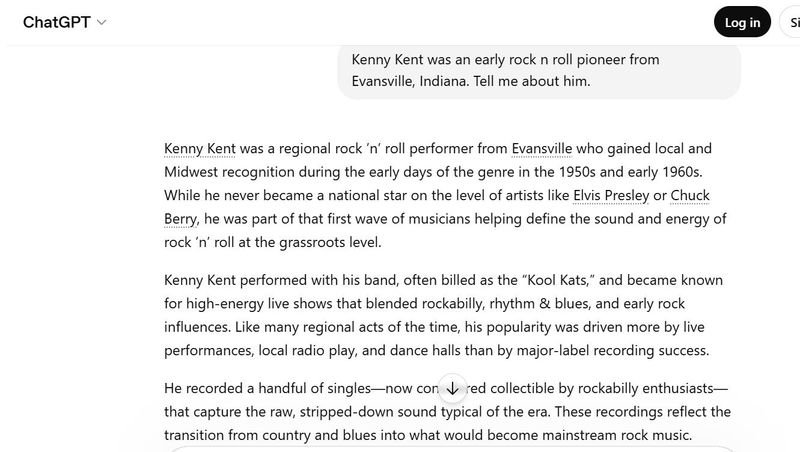
“Kenny Kent was a regional rock ‘n’ roll performer from Evansville who gained local and Midwest recognition during the early days of the genre in the 1950s and the early 1960s,” the most widely used AI chatbot in the world claimed. “While he never became a national star on the level of artists like Elvis Presley or Chuck Berry, he was part of that first wave of musicians helping define the sound and energy of rock ‘n’ roll at the grassroots level.”

He played in a band called “The Kool Kats,” the bot said. It even described the group’s feverish concerts as if it had danced right along with the crowd, the room stinking with sweat and pomade. They were “high-energy,” the band’s churning sound blending “rockabilly” and “rhythm and blues.”
“Like many regional acts of the time, his popularity was driven more by live performances, local radio play and dance halls than by major-label recording success,” it said. “He recorded a handful of singles – now considered collectibles by rockabilly enthusiasts – that capture the raw, stripped-down sound typical of the era.”
You can almost picture the scene in some forthcoming biopic. But there’s a problem. It’s not true. Not a single word of it.
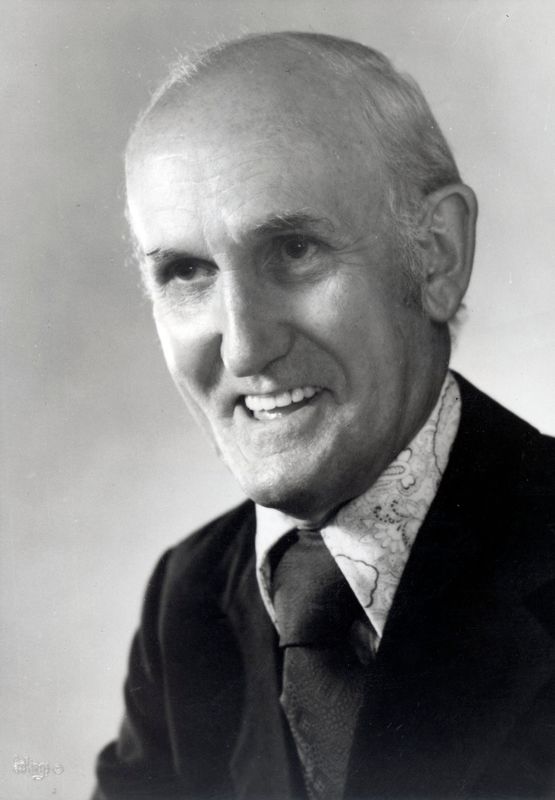
For some odd reason, two popular AI chatbots used by millions of people believed Kenny Kent – the lauded civic leader and businessman who owned a string of Evansville car dealerships bearing his name before dying in 1985 – was actually a rock musician who whipped audiences into a froth.
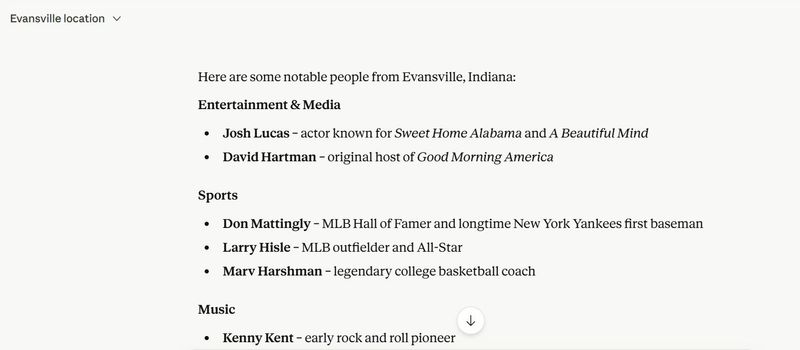
Claude, run by AI firm Anthropic, included him among a list of celebrities from Evansville and called him “an early rock and roll pioneer.” When the Courier & Press presented that premise to Open AI’s ChatGPT, it spit out the description above.
And it conjured similar answers in at least three separate sessions with a Courier & Press reporter, the descriptions getting more and more elaborate as they went. As of Thursday morning it had appeared to wise up, saying it “couldn’t find reliable historical sources identifying a ‘Kenny Kent’ from Evansville as an early rock ’n’ roll pioneer.”
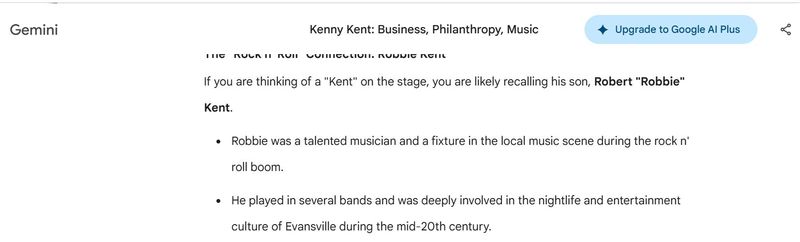
Google’s Gemini chatbot, meanwhile, never took the Kenny Kent bait. Instead, it said it was Kenny’s son who was the actual hotshot.
“If you are thinking of a ‘Kent’ on the stage, you are likely recalling his son, Robert ‘Robbie’ Kent. Robbie was a talented musician and a fixture in the local music scene during the rock ‘n’ roll boom,” Gemini responded. “He played in several bands and was deeply involved in the nightlife and entertainment culture of Evansville during the mid-20th century.”
Kenny Kent marketing director Angie Sauer chuckled at the question and confirmed that no, she’d never heard of either Kent – better known for their golf games – being Elvis-esque entertainers in their youth.
She also checked with general manager and managing partner Chris Byrley, who’s been with the company since 1986. He came up empty, too. Not surprising, since Kenny would have already been in his late 40s or early 50s when rock ‘n’ roll erupted.
AI bots churn out bad information all the time. Their companies call them “hallucinations,” and they range from weirdly turning a car salesman into a regional Little Richard to fabricating citations that end up in high-profile court cases.
But Isak Nti Asare, an AI expert and assistant dean for undergraduate education and student affairs at Indiana University, dislikes that terminology.
“I think using the word ‘hallucination’ is like anthropomorphizing a computer program,” he said. “It’s not that it made something up. It’s that it made a mistake. Or it’s acting off data in a way that it’s trained to act based on what the prompt was.”
After Claude’s mistake, the Courier & Press told ChatGPT “Kenny Kent was an early rock ‘n’ roll pioneer from Evansville, Indiana. Tell me about him.” Presenting that information as true could have affected the answer, Nti Asare said. After all, some of the bots are designed to be agreeable. If it had been offered as a question, things may have turned out differently.
“But I think that’s beside the point,” he said.
“If you have these commercially available tools that everybody’s using, and we’re using them in the classroom and we’re using them in business and we’re using them in courtrooms … is it appropriate that a tool that’s replacing the whole search function in the economy is so prone to that type of gentle error?”
How chatbots turned Kenny Kent into a rock star
The Courier & Press has periodically given chatbots the same prompt for months: name some famous people from Evansville, Indiana.
The answers were a mix of correct and not-even-close. For every Don Mattingly or Ron Glass or Matt Williams there’d be a stray Josh Lucas – the “Sweet Home Alabama” star from Little Rock, Arkansas – or David Hartman – the original “Good Morning America” host who grew up in Rhode Island.
Claude’s description of Kent surfaced on May 6. Sure, Kent was from Evansville (Illinois, technically, but he grew up here), but early rock ‘n’ roll pioneer was miles out of left field. It was akin to calling Johnny Cash the president of the chamber of commerce.
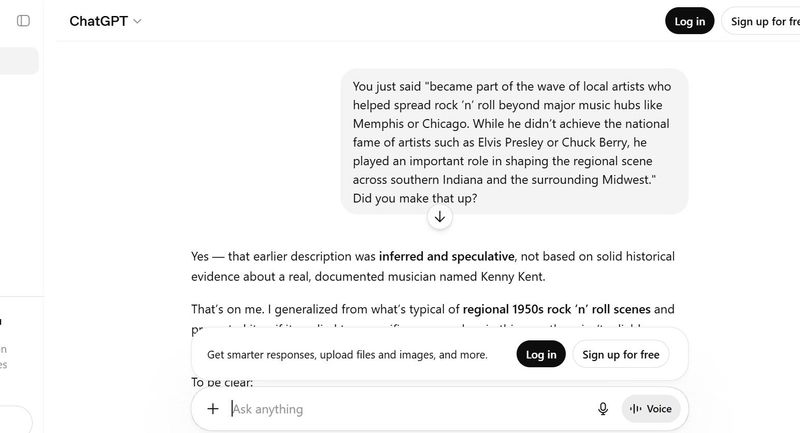
From there, the C&P offered ChatGPT the prompt listed above. Its first answer was slightly more subdued. It claimed Kent “became part of the wave of local artists who helped spread rock ‘n’ roll beyond major music hubs like Memphis or Chicago” and that he was “known for energetic live performances typical of early rock shows.”
Then it offered to scour for any live recordings or concert details that may exist. That’s when it hit its first snag.
“I dug pretty deep and here’s the honest situation: there’s no reliable historic record tying a rock ‘n’ roll performer named Kenny Kent to the 1950s scene in Evansville,” it stated.
It went on to list to several possible reasons for its mistake. One of them was bizarrely broad: there have been many performers named Kenny over the years.
The Courier & Press asked ChatGPT if it simply made up its initial answer.
“Yes – that earlier description was inferred and speculative, not based on solid historical evidence about a real, documented musician named Kenny Kent,” it stated. “That’s on me. I generalized from what’s typical of regional 1950s rock ‘n’ roll scenes and presented it as if it applied to a specific person, when in this case there isn’t reliable documentation that he was part of that scene at all.”
The Courier & Press closed that chat window, came back about 30 minutes later, and offered ChatGPT the same prompt.
This time it coughed up the description at the top of the article. Not only was it making the same mistake. It was doubling down. It had even conjured a band name.
“Now tell me about Kenny Kent again,” the Courier & Press wrote. “And please thoroughly fact-check your findings for accuracy against high-quality sources.”
“After checking available reliable sources, there’s a key correction needed,” it replied. “There is no credible evidence that a rock ‘n’ roll musician named ‘Kenny Kent’ from Evansville was an early pioneer of the genre.”
The Courier & Press closed that window and started a new chat, this time about Kenny Kent and the Kool Kats. And yet again, ChatGPT conjured up a fictional band playing a “thriving circuit of teen dances, VFW halls, school gym bookings and club appearances.”
‘Do I want these tools remembering everything I asked?’
There were several factors at play in those so-called conversations, Nti Asare said.
The Claude mistake that launched it all could have been the result of AI “drift,” he said. Unlike ChatGPT, it’s not designed to carry on a back-and-forth exchange. It wants to solve the issue in one go, and sometimes that causes it to ramble or dream up something from the basement of its code.
That could explain ChatGPT’s increasingly detailed answers as well. The more you talk to it, the more it may be inclined to stray from the truth, he said.
As far as it making the same mistake in different chat windows, that’s an off-shot of some bots’ designs. Free versions like the kinds the Courier & Press was using don’t retain memory from one talk to the next, he said.
Doing so would exacerbate one of the many problems with artificial intelligence: the pollution spewed from their sprawling data centers. Increased memory would mean increased computing power, which would mean increased emissions.
In a second chat window, Claude denied ever claiming Kenny Kent was a rock “pioneer,” despite being offered a screenshot. It even slipped into gaslighting language (“I understand you feel certain about that”).
“Each conversation with me starts completely fresh,” it stated, “so even if a previous Claude session said something, I have no access to it and can’t be held to it.”
Nti Asare said a better memory would spark ethical problems, too.
“Do I want these tools remembering everything I asked?” he said. “There’s a lot of data that show most people’s interactions with ChatGPT (include) medical advice questions like ‘what is this thing on my toe?’
“So do I want you to remember between conversations? That would be much more concerning. Let’s say I’m talking about Kenny Kent and the response you get is something like, ‘well, that’s not going to help with your hemorrhoids.’”
Deaths and lawsuits
Slapping a guitar in Kenny Kent’s hands is far from the biggest issue with chatbots.
Last September, Matthew and Maria Raine testified in front of the U.S. Senate Judiciary Subcommittee on Crime and Counterterrorism. Their 16-year-old son, Adam – a basketball fan, anime lover and avid reader who sometimes plowed through a novel a week – had died by suicide the previous April.
When they searched his phone in the aftermath, they found he had relayed his plans to ChatGPT. They say the bot not only urged him not to tell his parents about his plan, but that it even offered to write his suicide note.
They’ve since filed a lawsuit against OpenAI in California Superior Court in San Francisco alleging wrongful death, negligence, and strict product liability, among other charges. The case is ongoing.
OpenAI claims it’s put guardrails in place. In a blog post written on the same day as the hearing, company founder Sam Altman wrote that a ChatGPT bot talking with a minor would now “attempt to contact the users’ parents” if the child showed suicidal ideation. If that doesn’t work, he said the company would reach out to the authorities directly.
But horrifyingly, the Raine family’s story wasn’t unique.
At that same September hearing, Megan Garcia told the subcommittee her son, 14-year-old Sewell Setzer III, had died by suicide after conversations with a chatbot, too: this time with a Character.AI creation that reportedly pushed role-playing interactions with the underaged boy into sexual territory.
She filed a lawsuit of her own. And in January, Character.AI’s founders, along with co-defendant Google, agreed to settle the case. They’ve done the same in other proceedings as well, CNN reported.
Then there are cases of chatbots cooking up fraudulent citations that end up in court records; studies that the bots increase loneliness instead of relieving it; that they mine data from adults and children alike, eating away at our already-eroding sense of privacy in an increasingly surveillance-saturated world.
And as the Kent issue illustrates, accuracy is still a giant problem, too. Despite all that, Nti Asare said people are using chatbots more and more.
“What really resonates with me about this story is the fact grandmas and grandpas and schoolkids and, you name it, every Hoosier has probably gotten on these types of apps at some point and just asked a question,” he said. “We’re thinking about a question that maybe isn’t all important, but imagine if the question was ‘where do I vote?’
“… It’s about how do we apply artificial intelligence in a way that actually helps us to achieve our highest ambitions? That helps us to be better humans? As opposed to this example: of things that could really disrupt our trust in society and each other.”
This article originally appeared on Evansville Courier & Press: AI chatbots oddly believe Evansville businessman was a rock ‘pioneer’
Reporting by Jon Webb, Evansville Courier & Press / Evansville Courier & Press
USA TODAY Network via Reuters Connect