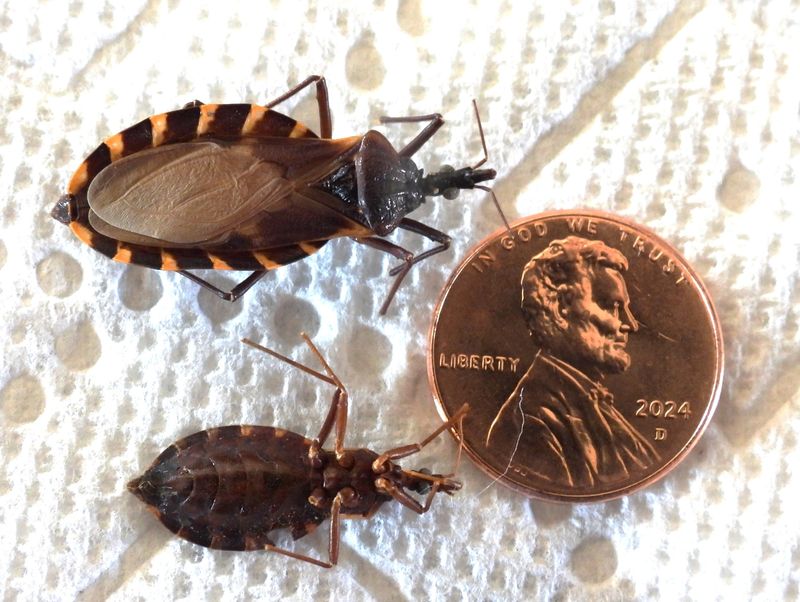
Late spring heralds the lovebug swarms that menace your auto’s paint job, but it’s also prime time for kissing bugs, which can really break your heart.
Kissing bugs are insects that suck the blood of sleeping mammals, amphibians and reptiles. But that’s not the main problem. These smoochers have a way of transmitting a parasite that can lead to chronic and possibly fatal, heart-debilitating effects.

They are getting more attention because researchers in September 2025 declared the disease they carry — Chagas disease — endemic to the United States, meaning it’s occurring regularly. Florida is carrying the third-highest burden of the disease in the country, researchers say.
Many infected may not know they have it and the estimated 300,000 U.S. cases are likely a fraction of the actual number. It’s not reportable to any government agency in Florida or the federal government.
Are kissing bugs something to worry about in Florida?
Trying to better size up the threat to humans, a team of University of Florida scientists and doctors are calling on Florida residents to be on the lookout for the 16- to 22-mm long, winged insect with a cone-shaped head and distinct red or orange stripes on its abdomen edges.
One of the two varieties of the critters found in Florida, known under the Latin name Triatoma sanguisuga, are entering the part of their year-long life cycle when they move into homes to lay their eggs, said Dr. Norman Beatty, a professor of medicine at the University of Florida College of Medicine, Department of Medicine, Division of Infectious Diseases and Global Medicine.
“This is when the adult kissing bugs are dispersing,” Beatty said. “They’re going to find a blood meal and find a mate.”
The problems for humans, dogs, opossums and other targets begin after the insects’ blood-sucking bite and the egg-laying. The insects — many of them infected with a parasite — excrete feces and then the unknowing host will rub and scratch near the bite, giving the parasite the opportunity to enter the body.
The parasite can also invade through the eyes or mouth. Less common types of transmission, like from mother to baby or through contaminated blood products, have also occurred. Dogs and cats can get the disease when they eat the bug, according to recent research.
What states have kissing bugs been found in?
Kissing bugs have been spotted in the southern half of the United States, but have reached as far north as Illinois and Pennsylvania.
Most who have been diagnosed with the disease that kissing bugs bring likely acquired it when traveling outside the United States. Still, locally acquired Chagas disease has been documented in eight states. And, even though Florida is not on the list of states with verified, locally acquired Chagas disease, researchers have plenty of reasons to believe it’s happening in the Sunshine State, also.
“When we’re close to it, it will adapt, and it has adapted,” Beatty said. “Our research has shown that there are certain parts of Florida where we are finding the kissing bug is a common invader of homes.”
Most Florida homes have no basement, but they do have a crawl space that’s ideal for these bugs. And, as more development sprawls into rural parts of the state, humans are moving into where they are most often found, Beatty said.
“It’s likely that our anthropogenic (man-made) changes to the environment are increasing our exposure to a scenario where (the parasite) could be transmitted to us humans,” Beatty said.
Of the kissing bug samples Beatty’s team has studied in Florida, 30% of them are infected with the parasite called Trypanosoma cruzi that causes Chagas disease, Beatty said.
One investigation of the kissing bugs’ innards showed evidence that close to a quarter of the blood meals had human blood in them, Beatty said.
What are the symptoms of Chagas disease?
At the onset of the disease, an acute stage, the victim may get flu-like symptoms, fever fatigue, body aches, rash and swelling at the bite site or eyelid. The second stage, the chronic stage, can come on decades later. The untreated infection can lead to the parasite spreading throughout the body and damaging organs.
Janeice Smith, now 72, of Newberry, had fatigue, fever and swelling in her eyelid as she and her family returned home from a visit to Mexico in 1965. With a fever that reached 107 degrees Fahrenheit, her parents rushed her 9-year-old self to Vanderbilt University Children’s Hospital.
“They tried everything they could think of,” Smith, now president of the Kissing Bug Alliance, wrote in an account of it. “Isolation, ice baths, iron lung, antibiotics, you name it. Yet, nothing seemed to bring my fever down or relieve the eye infection.”
Finally, to everyone’s amazement, the fever subsided, she said.
She went home from the hospital and didn’t think much about it until 2015, after she had married, given birth to a daughter and taught at Cedar Key School for many years.
“I was coughing all the time. I went to an ENT (ear, nose and throat) specialist, and he treated me for acid reflux … for about a year, and it didn’t help. It kept getting worse, and he kept increasing the dose, and it kept getting worse,” Smith said.
Another doctor put her on an anti-seizure medicine after finding a damaged nerve. Smith might never have known what was ailing her until she went to get her blood tested for COVID-19 antibodies at a blood donor center. And then she got a letter telling her she had tested positive for Chagas disease.
That brought her to Dr. Beatty, who works in a clinic across the street from UF’s Emerging Pathogens Institute.
“I’ll never be better, but the medication did prevent further damage,” Smith said, explaining that the parasite’s damage to her esophagus means that she can’t swallow even one bite of certain foods, like a dry steak or raw broccoli or carrots.
Now, she’s 98% free of the parasite, Smith said.
Is more research going into Chagas disease?
Beatty was the lone person researching kissing bugs and their attendant parasite when he came to UF in 2019, he said.
Now, UF has assembled a multidisciplinary team of researchers to take it on, drawing from UF’s Department of Entomology and Nematology along with its Department of Wildlife Ecology and Conservation. As a result, more answers are already available to doctors whose patients present with mysterious, chronic symptoms like Smith’s sooner rather than later.
“Demonstrating the presence of kissing bugs and the vector of the disease in Florida will have a tremendous impact on public health,” predicted Marco Salemi, Ph.D., interim director of the University of Florida Emerging Pathogens Institute and professor of experimental pathology at the department of pathology, immunology and laboratory medicine at the UF College of Medicine.
“Chagas is often asymptomatic for years, and when the parasite starts to damage the body, it is usually too late for treatment. Knowing that kissing bugs carrying the parasite are present in Florida will provide clinicians and primary care providers new ammunition to fight this neglected tropical disease in the Sunshine State.”
Ironically enough, the lovebugs swarming on Florida highways and dying on car grills in the throes of copulation, have undergone a marked decline in recent years.
See a kissing bug? Emerging Pathogens Institute at UF wants to hear from you. Email Emerging the Emerging Pathogens Institute at norman.beatty@medicine.ufl.edu.
Anne Geggis is statewide reporter for the USA TODAY NETWORK FLORIDA, reporting on health and senior issues. If you have news tips, please send them to ageggis@usatodayco.com. You can get all of Florida’s best content directly in your inbox each weekday by signing up for the free newsletter, Florida TODAY, at https://palmbeachpost.com/newsletters
This article originally appeared on Palm Beach Post: UF scientists warn of kissing bugs that can spread parasite in Florida
Reporting by Anne Geggis, USA TODAY NETWORK – Florida / Palm Beach Post
USA TODAY Network via Reuters Connect