President Trump’s push for Republican leaders in red states to redraw congressional boundaries to help him maintain power now pivots to his adopted home state, Florida – and his political frenemy, Republican Gov. Ron DeSantis.
As the late Tim Russert of NBC News once said about the presidency on election night 2000, the key to the GOP retaining control of Congress also could come down to “Florida, Florida, Florida.”

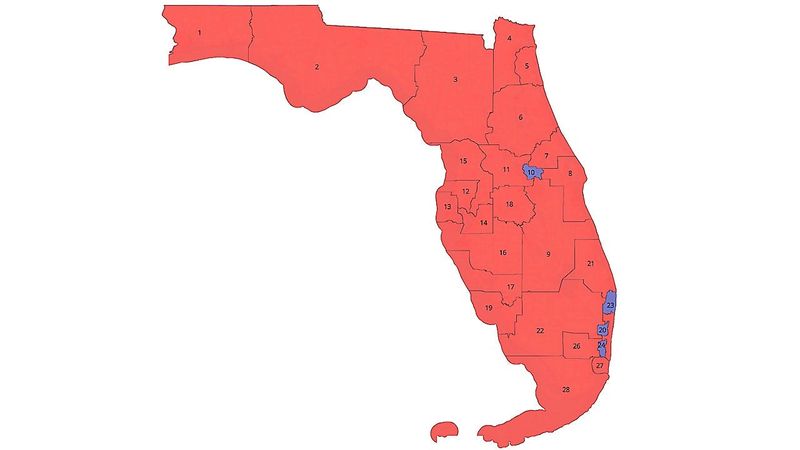
State lawmakers convene a special session April 28 to change Florida’s 28 congressional districts. Ruling Republicans are intent on increasing the odds of them winning as many as five more districts on top of the 20 seats they now hold.
The stakes also have climbed since April 21, when voters in Virginia approved a measure that could net Democrats as many as four more seats in Congress following November’s midterm elections. A state judge has since struck down the new lines, setting up an appeal and injecting new uncertainty into how those potential gains will play out.
Republicans now cling to a razor-thin lead in the U.S. House. But Trump’s sagging approval numbers are likely to cost the party in the midterms.
More GOP-leaning boundaries in Florida, though, could bolster the party’s chances. And yet the risks for the state’s Republicans also are high.
The overhauled maps were leaked to FOX News on the morning of April 27. Spokespeople with the Florida House and Senate told journalists they had not yet received them. The maps reveal that DeSantis aims to eliminate as many as four U.S. House districts held by Democrats.
Unlike in Virginia, where voters narrowly approved redistricting, a poll released this month by Emerson College found that 56% of Florida voters think redrawing congressional maps ahead of the midterm elections is a “bad idea.”
DeSantis delayed the scheduled start of Florida’s special session by a week, until after the Virginia vote. He’s also calling for lawmakers in session to pass an artificial intelligence “Bill of Rights” and a “medical freedom” bill making it easier for parents to opt kids out of vaccine requirements.
Redistricting is the main event in special session
But redistricting is the main event.
Recasting congressional boundaries to make more Democratic-leaning seats competitive can only be done by weakening currently strong GOP districts. And depending on how voters respond, Republicans could lose seats with a redraw, a process dubbed a “dummymander.”
DeSantis and GOP leaders also will have to somehow sidestep the state’s Fair Districts constitutional amendments, which prohibit lawmakers from deliberately drawing districts that help or hurt a party or incumbents.
Potential Fair Districts violations are certain to be part of any legal challenge Democrats bring against whatever emerges in a special session.
DeSantis for months had argued that Florida’s mid-decade redistricting would be needed once the U.S. Supreme Court ruled in a Louisiana case that could restrict the use of race in drawing districts.
But that opinion hasn’t emerged. DeSantis has stopped talking about it and is forging ahead in what some view as an attempt to burnish his national profile as he nears the January 2027 end of his two terms as governor. Some still expect him to make another run for the White House in 2028.
Redistricting success could bolster DeSantis’ GOP profile
“DeSantis currently is politically the odd man out,” said Aubrey Jewett, a University of Central Florida political scientist.
Secretary of State Marco Rubio and Vice President J.D. Vance “are in the Trump orbit and everyone is talking about them as the potential future of the party,” he added. Incumbent GOP Congress members from Florida also are urging DeSantis to back off.
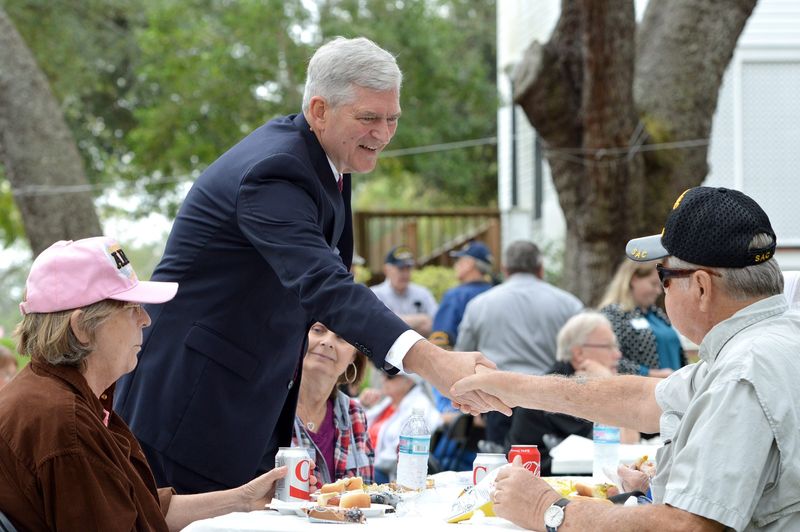
“Don’t do it; I’ve said it from the beginning,” U.S. Rep. Daniel Webster, R-Orlando, said after special elections last month resulted in Democrats flipping a pair of state legislative seats, including a traditionally Republican-leaning Palm Beach district that has Donald Trump’s Mar-a-Lago estate.
“I’ve been around enough reapportionments to know it’s a slippery slope,” Webster added.
After Virginia’s action, House Minority Leader Hakeem Jeffries, D-New York, warned Florida Republicans they were playing with fire. Texas was the first state to redraw districts last year, in response to Trump’s cry for help, triggering what is now a coast-to-coast redistricting war.
Democrats may have gained a one-seat edge over Republicans with districts redrawn in seven states. But Florida could prove decisive, with Republicans eyeing anywhere from a one- to five-seat pickup.
“If Florida Republicans proceed with this illegal scheme, they will only create more prime pick-up opportunities for Democrats, just as they did with Trump’s dummymander in Texas,” Jeffries said.
Eight Florida Republicans could be ousted, top House Dem warns
He went on to list eight Florida Republican representatives that could be ousted by voters in November. Jeffries also threatened “maximum warfare, everywhere, all the time.”
DeSantis, at a recent bill signing, in turn responded jokingly: “Please, be my guest. I will pay for you to come down to Florida. I’ll put you up in the governor’s mansion. We’ll take you fishing … There’s nothing that could be better for Republicans in Florida than to see Hakeem Jeffries … Voters will not like what they see; they will not want that type of ideology.”
Republican Party of Florida chair Evan Power, who has talked of flipping as many as five Democratic seats to GOP, also fired back at Jeffries.
“If Democrats want to come to Florida and burn more of their donors’ money, we welcome it — because we will beat them again and again,” Power said.
Trump, though, may have the most skin in the game. Prediction markets currently show Democrats with as much as an 85% likelihood of winning a House majority in November.
They might even capture the U.S. Senate, where forecasters put odds around 50-50 for a Democratic majority.
Losing the House would cloud Trump’s last two years in office
But even losing the House would cripple Trump in his final two years in office. A Democratic majority might even impeach him again, for abuse of power or enriching himself in office.
Ironically, DeSantis now stands as a possible political savior for Trump. It’s the latest turn in a relationship which has seen the Florida governor serve as Trump’s protégé, rival and most recently, awkward ally of the president.
Former U.S. Attorney Eric Holder, who served under President Obama, said that Florida’s special session on redistricting “could shape American democracy for years to come.”
Holder spoke on a call organized by Equal Ground Florida, among seven voters’ groups organizing busloads of protesters planning to converge on the state Capitol for the session’s scheduled start.
Democrats dismiss the need for a redistricting session. Along with Webster, a handful of Florida Republican members of Congress have spoken out, wary of the rare mid-decade redistricting.
Not much new data, no problem for DeSantis
Redistricting normally occurs after the decennial U.S. Census. Florida’s boundaries, which the DeSantis administration drew, were set in 2022. There’s not much new data for lawmakers to rely on when drawing maps.
“Florida has experienced 10 years of population growth in like three,” DeSantis has said. “And so if you look, our districts are not fairly apportioned because of that.”
Preliminary census findings show Florida’s population grew 8%, more than any other state, between 2020 and 2024. But DeSantis may be banking even more on the almost 1.5 million voter edge Republicans hold over Democrats in Florida registrations.
But no-party affiliated voters are wild cards. Analysis shows they are trending decidedly away from Trump and Republicans amid the Iran war, rising gas prices and the affordability crisis.
NPA voters represent 25% of the electorate. And both parties need their support to win in many congressional districts. Weakening Republican districts to make neighboring Democratic districts more competitive could backfire, especially if NPAs support the Democrat.
“In the midterm elections, the president’s party usually loses seats and an unpopular president loses even more,” Jewett said. “Throw all the data together, and you’ve got to conclude redistricting is risky.
“But it looks like they’re going to do it anyway,” he added.
John Kennedy is a reporter in the USA TODAY Network’s Florida Capital Bureau. He can be reached at jkennedy2@usatodayco.com, or on X at @JKennedyReport.
This article originally appeared on Tallahassee Democrat: Can DeSantis help Trump, GOP majority with high-risk redistricting?
Reporting by John Kennedy, Capital Bureau | USA TODAY NETWORK – FLORIDA / Tallahassee Democrat
USA TODAY Network via Reuters Connect