Political insiders say there’s little risk for Gov. Ron DeSantis in pushing for special sessions on congressional redistricting and property tax reform in his last year as governor.
Public support for redrawing Florida’s congressional map is weak, and Republican incumbents warn that the Legislature could put their seats in jeopardy.

And any significant reduction in property taxes would likely take effect after DeSantis leaves office, leaving its consequences – fiscal or political – for others to manage.
But DeSantis said he wants redistricting to ensure election maps comply with constitutional and legal standards, while a session on property taxes forces lawmakers to address rising costs by delivering broad affordability relief.
By calling special sessions, DeSantis can drive the agenda and force debate, even if the political or fiscal fallout unfolds after he leaves office. And by advancing high-profile issues that energize his base, he burnishes his policy legacy if he decides to run for president in 2028.
A low-risk final act
Academics who have studied Florida politics for decades caution one never truly knows the motivations for elected officials even when they speak out and say why they are doing something. It’s always possible there is another ulterior motive.
“It’s more than the two issues of adopting a property tax cut and drawing a new map,” said Susan MacManus, the Distinguished University Professor Emerita of Political Science at the University of South Florida.
But DeSantis himself – as far back as 2021 – has repeatedly said, “I’m not considering anything beyond doing my job,” and “I’m focused on delivering results for Floridians,” when asked about his political and career strategy.
Yet, lawmakers in both parties, as well as consultants and others agree with MacManus that political posturing is part of DeSantis’ special session strategy in his final act as governor.
Power of a governor’s call
Florida’s constitution enables governors to set the state’s political agenda with the power to call the Legislature back to Tallahassee and address issues they consider important.
The governor can then elevate the issues he wants addressed and shaping the laws he will implement and enforce as the chief executive, says University of Central Florida political science professor Aubrey Jewett, who has written a chapter about governors and special sessions in a Florida Political Almanac to be published this summer.
“Even if the Legislature doesn’t pass what he wants, he still gets credit for pushing it,” Jewett said.
DeSantis said he wants a new map because of population growth and to legally comply with a pending Supreme Court ruling he expects will weaken or reinterpret parts of the Voting Rights Act. But other Republicans have openly discussed the partisan stakes. DeSantis is betting that the Legislature will align Florida with redistricting efforts favored by President Donald Trump.
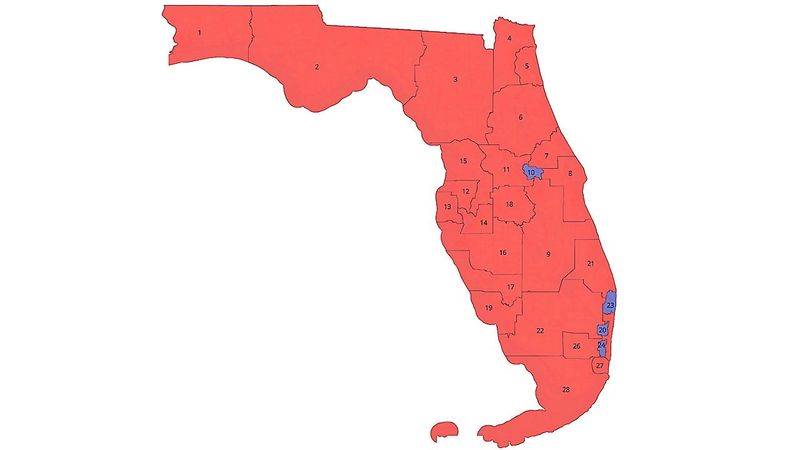
In the proposed map he released April 27, the day before the session’s start, analysts project the GOP would pick up four additional Republican leaning districts, possibly shifting the state’s congressional delegation from the current 20 – 8 GOP Democrat split to 24 Republicans and 4 Democrats.
That would cancel out the four additional House seats Democrats are expected to pick up in Virginia after voters there agreed to a new map explicitly framed as a response to Texas and other states GOP-led redistricting. That map, however, is on hold after a court challenge and a trial judge’s order striking that map.
Republicans hold only a narrow majority in the U.S. House, meaning a swing of just a few seats could flip control, and with other GOP- and Democratic-led states having already redrawn their maps, Florida is the last major Republican-led controlled state that could add Republican seats in this battle.
By waiting to release his proposal less than 24 hours before lawmakers would begin meeting on a new map, DeSantis’ left little time for lawmakers or the public to review it for unintended consequences such as weakening Republican majorities in some districts, or other deficiencies.
The maneuver left Republicans unsettled and Democrats frustrated.
“The governor called for this special session. We did not,” House Speaker Daniel Perez said. And Congressman Greg Steube, R-Sarasota, warned if DeSantis is too aggressive he “could put incumbent members at risk,” according to Politico.
Two issues, two clocks
If DeSantis is racing the clock on redistricting, he is doing the opposite on property taxes.
The governor has pledged to call a special session on property tax relief aimed at putting a constitutional amendment on the November 2026 ballot and has said lawmakers could face multiple special sessions if they fail to act.
Logistically, they would face an August deadline to get an initiative on the ballot. And state lawmakers, unless a chamber’s leadership changes or suspends its rules, generally are not allowed to raise money for their campaigns while in session.
Property tax relief sounds appealing until lawmakers start to consider how local governments are supposed to pay for police, fire protection, and other services.
By delaying details on property tax reforms, DeSantis avoids accountability for the tradeoffs that have to be made while still benefiting from the abstract popularity of tax relief, said Charles Zelden, Nova Southeastern University political scientist.
“It sounds like a political winner. Everyone likes tax cuts. But it could be a real loser when local governments don’t have the money to do what we expect them to do. But DeSantis won’t be the one dealing with the aftermath,” Zelden said.
Strategy over substance?
DeSantis has floated a July or August for a special session on property taxes. If lawmakers do not approve a property tax amendment by late August, one cannot make it to the November ballot.
Congressional qualifying ends June 12, and any new map will need to be approved by then.
DeSantis is using different clock management styles in addressing the two issues, forcing the Legislature to move fast on redistricting increases the odds a map survives long enough to matter electorally.
Withholding specifics on property taxes, DeSantis enhances his image as a tax fighter, and he can use the political calendar to pressure lawmakers to adopt his plan.
“In politics, sometimes controlling the clock matters more than controlling the room,” Jewett said.
James Call is a member of the Network’s Florida Capital Bureau. He can be reached at jcall@tallahassee.com and is on X as @CallTallahassee.
This article originally appeared on Tallahassee Democrat: DeSantis using special sessions, political clock to shape legacy
Reporting by James Call, USA TODAY NETWORK – Florida / Tallahassee Democrat
USA TODAY Network via Reuters Connect