Timing is everything in plant life. Our warm weather elevates the metabolic rates in blooming plants, which in turn produce colorful flowers. Each year, we are negotiating the new ‘normal’ summer weather patterns both in length and intensity. And when the scorching climate becomes extreme, many plants experience energy imbalances, thereby affecting flower quality.
They usually show us all the signs of struggle: wilting leaves, stunted growth and flower drop, to name a few. And they are not alone; I, too, struggle and react much in the same way when outdoors in these conditions. Early June inevitably leads me to make a decision every year, to prune or not to prune my flower friends. Do I want to optimize the blooming magic and keep my plants looking tidy in the garden? Or do I allow nature to take its own course and let them go to seed?

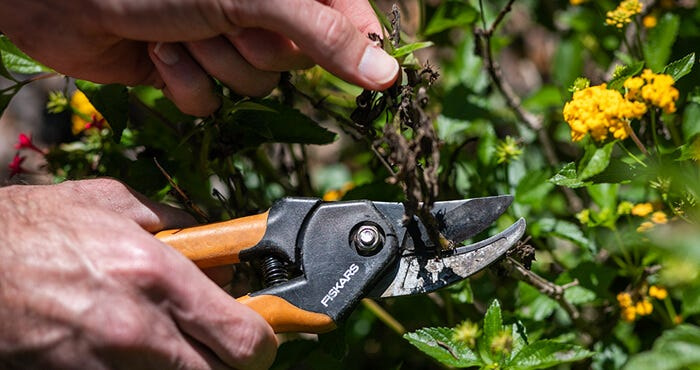
The window of reproductive maturity varies between species, but most ornamentals have a timeframe that peaks from a few days to months. This interval is when the plant is operating on all cylinders. Emerging buds form before flower petals unfold, inviting pollinators in to do the reproductive work. The practice of removing flowers that have either faded in color or are in demise by hand can redirect the internal energy in the plant.
This action favors extended bloom production and prevents seed development. Alternative pruning techniques like pinching back and disbudding should not be confused with deadheading. Pinching back refers to the removal of the stem tip with shears or with your thumb and forefinger for the purpose of changing the trajectory of the plant’s shape and branching. Plants that produce clusters of flowers can be manipulated by disbudding practices. Discarding some of the new blooms redirects the plant’s internal resources to the remaining flowers with the expectation that they will grow larger and healthier.
And while we are on the topic of pruning in the summer months, remember to keep it light: no more than one-third of the plant’s foliage. Plants can easily succumb to environmental stressors even before some of their parts go missing. If you are not eliminating dead material or attempting to control the overall structure, you could end up doing more harm than good by way of disease and pests.
Letting flowers go to seed means that the plant will no longer produce blooms and sometimes fresh leaves. The explosion of floral beauty has reached its expiration date, but the plant is not dead. Instead, it shifts into energy-saving mode and produces seeds as part of the life cycle. Plants can produce as little as a few to thousands of seeds, depending on the type.
Plants like Salvia spp, Bee Balm/Monarda spp and most other wildflowers are self-starters and often germinate quickly once landing in the surrounding soil. Other pollinator plants will delay sprout to the next spring season, like milkweed/Asclepias spp, snapdragons/Antirrhinum majus and marigolds/Tagetes spp or example. This is how the life span evolves in undisturbed meadows and wild habitats.
The UF/IFAS extension has published a guide to common native wildflowers of North Florida, which lists species that are successful in different types of soil and lighting conditions. To learn more, please visit this site: https://ask.ifas.ufl.edu/publication/EP061.
Of course, you can make the decision to harvest the seeds of plants you would like to replicate in a different season and perhaps area. The act of intentionally collecting ripe seeds and storing them for a new garden, for myself or for others, can be a cathartic encounter. If the idea is new to you or you have struggled in the past with successful gathering, flower or vegetable seeds, here is an online source to help get you restarted: https://gardeningsolutions.ifas.ufl.edu/care/planting/seed-saving/.
And the decision to allow seeds to remain on the plant when the growing season has expired can also be liberating. Sure, letting it go does tend to look tired and even neglected, but it is more than just waiting until everything looks brown and brittle. Think of it as you passing the stewardship of your land to Mother Nature for a time: allowing the natural world to benefit from the offerings of a once vibrant plant with the dispersal of seeds by wind, water, insects and birds.
Without fail, I end up doing a little of each practice, deadheading in spring to early summer, before conceding to human intervention. I collect seeds of certain plants and allow the others to be free to carry on or not. I think in balanced moderation, it contributes to the process of giving more than you take. If you are interested in learning more about growing plants from seed but don’t currently have a garden source to harvest from, please visit this link: https://gardeningsolutions.ifas.ufl.edu/care/planting/seed-sources/.
Appreciate what plants can do throughout the summer months and use safe gardening practices when you are outside.
Candace Barone is a Master Gardener Volunteer with the Duval County Extension Service and the University of Florida/IFAS. For gardening questions, call the Duval County Extension Office at (904) 255-7450 from 9 a.m. to noon and 12:30 to 3:30 p.m. Monday-Friday and ask for a Master Gardener Volunteer.
This article originally appeared on Florida Times-Union: Should you prune your summer flowers or let them seed?
Reporting by Candace Barone, For the Jacksonville Florida Times-Union USA TODAY NETWORK / Florida Times-Union
USA TODAY Network via Reuters Connect
By Candace Barone, For the Jacksonville Florida Times-Union USA TODAY NETWORK | USA TODAY Network