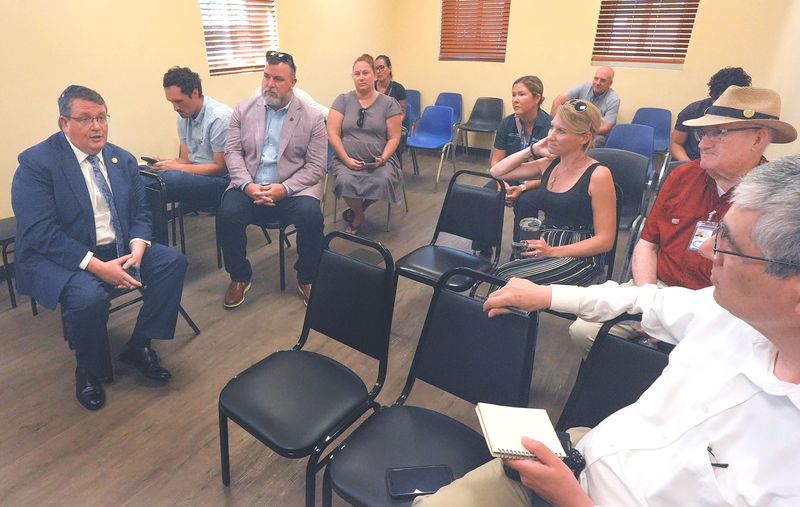
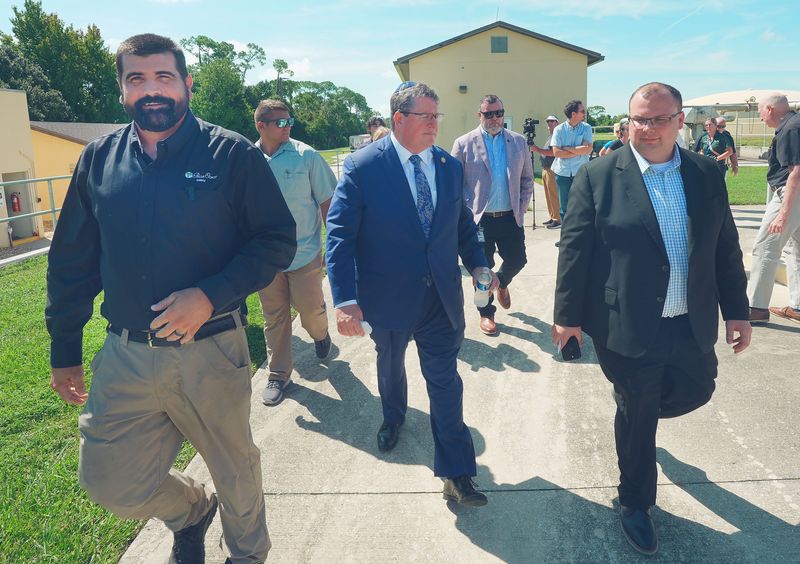
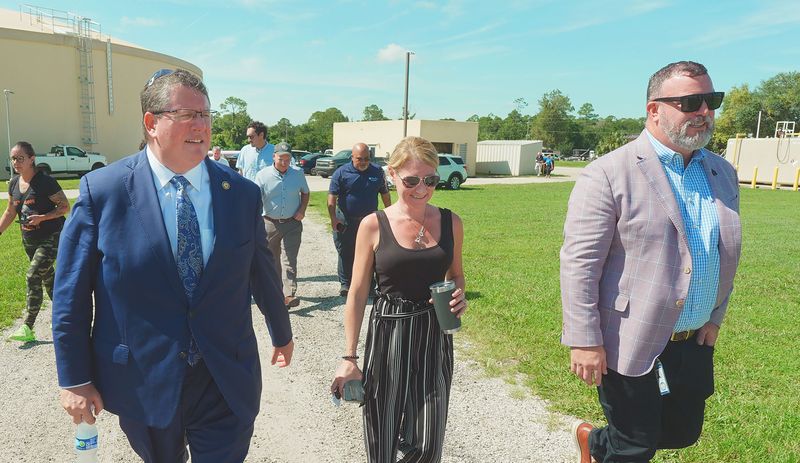
The city of Palm Coast has a serious wastewater problem, and the local government officials are hoping their local congressman can help out.
U.S. Rep. Randy Fine toured Wastewater Treatment Plant #1 on Wednesday, Aug. 13, with a group of local government officials. There were high hopes given that Fine recently pulled in $5.6 million in federal funds for the city of Bunnell to tackle its wastewater problem.

Palm Coast needs funds to fix wastewater woes
Wastewater Treatment Plant #1 operated over capacity for four months in 2024, had sanitary sewer overflows from the wastewater collection system, and had water samples that failed to meet parameters, according to Carl Cote, Palm Coast’s director of stormwater & engineering, during a council workshop in February.
Problems with the plant led the city of Palm Coast to be contacted by the Florida Department of Environmental Protection in December 2024 for failing to meet requirements.
Bunnell’s funding is partly a result of a “Community Project Funding” request letter that Fine sent to the Energy & Water Development Appropriations subcommittee, according to Esteban Elizondo, Fine’s communications director. The request was approved as part of an appropriations package for the 2026 fiscal year.
Fine said he believes infrastructure projects like treatment plants are “fundamentally a local government responsibility.” However, he also said that the federal government can sometimes step in to help.
“My primary interest is on things that extend beyond Palm Coast,” he said. “So when sewage gets dumped into the Intracoastal (Waterway), that doesn’t just affect Palm Coast. That affects all of Flagler County. And it doesn’t just affect all of Flagler County, it affects the whole east coast of Florida.”
Palm Coast’s city council members and Fine’s team have yet to agree on how much they will ask for.
“We certainly aren’t going to turn down any money,” Vice Mayor Theresa Pontieri told The News-Journal. “But there’s no amount that we have actually put forward or asked specifically at this point. I think that’s what his director will probably get with staff about at this juncture and discuss those nuts and bolts.”
The city council has already raised rates by 8% in April 2025 and will raise them by another 8% in October. Then, the rate will increase annually based on the consumer price index starting in October 2026.
“The plant’s planned expansion from 6.83 million gallons per day to 10.83 million gallons per day is one of the most urgent projects, with an estimated cost of $169 million,” read the March news release.
The plant, which, again, struggled in 2024 to stay under its limit, has since diverted wastewater to another facility to keep within capacity and treat the water properly, according to Danny Ashburn, Palm Coast’s wastewater manager.
However, this is not the first time the plant has been expanded. The plant, built in the late 1970s, was designed to hold 300,000 gallons per day.
The council is currently looking at spending about $279.59 million from the 2025 to 2029 fiscal year across all its wastewater facilities, which includes the creation of a new plant, plant #3, and the approximately $169 million expansion for plant #1, according to the city’s website.
The News-Journal asked Dan Niemann, lead operator of Wastewater Treatment Plant #1, if he was worried about the increased development of Palm Coast.
“As long as we expand our capacity to keep up with it, I’m perfectly happy with it,” Niemann said. “We also ran into a situation just these couple years ago where we were getting more than we could treat properly. And that was a concern because we take pride in our work. We want to get everything absolutely as clean as possible.”
This article originally appeared on The Daytona Beach News-Journal: Palm Coast seeks Congressman Randy Fine’s aid for wastewater treatment plant woes
Reporting by Gabriel Velasquez Neira, Daytona Beach News-Journal / The Daytona Beach News-Journal
USA TODAY Network via Reuters Connect