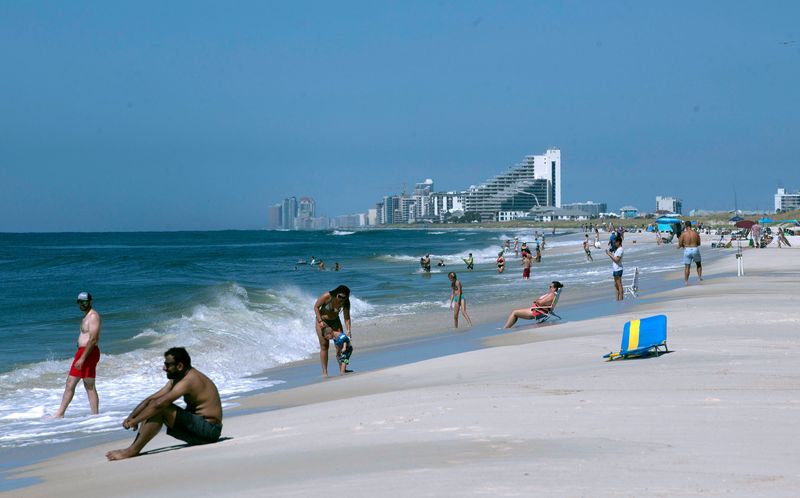
A new Florida law makes it easier for local governments to allow the public to access the beach even when there are disputes over private property, an issue that has often been hotter than the middle of summer on Perdido Key Beach and has led to lawsuits.
However, Escambia County Commissioner Steve Stroberger, who represents the area, doesn’t think it’s necessary to put the new law into action, at least for now.

Under the new law, local governments can allow the public some access to beaches considered “private” without undergoing costly litigation, especially if the beaches were historically used by the public.
Gov. Ron DeSantis signed Senate Bill 1622 into law in June to restore “local control” by allowing local authorities to recognize recreational customary use of Florida’s beaches. The law also streamlines beach restoration efforts in small Gulf Coast counties.
Perdido Key’s beaches generally allow public access to the “wet sand” area, which is south of the mean high-water line. This means that while private property may extend to the high-water mark, the public is generally permitted to walk, swim and fish in the wet sand area.
However, access to the dry sand portion of the beach is often restricted to private property owners.
Under the new law, counties and cities can adopt ordinances that allow activities like walking, fishing and swimming in the “dry sand” area of beaches, even on privately owned beachfront property.
Escambia County resident Gary Holt has been fighting for more public access on Perdido Key for years. He organized an effort asking the county to remove “no trespassing signs” private property installed in rows on the beach.
Private property owners put up so many “no trespassing signs” on Perdido Key, Escambia County passed an ordinance in 2023 limiting them to one sign, 10 feet from the dune line, instead of three signs.
Holt said he and others are now in the process of asking Escambia County commissioners to recognize the new law as an executive order signed by DeSantis for customary use of Florida beaches.
“Customary use is a game changer for Perdido Key,” Holt said. “No more arguing over property lines and who own which white sand! It is a big campaign issue for the West Escambia County residents that love Perdido Key. Also for the local and out-of-state condo owners that were told by local realtors if they bought in Perdido Key they would have a private beach. For the last 10 years the local realtors have used this sales gimmick to separate their condo listing from Orange Beach and Pensacola Beach.”
The Perdido Key Association, a nonprofit organization that represents property owners, did not return a request for comment about the new law by deadline.
Why Escambia Commissioner hesitant to push for new ordinance
Stroberger said he has accompanied the Escambia County Sheriff’s Office on patrols of the Key and listened to views from law enforcement, property owners and the public on the issue of beach access on Perdido Key, and currently he doesn’t believe it’s necessary to push for an ordinance recognizing recreational customary use.
“It’s not my intention to do anything at this point,” Stroberger said. “I feel like everybody’s working well together down there on the beach. We’ve even got deputies down there to make sure that everybody abides by the rules.”
Stroberger says the deputies are mainly focusing on discouraging trespassers from taking advantage of the restrooms and pools of private condominiums where they are not guests.
Public access to Perdido Key Beaches has long been a point of discussion and legal action. In the past there have been several clashes between the public and private property owners over access to the beaches.
The discovery of the original deeds to some Gulf front properties on Perdido Key, dating back to 1957, revealed there are 75-foot public access easements, which opened up about 1.2 miles of beach on that were previously thought exclusive.
Some property owners who bought condos and were told the beach was part of the deal are still in litigation with the county over the decision to open it up to the public.
Where litigation over 75-foot public access easement stands
Last December, an Escambia County judge dismissed several lawsuits filed by condominium associations seeking to overturn the 75-foot access public access easement. Several condo associations refiled in January saying it’s a “cloud” on the title and property owners bought their units under a claim of title exclusive of any other right.
They don’t believe the county has a valid claim to the easement for several legal reasons, and they were seeking from the court a legal declaration of condominium associations’ rights concerning the validity and enforceability of the county’s actions.
However, a motion by the plaintiffs to stay the litigation for about five months was filed June 24, the same day the governor signed SB 1622 into law.
“I think everything is essentially on hold,” Stroberger said. “They want to see what we’re going to do. I don’t want another lawsuit, and I don’t really want to mix it up with everybody, if everybody seems to be doing well on the beach. I do believe that the beaches are for the public, but I also believe in property rights. It’s really quite a tightrope we have to walk with that.”
The new law repeals a 2018 law that limited the ability of local governments to uphold long-standing public beach access traditions, and DeSantis said one of the goals of passing it is to give local governments the authority to recognize recreational customary use without having to go through “costly judicial declarations on a parcel-by-parcel basis.”
New law also addresses beach erosion
The governor said the legislation also improves the process for restoring eroded beaches in certain Gulf Coast counties for those with fewer than 275,000 residents and at least three municipalities, by allowing the state to use the mean high-water line as the erosion control line, eliminating duplicative procedures that delay critical restoration projects.
This article originally appeared on Pensacola News Journal: New Florida law gives local leaders more control over beach access. Will they use it?
Reporting by Mollye Barrows, Pensacola News Journal / Pensacola News Journal
USA TODAY Network via Reuters Connect